On May 21, 2026, an Ankara appeals court annulled the 2023 congress of Turkey’s main opposition party, the Republican People’s Party (CHP). It removed the chairman who had led the party to its first nationwide victory over President Recep Tayyip Erdoğan’s Justice and Development Party (AKP) in 2024 and reinstated the deeply unpopular predecessor the party had voted to replace. The ruling landed while the CHP’s most popular figure and presidential candidate, jailed Istanbul mayor Ekrem İmamoğlu, faced a politically motivated trial. With its candidate in prison and its leadership dissolved by court order, the opposition’s path to defeating Erdoğan all but closed. No tanks moved and no emergency was declared; a court simply reached inside a rival party and rearranged its leadership.
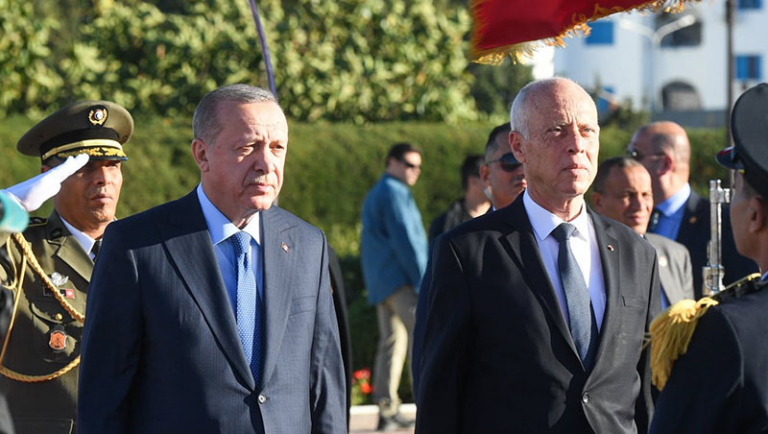
This is increasingly how elected governments dismantle democratic competition. For much of the twentieth century, the end of democracy typically came from a coup or a revolution; today, courts, constitutions, and elections have turned into instruments for entrenching power while the outward forms of democracy remain. Turkey and Tunisia, once the region’s most promising democratic openings, are among the clearest examples and share a common repertoire: capturing the courts, rewriting constitutions to concentrate power, hollowing out elected institutions, and casting the opposition as a threat to the nation. Yet the two diverge sharply in pace. Erdoğan needed nearly two decades to dismantle Turkey’s democratic constraints, while Tunisian President Kais Saied reached a comparable concentration of power within just a few years of his July 2021 power grab. Although the instruments were largely the same, the difference lies in what each inherited: Erdoğan had to grind down a dense political order built over decades, while Saied faced a far younger democracy whose institutions were easier to sweep aside.
Capturing the Courts
Rather than banning opponents outright, these governments deploy legal warfare: using investigations, arrests, and disqualifications to make dissent costly while hiding behind a facade of legal legitimacy.
In Turkey, it took several years to bring the judiciary under executive control, beginning with the 2010 referendum that reshaped judicial appointments and accelerating after the July 2016 coup attempt, when thousands of judges and prosecutors were dismissed. The compliant judiciary was used first against the Kurdish movement. In 2016 and again in 2019, the government replaced dozens of elected mayors from pro-Kurdish parties, including the Democratic Regions Party (DBP) and the Peoples’ Democratic Party (HDP), with appointed trustees. It also has held the HDP’s former co-chair, Selahattin Demirtas, in prison since November 2016, despite repeated European Court of Human Rights orders for his release. Treating Kurdish politicians as proxies for the outlawed Kurdistan Workers’ Party (PKK), which has fought the Turkish state since 1984, normalized the use of criminal law against elected officials.
The same tools were then applied to the main opposition party. After the CHP won the March 2024 local elections, dozens of its mayors faced investigation and more than twenty were detained. The escalation peaked with İmamoğlu, the Istanbul mayor and Erdoğan’s strongest challenger, who was detained on March 19, 2025, and formally arrested on corruption charges on March 23, the day the CHP was to name him its presidential candidate. The arrest, preceded by the annulment of his university degree (a requirement to run for president), removed the figure best placed to defeat Erdoğan, and triggered some of the largest protests in years. The May 2026 annulment of the CHP congress marked the final step. By this point, the judiciary had moved from prosecuting individual opposition figures to determining who could lead the opposition.
In Turkey, it took several years to bring the judiciary under executive control… Tunisia reached the same destination far faster.
Tunisia reached the same destination far faster. Saied suspended parliament in July 2021 and began ruling by decree, then moved against the courts. In February 2022 he dissolved the High Judicial Council, the guarantor of judicial independence, and that summer dismissed dozens of judges. With no independent judiciary left to restrain him, prosecutions soon followed. Rachid Ghannouchi, leader of the Islamist party Ennahda and the dominant figure of the post-2011 order, was arrested in 2023, and the arrests quickly expanded to include a wide variety of critics, including lawyers, media figures, secular politicians, and former officials.
Rewriting the Constitution
Where the courts narrowed competition case by case, constitutional change locked in the advantage. Both Erdoğan and Saied rewrote the basic rules to shift power permanently toward the presidency and used a referendum as the democratic veneer.
Turkey came first. In an April 2017 referendum, carried narrowly (51.4 percent) under the state of emergency imposed after the 2016 coup attempt, voters approved 18 amendments that abolished the office of prime minister and replaced the parliamentary system with an executive presidency. The president could then issue decrees with the force of law, appoint and dismiss ministers without parliamentary approval, dissolve parliament, and shape appointments to the council that governs judges and prosecutors, while parliament lost its power to call ministers to account or bring down a government. Executive oversight was effectively written out of the constitution.
Tunisia followed a similar path on a compressed timeline. On July 25, 2022, one year to the day after he suspended parliament, Saied put a new constitution to a referendum that drew barely 30 percent turnout amid an opposition boycott. It replaced the parliamentary system created by the 2014 charter, the negotiated settlement that ended the revolution, with a presidential system. It created a new system wherein the president is head of the government, is able to name and remove ministers at will, and is responsible for senior judicial appointments. Popular alienation came within months. In the December 2022 legislative elections, held under a new law that barred political parties from running campaigns and funding candidates, turnout reached just 11.2 percent, producing a parliament with neither the standing nor the power to check the president.
Hollowing Out Elected Institutions
With the presidency and courts secured, the remaining threat was elected bodies outside of the government’s control. Local government’s primary role is to deliver services, but in both countries, it was the last arena in which the opposition could still win. As national figures like İmamoğlu rose through local politics, this space became a target for Erdoğan and Saied.
In Turkey, the opposition’s municipal base grew from Istanbul and Ankara in 2019 to most major cities in 2024. Erdoğan addressed the burgeoning threat using a variety of tools. Since October 2024, the government has jailed more than 20 CHP mayors, İmamoğlu among them, and dozens of party officials on corruption or “criminal organization” charges. In such cases the local council elects a replacement, so it is possible for the seat to remain with the opposition, as it did in Istanbul after İmamoğlu’s arrest. A trustee can be imposed only on a terrorism charge, allowing the government to replace an elected mayor with a state appointee. First used against pro-Kurdish municipalities, the government has sought to attach terrorism charges to cases against the main opposition whenever it could. This drove the ongoing parallel terrorism investigation against İmamoğlu: a corruption charge could jail the man, but a terrorism charge could take the Istanbul seat from his party. The charges further undercut the opposition, successfully pressuring a steady stream of CHP mayors, several under investigation, to defect to the ruling party.
In Tunisia, Saied removed the same threat from the opposite direction: rather than capture elected local government, he abolished it. In March 2023, he dissolved the municipal councils elected in 2018, Tunisia’s first democratic local bodies, and rebuilt local administration as councils without any autonomy; their own budgets are now even set by the executive. Those councils, chosen in December 2023 with under 13 percent voter turnout, fill a new parliamentary chamber, the National Council of Regions and Districts. Presented as bringing power closer to the regions, it did the reverse, stripping local government of autonomy and adding an indirectly chosen layer above an already-emptied assembly. Where Erdoğan had to seize the opposition’s local strongholds, Saied dismantled the institution before it could become one.
Casting the Opposition as a Threat
These measures all depend on a narrative that turns opponents into something more dangerous than rivals: terrorists, traitors, or agents of foreign powers. The label enables the government to turn political competition into a security problem that courts and police can resolve.
In Turkey, the template was set by the failed coup of July 2016, the catalyst for much of what followed. The government blamed the attempt on the Gülen movement, a once-allied Islamic network it now designates a terrorist organization, and used it to justify a two-year state of emergency and a purge of more than 150,000 public officials, thousands of them judges. Anyone tied to the movement, and many only loosely connected to it, could be prosecuted as a terrorist. Opposition became associated with existential danger. The government treated the Kurdish movement as a front for the PKK. By 2025 it applied the label to the main opposition: Prosecuting İmamoğlu on charges of both corruption and espionage, casting the CHP’s alliance with Kurdish politicians as coordination with terrorists.
These measures all depend on a narrative that turns opponents into something more dangerous than rivals: terrorists, traitors, or agents of foreign powers.
Saied built the same frame faster. From early 2023 he branded his opponents conspirators and traitors as the security services rounded up activists, lawyers, and politicians in the “Conspiracy Case.” Roughly 40 defendants were charged with plotting against state security and belonging to a terrorist group, partly on the evidence that they had met foreign diplomats; in April 2025 a court handed down sentences of up to 66 years in prison— after a trial the accused were barred from attending. Saied settled the verdict in advance, calling the defendants terrorists and warning that any judge who acquitted them was an accomplice.
The charges are rarely meant to be proven. Instead, they are a fig leaf that allows the courts, trustees, and a rewritten constitution to be turned against people whose only real offense is opposition.
Why the Pace Differs
If the instruments are so similar, why did Tunisia’s democracy fall in three years while Turkey’s has taken more than two decades and is still contested? The answer lies in what each inherited; the same tools meet far more resistance where institutions are deeply rooted.
When Erdoğan began concentrating power, Turkey had decades of multiparty competition, entrenched parties, extensive local government structures, and an organized civil society. None of this guaranteed democracy, but it was a great deal to dismantle. Even now the opposition still wins elections and governs the largest cities; only recently, and against real resistance, has the ruling government been able to move directly against it.
By contrast, Tunisia’s democracy was barely a decade old when Saied moved against it. The 2014 constitution had been in force for seven years; the parties were fragmented and discredited after a decade of economic decline. When Saied, an independent elected in 2019 as a rebuke to that class, suspended parliament in 2021, there were no strong grassroots parties or entrenched institutions capable of resisting him; the constitutional court meant to arbitrate such disputes had never even been set up. Much of the public, disillusioned with the post-revolutionary order due to economic problems and elite fragmentation, welcomed it. The democracy Saied faced was too young to have grown defences against him.
Conclusion
Turkey and Tunisia are not unique cases. They illustrate an authoritarian playbook that elected leaders elsewhere can, and increasingly do, draw on. Neither consolidated power in isolation; the external environment lowered the cost of both. The United States has largely abandoned democracy promotion, while the European Union (EU) has become more transactional. The 2016 EU agreement with Turkey, worth six billion euros, made Ankara the gatekeeper against migration to Europe; its 2023 memorandum with Tunisia offered around a billion euros for the same purpose. Migration cooperation, reinforced by Turkey’s NATO membership and Tunisia’s place on the central Mediterranean route, muted official Western criticism while both leaders dismantled democratic institutions. External permissiveness did not cause the backsliding, but it removed a constraint that might otherwise have raised its price.
For external actors, the lesson is about timing. Both crackdowns advanced while formal institutions still stood, and outside actors treated this as secondary to migration and security. But once courts, local governments, and opposition parties are hollowed out, rebuilding them is far harder than defending them would have been.
That is why Turkey, where more remains standing, still offers more room for pressure to matter. An organized opposition continues to contest elections and retains the capacity, at least in principle, to reverse the trajectory of authoritarian consolidation. Tunisia shows what the later stage costs, but it too is not a lost case: the European Union still funds Saied through the migration deal, holding influence it has chosen not to use, and the politicians, lawyers, journalists, and civic groups now being prosecuted are the people any future recovery would depend on. Authoritarian consolidation is rarely as permanent as it looks at its peak, and what outside actors do now will shape whether anything is left to build on when an opening comes.
The views expressed in this publication are the author’s own and do not necessarily reflect the position of Arab Center Washington DC, its staff, or its Board of Directors.
Featured image credit: Tunisian Presidency via FB