
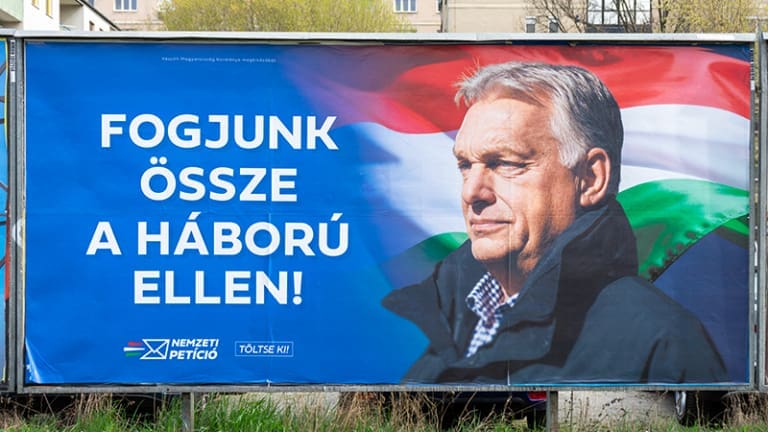
Viktor Orbán’s defeat in Hungary’s April 2026 elections, after 16 years in power, showed that entrenched rulers can be defeated at the ballot box even when they control the media, state resources, and public institutions. Perhaps nowhere was this outcome watched more closely, or more anxiously, than in Turkey where Recep Tayyip Erdoğan has been in power since 2003.
The speed with which pro-Erdoğan commentators rushed to insist that “Turkey and Hungary are very different” is telling. When a regime feels compelled to preempt a comparison, it usually understands the comparison better than it lets on. Political scientists often classify Hungary and Turkey as competitive authoritarian systems—political orders where elections exist and matter, but where the playing field is systematically tilted through the ruling party’s media control, judicial capture, and weaponization of state resources. Unlike closed autocracies, these regimes retain genuine competition: results are not predetermined, and opposition forces can and sometimes do win.
Hungary offers real lessons […]. But Turkey’s opposition operates under a far heavier weight of repression.
In this context, Orbán’s defeat has inevitably raised hopes that the same can be achieved in Turkey. Hungary offers real lessons, above all about candidate selection. But Turkey’s opposition operates under a far heavier weight of repression, which means that lessons from Hungary cannot be imported directly.
The Candidate Is the Coalition
The most important lesson from Hungary is which kind of candidate can successfully challenge an authoritarian incumbent. Péter Magyar, the former government official who defeated Orbán, was not a conventional opposition figure. He spent most of his career in Orbán’s ruling party until he resigned from the government in 2024. A conservative insider untainted by the opposition’s accumulated electoral failures, he built his own movement rather than join the established opposition. He avoided Orbán’s culture war traps, refusing to be drawn into the identity battles that the incumbent had used to divide and polarize society. The result was a candidate who could occupy the center and rally the opposition while drawing from Orbán’s own base—a combination that no previous challenger had achieved.
Turkey’s experience offers a sharp illustration of what happens when the opposition ignores this logic. In 2023, the opposition assembled its broadest-ever coalition: six parties, a detailed political program, and eventually the informal support of the pro-Kurdish DEM party. Yet the coalition nominated Kemal Kılıçdaroğlu, the leader of the main opposition Republican People’s Party (CHP), whose 12 years of accumulated electoral defeats left him with little credibility. His minority Alevi-Kurdish background further gave Erdoğan exactly the kind of identity cleavage that he excels at exploiting. The opposition did the right thing by assembling a broad coalition, but chose the wrong candidate.
Why was a more appealing candidate not chosen? Turkey’s presidential system concentrates enormous power in the presidency, giving opposition party elites rational reasons to fear a genuinely popular candidate. Such a figure, once in office, would owe nothing to the coalition partners who had helped elect him. Kılıçdaroğlu’s weakness was, paradoxically, his electability among party elites. Figures from Erdoğan’s ruling AK Party who left and founded breakaway parties compounded this dynamic. Unlike Magyar, these were technocratic figures without popular appeal, who feared that a candidate who could cross identity lines and directly appeal to the conservative electorate would render them irrelevant. So they backed Kılıçdaroğlu, claiming they were the link that could deliver conservative voters he could not otherwise reach. The coalition effectively selected the least threatening candidate, not the most competitive one.
Adapting the Lesson, Not Copying It
Magyar’s path is not straightforwardly replicable in Turkey, a large country with deep identity cleavages, where a candidate without party infrastructure and established networks would struggle to compete at national scale. But the underlying logic holds: what Turkey needs is not a copy of Magyar himself, but a figure who can do what Magyar did, on Turkish terms.
Ekrem İmamoğlu is such a figure. As mayor of Istanbul, Turkey’s largest city, since 2019, he has built a national profile by governing pragmatically and by appealing across ethnic, sectarian, and political lines, including to voters who previously supported Erdoğan. He represents a new generation within the CHP. He is ideologically moderate and has managed to avoid the culture war traps that Erdoğan sets and that other opposition figures could not escape. Part of this is political skill; part of it reflects his upbringing in a conservative Black Sea family and his religious roots.
The 2024 municipal elections revealed the extent of İmamoğlu’s appeal. Even with the opposition alliance fragmented and no formal coordination, İmamoğlu was reelected as Istanbul mayor by a large margin (another opposition candidate, Mansur Yavaş, won in the capital Ankara). In both cities, voters coalesced around the candidates, not the parties. Elite-level coordination may be useful, but in a personalist system, the right candidate can do what no alliance document can: bridge the ethnic, sectarian, and political divides on which incumbents rely to fragment the opposition.
The Stakes Are Higher
This is where the comparison must be handled honestly. Hungary and Turkey are not equivalent cases, and the gap between them has widened considerably, particularly over the past year. Even under Orbán, Hungary, constrained by European Union membership, has retained enough institutional competitiveness for an electoral transfer of power to occur. Turkey has moved in the opposite direction. Since the AKP’s heavy municipal election defeat in 2024, the regime has trained its repressive apparatus on the CHP itself, with mass detentions of opposition politicians and the appointment of trustees to replace elected mayors. As the CHP presidential candidate for the 2028 elections and the opposition’s most popular figure, İmamoğlu has crosscutting appeal that has made him the regime’s primary target. Since 2022, he has faced a succession of politically motivated legal proceedings, culminating in his imprisonment in March 2025. While Orbán tried and failed to prosecute Magyar, in Turkey, Erdoğan succeeded.
This is not incidental. Erdoğan has been quite explicit about his intentions. In a recent statement, he expressed confidence that “Turkish democracy” will have “the opposition it deserves”—a thinly veiled signal that the regime intends to shape not just the government but also the opposition. Some opposition actors are tolerated, even accommodated, while those seen as capable of seriously challenging the regime increasingly face legal pressure and, in some cases, detention. The objective is not to eliminate opposition altogether, but to tightly constrain it.
The opposition’s best response is to find and develop more candidates like İmamoğlu at every level of politics, so that the regime’s selective repression cannot keep pace.
What this means in practice is that the Turkish opposition faces a challenge that Magyar did not: success itself invites repression. Being effective, being popular, building cross-constituency coalitions, winning local offices—all of this makes political figures a target of Erdoğan. There is no tactical way around this. The opposition’s best response is to find and develop more candidates like İmamoğlu at every level of politics, so that the regime’s selective repression cannot keep pace. This is easier said than done. İmamoğlu himself is a relatively new national figure, and such politicians are rare. But each crackdown also creates an opening: the mass protests that followed İmamoğlu’s imprisonment showed that repression too has its costs. The opposition must keep those costs high through sustained mobilization.
If Hungary shows that competitive authoritarian regimes are not invincible, Turkey shows that the personal cost of challenging them can be extremely high. Turkey’s opposition cannot afford to ignore that asymmetry. It has two tasks: to find the right candidate—and to keep that candidate out of prison long enough to run.
The views expressed in this publication are the author’s own and do not necessarily reflect the position of Arab Center Washington DC, its staff, or its Board of Directors.
Featured image credit: Arpasi Bence via Shutterstock