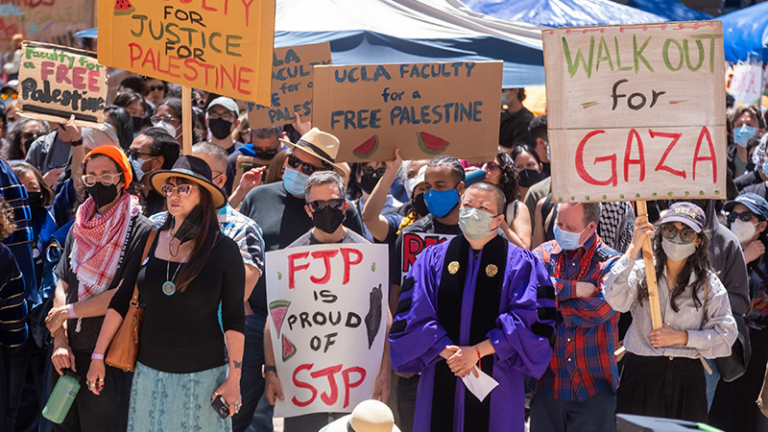
It has been more than two years since Columbia University students established the first Palestine Solidarity Encampment on April 17, 2024. Within weeks, students launched encampments at more than 100 universities across the United States, protesting the intensified Israeli genocide in Gaza post-October 7, 2023, and the US funding that enabled it. Students demanded that their universities disclose their investments, divest from companies linked to Israel, and end academic partnerships with Israeli institutions. Rather than consider these demands in good faith, universities responded with intense repression against student activism and speech about Palestine.
This repression was part of a coordinated campaign by US universities, government actors, and right-wing, pro-Israeli organizations to silence pro-Palestine speech—and eventually freedom of speech and academic freedom more broadly. The detrimental consequences for higher education—and for democracy—are far-reaching and long-lasting. The repression of the pro-Palestine student movement has structurally reshaped US higher education, establishing a new university order that is more surveilled, policed, and repressed—not just regarding Palestine but around any form of dissent, including critique of the increasingly authoritarian US administration. We are already seeing the effects today: the United States and Israel are waging arguably the most unpopular war in US history, against Iran, yet campuses remained largely silent.
Universities Against Encampments: Policing and Discipline
In 2024, students, animated from silence into action by watching Gaza’s live-streamed genocide, ignited the largest student protests for Palestine in US history, transforming campus grounds into political arenas with tents, banners, and teach-ins that attracted national media coverage, raised awareness about Palestine, and forced people to recognize that support for Palestine was growing.
Initially unprepared to deal with extended-occupation protests, universities responded with intense repression, including the use of force. Some 70 universities called police on their own students, resulting in violent attacks and the use of tasers, tear gas, and pepper balls against students, countless injuries, and more than 3,200 arrests. Many universities targeted dozens of students with suspensions, expulsions, degree revocations, and other sanctions, although these harsh crackdowns often ignited larger demonstrations in support of protesters.
University Adaptation and Repression
After their perceived failure to prevent the encampments in the spring, universities spent the summer of 2024 preparing to more effectively stifle pro-Palestine activism when classes resumed in the fall.
Universities and colleges hastily updated their regulations, often circumventing their own processes and faculty input to enact overly restrictive protest policies with harsher punishments for violations. They banned encampments, confined permissible demonstrations to designated times and spaces, tightened campus access, and banned face masks to more easily identify students. Many universities increased their surveillance and policing of student spaces, spending thousands of dollars on AI surveillance tools, including CCTV footage and tracking student identification cards, hiring private investigators to monitor students, and building private police forces authorized to remove or arrest students on campus grounds.
Universities paired these system-wide changes with targeting individual student protesters. Those who were not immediately suspended, expelled, or otherwise punished were subjected to intimidating hearings and protracted investigations that could last more than a year, and that sapped students’ time and energy for campus organizing. In a tactic called “lawfare,” legal processes were also weaponized to harass, intimidate, and silence activists and to drain the resources of activist groups through long, costly legal battles. Many of the thousands of students arrested in spring 2024 continued to deal with legal battles in the fall, with some 58 facing extreme criminal charges in federal courts, some potentially involving years in prison. International students faced deportation threats, especially after more than 300 student visas were revoked and at least a dozen international students involved in pro-Palestine advocacy were detained by immigration authorities, prompting many others to leave the country.
Universities often coordinated with law enforcement to identify student protesters.
Universities often coordinated with law enforcement to identify student protesters, including improperly using sealed police arrest records as a basis for campus bans and disciplinary sanctions. And in response to government demands, some universities handed the government personal data about students with Palestine-related disciplinary records, a serious breach of confidentiality that may have made these students targets of government surveillance and repression, especially non-US citizens. Many students thus faced both criminal and student disciplinary processes, wiping out leaders and bolder protesters from the movement or diverting their energy from Palestine toward campaigns to get their charges dropped.
The silencing effect of these attacks extended beyond those directly targeted. Would-be protesters witnessing their peers being punished for speaking out about Palestine were deterred from doing the same. With the cost of protesting so visibly increased, mobilizing the large numbers seen in spring 2024 became nearly impossible, despite rising public support for Palestine.
A Coordinated Response: Political Pressure and Anticipatory Obedience
Universities were not acting alone: many post-encampment changes involved external political pressure. The American Association of University Professors (AAUP) reported in November 2025 that both the Joe Biden and the Donald Trump administrations weaponized civil rights law against pro-Palestine speech on campus. They framed anti-Zionist activism as “antisemitic” in an attempt to legitimize crackdowns on students and faculty who criticized Israel, even when they were Jewish, in a government attack on academia not witnessed since 1950s McCarthyism. During President Biden’s last months in office, federal antisemitism investigations were initiated into 20 universities, largely driven by pro-Israel and right-wing organizations, and nearly entirely on the basis of speech critical of Israel. The universities under investigation, including the University of Michigan, Brown University, and Johns Hopkins University, implemented sweeping policy changes and handed the government extensive personal data on students accused of “antisemitism.”
The newly elected Trump administration made controlling pro-Palestine sentiment in higher education a priority.
In early 2025, the newly elected Trump administration made controlling pro-Palestine sentiment in higher education a priority. On January 30, 2025, 10 days after taking office, Trump issued an executive order to combat pro-Palestine “radicals,” followed by a multiagency “Federal Task Force to Combat Antisemitism” that threatened 60 schools with massive funding freezes unless they accepted stricter controls over campus activism and harsher crackdowns on criticism of Israel. The administration then extended its attacks to abolish diversity initiatives and anti-racist teaching, to eliminate academic freedom, and to undermine the value of higher education and academic freedom entirely.
These threats materialized in March 2025, when the Trump administration canceled $400 million of government grants and contracts to Columbia. The first of many universities with Palestine-related funding cuts, Columbia set a spineless example by quickly capitulating to demands the very same day, expelling students involved in the previous year’s Hamilton Hall occupation and later hiring 36 “special officers” empowered to arrest students. Two months later, after students bravely protested despite these changes, Columbia expelled, suspended, or revoked the degrees of more than 70 protest participants. Most universities, even those not directly targeted by the government, adopted similar measures in anticipatory obedience, preemptively demonstrating control over pro-Palestine activism in hopes of avoiding Columbia’s fate. Only a tiny minority resisted the attacks.
Repression Works: The Decline of the Movement
In fall 2024, students returned to a far more oppressive campus environment. Protest activity then dropped by more than 64 percent from the previous semester and continued to decline into spring 2025 and into the 2025-26 academic year, though not for lack of student support for Palestine. A March 2025 Gallup Poll found that sympathy in the United States for Palestinians had reached a record high, especially among younger generations. Former encampment organizers committed in early fall 2024 to “[hit] the ground running” and to keep protesting until their universities divested from companies supporting Israel.
The decline in protests was a direct result of the increased repressive policies, surveillance, and crackdowns on protesters, which significantly narrowed feasible protest tactics, intimidated would-be supporters, and made pro-Palestine activism much more difficult to accomplish. In fall 2024 and spring 2025, students at several campuses attempted to launch new encampments or occupations of buildings, including at Columbia’s Barnard College, the University of Washington, Yale University, Boston University, Howard University, Swarthmore College, and Johns Hopkins. Between the universities’ improved repression strategies and protesters’ reduced numbers, most of these demonstrations were shut down within hours by police or administrations. At Columbia, an encampment planned for April 2025 never launched after student plans were leaked to the media. Student tactics that had worked the previous semester were now easily suppressed, making campuses chillingly quiet.
Silence Spreads Past Palestine
Worryingly, this chilling effect silenced not only student protests but also everyday free speech across the university. A Middle East Scholar Barometer survey conducted in early 2025, seven months after the encampments, showed that 78 percent of US scholars self-censored when speaking about Israel-Palestine. 83 percent felt the need to self-censor most when it came to criticizing Israel, while 11 percent felt the need most when it came to criticism of Palestinians.
The silencing effect extended beyond Palestine to affect free speech and activism more broadly, including criticism of the US government. When the Trump administration began attacking diversity initiatives, immigrant populations, and anti-racist teaching, universities—having failed to build systems to resist federal pressure around Palestine—defaulted to the same anticipatory obedience. Clearly, the AAUP’s concern that the federal and academic responses to the encampments were “impos[ing] severe limits on speech and assembly that discourage or shut down freedom of expression” was deeply warranted.
A survey conducted in early 2025 showed that 78% of US scholars self-censored when speaking about Israel-Palestine.
Human rights attorney Jameel Jaffer has observed that after witnessing the severe targeting of students for pro-Palestine advocacy, students and faculty are far more reluctant to protest because the “official and unofficial consequences of speaking out can be severe, and even life-altering.” This fear has spread even to relatively uncontroversial issues on which the majority of US opinion is united—and it is especially palpable today considering campus responses to the US-Israeli war on Iran launched in February 2026. After students’ 2024 mass protests against US support for Israel’s war crimes in Gaza, we might have expected an even more powerful response to Trump directly waging an unauthorized war against Iran. Yet in spring 2026, campuses stayed silent. The extreme repression of the pro-Palestine movement and its inability to stop the genocide in Gaza arguably has created a pervasive feeling of powerlessness that prevents a sustainable anti-war student movement today, despite the unprecedented widespread unpopularity of the Iran war across the US political spectrum.
The New University Order
Nevertheless, the 2024 encampments did achieve something. They elevated public attention to Gaza, expanded conversations about topics like investment transparency in university endowments and campus policing, and mobilized a generation of student organizers engaged in the Palestinian cause. Multiple student and faculty bodies formally supported, and at least three universities have actually enacted, divestment from Israel-linked funds. Institutional change remains possible.
However, the regulatory and political infrastructure developed to repress the 2024 encampment movement also endures. It continues to restrict the student movement, making further institutional change far more difficult to achieve. It has brought about a new university order that is more policed, surveilled, controlled, and censored than ever before. The longer that this order goes unchallenged, the more entrenched it will become. Already, universities’ accommodation of federal attacks against pro-Palestine sentiment has opened the way for further erosion of free speech, academic freedom, accessibility, diversity, and inclusion. Today, we are seeing the impact in the absence of organized student opposition to the US-Israeli war on Iran.
Moving Forward: The Student Movement Will Rise Again
The situation is dire, but not hopeless. The last two years have tested US higher education values, and universities failed, choosing profit and power over their democratic and moral obligations. We are now at a crossroads: if universities do not overhaul the new order imposed on them, we may be witnessing the end of US higher education, and democracy, as we know it.
Students may be in a unique position to challenge this trajectory, but students are now highly aware of the infrastructure that exists to silence and punish them. This is perhaps inevitable: institutions adapt to stifle forms of dissent that threaten them. What gives this author hope is remembering that students, and movements, can also adapt, and that the fight for liberatory change is long and rarely glamorous, visible, or instantly rewarding. It took many years of organizing, coalition-building, and overcoming many setbacks for anti-apartheid activists to successfully pressure more than 100 universities to divest from corporations doing business with South Africa. The 2024 Gaza encampments will not be the end of the student movement for Palestine. If students can adapt effectively to this new era of oppression, when the next political opportunity arrives they will rise again.
The views expressed in this publication are the author’s own and do not necessarily reflect the position of Arab Center Washington DC, its staff, or its Board of Directors.
Featured image credit: Ringo Chiu via Shutterstock