In this second term of the Trump administration, personal ties, backhanders, and flattery have all but replaced formal diplomacy in the Middle East.
The son of Steve Witkoff, US Special Envoy to the Middle East, reportedly leveraged his connections to secure billions of dollars in investments from the Gulf.
Overseas investors, including from Saudi Arabia, account for 99 percent of the $6.16 billion managed by Affinity Partners, the investment fund founded and led by Jared Kushner, Trump’s son-in-law and informal advisor, who also participated in delicate regional negotiations over Gaza.
A 49-percent stake in World Liberty Financial, co-founded by several members of the Trump and Witkoff families, was recently acquired for $500 million by UAE National Security Advisor Sheikh Tahnoon bin Zayed, prompting suspicions of a quid pro quo when the Trump administration later allowed Abu Dhabi to access advanced US-made AI chips.
Trump’s foreign policy in the Middle East seems to be built more on personal connections than on professionalism and institutions.
His administration has hollowed out both the National Security Council (NSC) and the State Department, which were supposed to advise and constrain the president and other agencies. The NSC has been reduced to a few dozen personnel, none of whom seem to have much influence on policy.
The US Agency for International Development (USAID), once an important actor for global humanitarian good and a crucial instrument of US soft power, has been destroyed.
The peripatetic Secretary of State, Marco Rubio – triple-hatted since 2025 as national security adviser, secretary of state, and administrator of what little was left of USAID – seems more concerned with a potential run for the presidency in 2028 than with doing any of these jobs, or being the nation’s top diplomat. Rubio seems to be merely a spokesperson for policies decided elsewhere.
The return of court politics
Trump’s approach mirrors the trappings of Europe’s monarchical age: a courtly clique of family members, loyalists, and wealthy patrons. Scholars have aptly described this personalist style of foreign policy as “neo-royalism.”
The Trump administration treats international affairs not as a series of relations between sovereign governments, but as interactions between a closed circuit of sovereigns, in which only the leaders – and their inner circles – decide the fate of entire peoples.
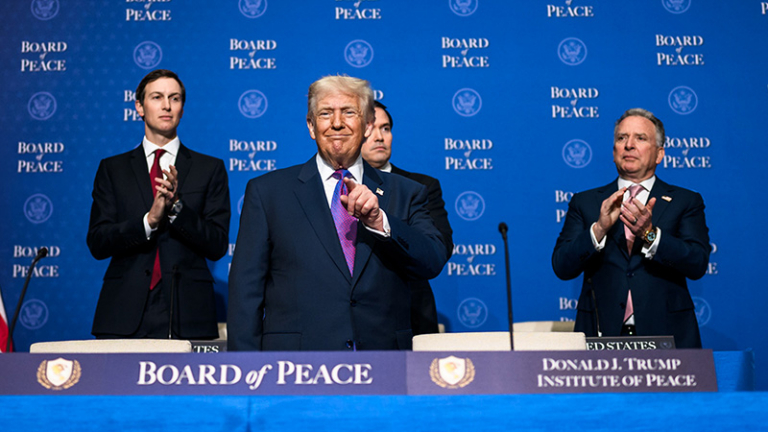
Perhaps the most vivid example of this approach is seen in how Palestinians are denied agency, their fate referred to a distant “Board of Peace” chaired by the US president, on which a permanent seat can be purchased for a billion dollars. The lives of ordinary people are no longer seen as part of nations that should be respected; they are consigned to the status of commodities to be traded rather than nations.
Private enterprise, buttressed by state power, now calls the shots. Economic policies on tariffs and technology increasingly correspond to tributes in the form of “investments” that benefit the president’s inner circle. Louis XIV, call your office.
Whoever is in the room with Trump at any given time is now paramount. Steve Witkoff and Jared Kushner, both real estate professionals, are more powerful and influential diplomats than Secretary of State Rubio, but they bring little experience to bear on complicated issues and have failed to draft, define, and implement agreements with real weight to end disastrous conflicts.
The failed ceasefire agreement between Iran and the United States, for example, left out many key details and opened the door to the resumption of hostilities. The Gaza ceasefire agreement, also negotiated by Witkoff and Kushner, remains valid on paper but has allowed Israel free rein to conduct attacks in Gaza that have cost the lives of more than 1200 Palestinians so far.
The humanitarian aid and reconstruction of the Strip promised by the agreement have yet to materialise. But the White House has never formally renounced the plan, and key figures tied to the Board of Peace have continued pushing variations of the “Gaza Riviera” vision, in which the Strip is redeveloped by wealthy outsiders, including the Gulf monarchies and American investors potentially associated with Trump.
Diplomacy for the highest bidder
Across the Middle East, it is this new royalty that decides policy. The Iran war began in February 2026 with joint US-Israeli strikes on Iran’s nuclear and military capabilities, but it continues aimlessly today, led by a president who appears to have no goal in mind but personal triumph.
Trump seems to have believed that America’s successful seizure of Venezuela’s president, Nicolás Maduro, was a blueprint for an easy decapitation strike against the Iranian regime. It was not.
Neo-royalism has little time for international law, much less human rights or democracy, which, although seldom the driving force, was in the past at least as a nominal component of US foreign policy.
But not today. The horrors of Hamas’s 7 October 2023 attack on Israel have given way to what legal experts and scholars have called a genocide in Gaza, with no accountability for the perpetrators. Washington has failed to condemn Israel’s war, let alone stop arms sales to Israel.
The personalised foreign policy of President Trump has displaced the US-led international order, which – with all its flaws and failures – established a blueprint for global relations that helped secure a measure of peace for some seven decades after World War Two.
Multilateral treaty organisations such as NATO and numerous bilateral agreements – unequal and flawed as they may have been – arguably helped stem the tide of global authoritarianism.
Today, the floodgates have been reopened. There is no sense that the United States stands for a stable world order. The tumult in the Middle East is simply one manifestation of that fact.
The president’s threats to seize Greenland, the seemingly random application of tariffs to include many of America’s closest allies, haphazard military actions such as seizing the Venezuelan president, and air strikes in Nigeria, demonstrate the chaos that one-man rule over US foreign policy has unleashed.
In the Middle East, Trump’s new royalism is likely to provoke a scramble for new alliances and deals – economic, diplomatic, and military – that can help replace Washington’s erstwhile commitment to stability.
That, in turn, is likely to fuel existing regional conflicts and may spur new tensions. Globally, we are living in a new era of uncertainty, fuelled by leaders’ unfettered pursuit of private interest and personal agreements above the public good.
This article was originally published by The New Arab as part of the From Washington series. ©️ 2026 The New Arab. Republished with permission.
From Washington is a collaboration between The New Arab and Arab Center Washington DC exploring the ideas, interests, and power dynamics shaping US policy towards the Arab world.
Featured image credit: The White House via Flickr