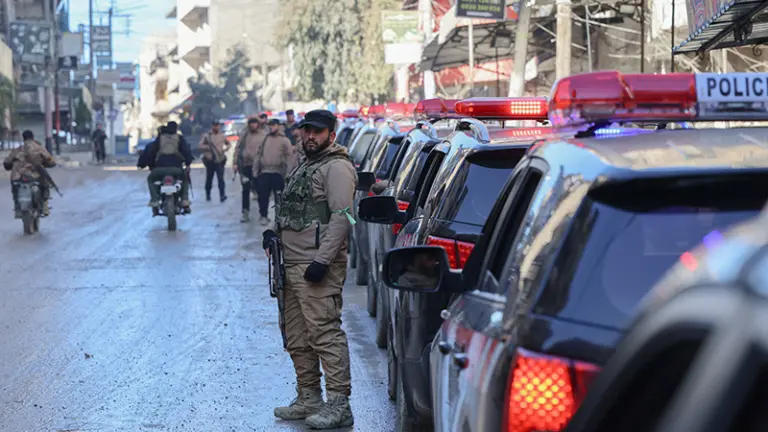
On January 8, 2026, Syrian interim government forces moved into two neighborhoods in Aleppo controlled by the Syrian Democratic Forces (SDF), the US-backed coalition assembled to fight the so-called Islamic State (IS) in northeast Syria. The move into Aleppo launched what became a remarkably swift transformation of Syria’s territorial order. Within two weeks, government control expanded from those initial neighborhoods to almost all the territory previously overseen by the Democratic Autonomous Administration of North East Syria (DAANES), which had been a de facto self-governing region since 2012. Not only did Arab tribal forces that were part of the Kurdish-led SDF drop away as government forces took these areas, but the United States—which for over a decade had armed, funded, and politically backed the SDF—expressed its support for a strong central government in Damascus after announcing that the SDF’s role as the main anti-IS force had “expired.”
At the time of writing, a temporary ceasefire has confined SDF forces to the town of Kobane, on the border with Turkey, and to a narrow zone between Hasaka and Qamishli in the northeast. This rapid territorial shift reveals a core feature of Syria’s emerging political order: central authority is being restored by absorbing the regions not after inclusive negotiations but according to parameters set by outside powers, especially Israel, Turkey, and the United States. Although Israel may want to fuel tension between Damascus and certain regions, Ankara and Washington seem to concur that stability through centralization is preferable to fragmented governance. What looks to be emerging in Syria is a unified state structure in which only external protection—not domestic bargaining—can deliver regional autonomy.
The Collapse of the SDF: Contingency, Miscalculation, and Re-Centralization
The rapid disintegration of the SDF surprised many observers, not because its internal vulnerabilities were unanticipated, but because of the speed with which its territorial, political, and social foundations eroded. The SDF was comprised of elements from Arab tribes, ethnic militias, and the forces of the Kurdish People’s Protection Units (YPG)—the militia of Syria’s Kurdish Democratic Union Party (PYD), which is itself an offshoot of Turkey’s Kurdistan Workers Party (PKK). As such, the SDF was always vulnerable to defections by Arab fighters. In the event, the SDF’s ill-preparedness for the collapse of US support accelerated its demise.
The rapid disintegration of the SDF surprised many observers because of the speed with which its foundations eroded.
Established in 2015 to fight IS, the SDF was always a contingent political arrangement. For many Arab tribes and local militias, alignment with the Kurdish-led forces offered a pragmatic alternative to Damascus while the Bashar al-Assad regime remained in place. In SDF-controlled areas, Arabs outnumbered Kurds in terms of both population and fighting force, but authority remained concentrated in Kurdish hands—a reality tolerated because the SDF afforded an opportunity to resist the regime. Assad’s fall in December 2024 fundamentally altered this equation. Once the new al-Sharaa regime in Damascus emerged as a viable center of authority, cooperation with the SDF lost much of its appeal for Arab actors in the northeast. The SDF succeeded in delaying this shift for nearly a year but ultimately failed to prevent it.
The rapid unraveling of the SDF was the product of another strategic miscalculation. SDF leaders appear to have assumed that the new authorities in Damascus would struggle to consolidate power and to secure international legitimacy. The al-Sharaa regime’s militant origins and the implication of regime elements in the 2025 mass violence against minority communities in coastal areas and al-Suwayda fed expectations that external actors, especially the United States, would withhold full recognition of the regime headed by al-Sharaa and that Damascus would eventually be forced to negotiate meaningful autonomy for the northeast.
The SDF’s misplaced expectations shaped its approach to negotiations with Damascus. The SDF interpreted the March 10, 2025, agreement with al-Sharaa as offering the opportunity for a nominal integration into the national armed forces that would preserve its distinct chain of command, identity, and institutional cohesion. Damascus, however, saw the agreement not as a suggestion of autonomy but as a proposal for integrating SDF fighters into the national armed forces on an individual basis. This divergence proved critical. Since the March 2025 agreement, the SDF delayed making difficult concessions, including over Arab-majority areas that it was either unable or unwilling to defend militarily, while the al-Sharaa regime consolidated power and became an increasingly attractive option for Arab elements of the SDF coalition. After its military defeat, the SDF had little choice but to accept Damascus’s interpretation of the agreement.
External actors have shaped this outcome decisively, albeit indirectly. Credible reports suggest that Turkey may have prevented the emergence of a modus vivendi between Damascus and the SDF, and encouraged Damascus to adopt a hardline position toward SDF demands. For its part, the United States did not work to dismantle the SDF, but it did not intervene to save it at the crucial moment. Instead, the Trump administration chose not to constrain the process of al-Sharaa’s consolidation of power and has endorsed the end of the SDF’s autonomous political role. President Donald Trump’s Syria Envoy Tom Barrack bluntly announced on social media on January 20, 2026, that the SDF’s role as the “primary anti-ISIS force on the ground” had “largely expired” and that the Syrian armed forces now had that role. Barrack also stated that the “greatest opportunity for the Kurds in Syria right now lies in the post-Assad transition under the new government led by President Ahmed al-Sharaa,” rather than in the continuation of regional autonomy. Turkey and the United States have now converged on the restoration of a centralized state as the best way to deliver stability in Syria.
In this context, Damascus’s approach to regaining control of the northeast has arguably been calibrated to avoid triggering diplomatic repercussions or external intervention. Earlier episodes of violence involving minority communities, such as in al-Suwayda, generated international backlash and narrowed the regime’s room for maneuver. In contrast, this month’s government operations in northeast Syria have been conducted with greater attention to external sensitivities, underscoring how al-Sharaa is pursuing centralization within clearly perceived international red lines over indiscriminate violence against civilians.
Israel and the Logic of Bargained Centralization
Israel initially appeared to be an outlier to the emerging US and Turkish consensus on Syria’s recentralization. Israel has kept its political distance from the new regime in Damascus, while seeking to keep it weak by regularly bombing targets in Syria. Yet recent developments suggest that Israel is no longer outright opposing al-Sharaa’s reassertion of central authority but engaging with it selectively, offering de facto acceptance of a strengthened state in Syria in return for certain concessions. Significantly, Damascus’s recent military moves against Kurdish-held areas only began after a security understanding was reached with Israel during recent talks in Paris.
Israel’s relatively muted criticism during the dismantling of the SDF reflects its strategic calculations. Tel Aviv may have realized that a consolidated regime in Damascus can serve Israeli security interests just as effectively as a fragmented Syria with unpredictable semi-autonomous actors. A centralized state bound by enforceable security understandings offers leverage opportunities that fragmented actors cannot provide. What distinguishes Israel from other external actors is the depth of the concessions it extracts in return, such as those related to a demilitarized zone in southern Syria and autonomy to the Druze in al-Suwayda.
This dynamic is evident in the gradual transformation of southern Syria into a de facto Israeli buffer zone. Israel’s longstanding occupation of the Golan Heights has been normalized through international acquiescence and the absence of a meaningful Syrian challenge. Areas occupied following Assad’s fall have entered a grey zone: Israel has not formally annexed them, yet Israel increasingly treats them as permanent acquisitions. Israel’s strategy remains incremental. By acquiescing to a strong central state in Syria that can effectively neutralize opposition to its ongoing presence in the country, Israel converts de facto control into a more lasting political outcome. In acquiescing to a centralized Syria while extracting security and territorial concessions, Israel can infringe upon Syria’s national sovereignty without pushing for the state itself to be dismantled.
Whether or not Damascus grants some kind of autonomy to al-Suwayda has little to do with domestic politics. The Druze-majority region represents a potential exception to Syria’s ongoing centralization not because of any negotiated autonomy, but because of external protection from Israel. Israel’s signaling, explicit and implicit, has so far deterred the Syrian government from forcibly reintegrating al-Suwayda under central control. The outcome of the current hiatus will rest on external backing from Israel, not internal deals.
Seen from this perspective, Israel’s approach toward Damascus reinforces the argument that autonomy is not earned through bargaining, representation, or local legitimacy in the new Syrian order. Instead, autonomy is largely a product of external sponsorship.
Protection, Not Power
The experience of Syria’s Alawi community under al-Sharaa’s rule offers a different perspective on the dynamic between centralization and regionalism. Closely associated with state power during the Assad regime, the Alawi population lacks any external patron to push for a serious discussion of Alawi autonomy or their special status in the post-civil war order. The March 2025 violence against Alawi communities on the coast underscored their vulnerability: The absence of an external guarantor—and the greater social diversity of the coastal region, home to a mixed population of Alawis, Sunnis, and Christians—has translated into the absence of any proposal for autonomy on the coast.
The region of al-Suwayda contrasts with this case. Here, the potential for limited autonomy has endured precisely because of external signaling, particularly from Israel. While the contours of this protection remain ambiguous, its deterrent effect has been real. Coercive integration into the central state has been avoided, and local self-administration has persisted in ways not seen elsewhere. Importantly, this outcome has not flowed from negotiated inclusion or constitutional guarantees, but from the implicit understanding that external intervention would follow any attempt at forceful centralization.
Northeast Syria follows a different but likely ultimately convergent trajectory. For years, Kurdish-led governance in northeastern Syria rested on the assumption that US backing would provide sufficient deterrence to sustain a putatively multi-ethnic autonomous project. That assumption proved only partially correct. While US protection constrained large-scale military confrontation with regime forces, it did not extend to preserving the SDF as Arab tribal partners defected. With the SDF’s likely imminent collapse, the PYD has lost an important pillar of its power.
For years, Kurdish-led governance in northeastern Syria rested on the assumption that US backing would provide sufficient deterrence.
The situation today is fluid. A temporary ceasefire is in place between Damascus and the SDF, though its duration is uncertain. Statements by al-Sharaa about recognition of Kurdish rights suggest that Damascus may consider some form of limited autonomy for Kurdish-majority areas. Commitments to recognize Kurdish as a national language or to allow its use as an elective language in education mark a departure in Damascus from earlier denialist policies. Yet these measures fall short of recognizing Kurds as a political community or granting constitutionally protected collective rights. In the absence of a constitutional framework, such concessions remain discretionary and reversible. Moreover, cultural recognition should not be conflated with political autonomy: accepting Kurdish as national language alongside Arabic does not imply recognition of Kurds as a constituent group within the state. Even with the most liberal approach to Kurdish rights from Damascus, any political arrangement for the Kurds would be significantly smaller in scope and substance than the previous de facto autonomous administration.
The decisive variable in these negotiations is not the balance of forces on the ground, but continued US mediation. As long as the Trump administration chooses to actively underwrite the negotiation process, a narrowly circumscribed, fragile arrangement may endure. Should US mediation weaken or end, the prospects for the PYD’s political and military survival will diminish sharply. In this sense, the future of self-rule in the northeast is less a function of negotiations with Damascus than of external willingness to impose constraints on centralization.
Conclusion: Autonomy as an Exception, Centralization as a Rule
Recent developments point to a clear conclusion. The “new Syria” is taking shape not through inclusive negotiation or durable decentralization, but through the reassertion of central authority operating within externally defined boundaries. From Aleppo’s Kurdish neighborhoods to the northeastern autonomous administration, local governance experiments have either collapsed or been reduced to narrow exceptions. What determines their fate is not internal power-sharing but the presence or absence of external protection.
The contrasting experiences of Syria’s regions clarify this logic. Lacking any credible external patron, coastal Alawis have few prospects of autonomy or communal rights. In al-Suwayda, Druze may effectively retain limited self-rule because of Israeli deterrence. In the northeast, the PYD’s political project has been compressed into a far more precarious space as the United States has turned to the national army as its main partner in the fight against the so-called Islamic State. In each case, identity and organization matter less than access to foreign patronage.
This framework has profound implications for Syria’s political future. Minority protection, local self-rule, and pluralism are not primarily domestic questions but are shaped by international bargaining priorities. Autonomy in this system is neither a constitutional right nor a durable institutional arrangement. It is a revocable privilege, granted when external powers find it useful and withdrawn when their priorities shift. As long as this dynamic endures, Syria’s post-war order will reflect external accommodation more than internal reconciliation. For political actors in Syria, survival is less a matter of domestic negotiation than of securing—and retaining—foreign backing.
The views expressed in this publication are the author’s own and do not necessarily reflect the position of Arab Center Washington DC, its staff, or its Board of Directors.
Featured image credit: MOHAMMAD DAHER / NURPHOTO / NURPHOTO VIA AFP