
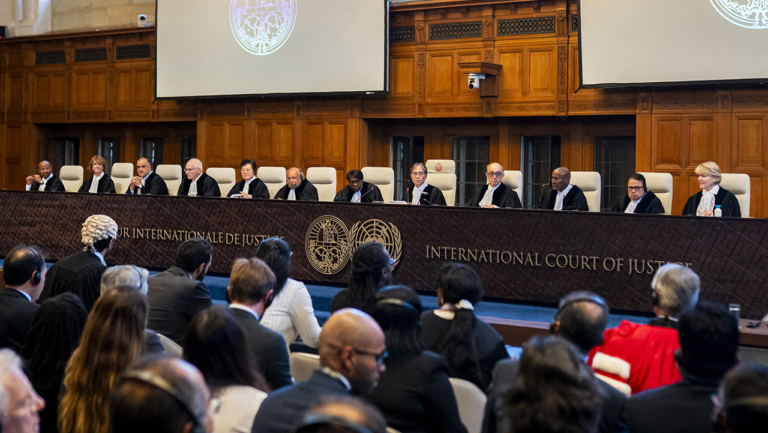
On November 19, 2026, the International Court of Justice (ICJ or “the Court”) delivered the first ever international legal judgment against a government under the 1948 Convention on the Prevention and Punishment of the Crime of Genocide. The ruling followed The Gambia’s case, originally filed in November 2019, primarily in response to violence by Myanmar’s armed forces against the country’s Rohingya population between 2016 and 2017.
Much like South Africa’s case against Israel, filed in December 2023, the case of The Gambia v. Myanmar concerns alleged acts falling under the definition of genocide provided in Article II of the 1948 Genocide Convention, specifically: (a) killing members of the group; (b) causing serious bodily or mental harm to members of the group; (c) deliberately inflicting on the group conditions of life calculated to bring about its physical destruction in whole or in part; and (d) imposing measures intended to prevent births within the group. After considering the evidence, the Court found Myanmar responsible for killing at least 10,000 Rohingya. Over 1,800 Rohingya were raped or subjected to sexual violence; up to 2,109 children under the age of five were killed or died from the violence; and some 87,000 Rohingya fled to Bangladesh in 2016, followed in 2017 by more than 700,000—more than 85 percent of the population then living in Myanmar’s northern Rakhine State.
Given the extensive death and suffering inflicted on Palestinians in Gaza by Israel since October 2023, as documented by United Nations (UN) bodies, and the even more substantial record of dehumanizing Israeli hate speech legitimizing the attacks on Gaza’s population, the ICJ’s test, as applied, should be met to prove specific genocidal intent by Israel. The Myanmar judgment provides a significant precedent for assessing the cumulative evidence in a flexible, context-based manner.
What did the ICJ rule in The Gambia v. Myanmar?
The ICJ found that Myanmar had committed genocide against the Rohingya, a protected “national, ethnical, racial or religious group,” by committing enumerated culpable acts with the specific intent to commit genocide. However, the judges were deeply divided on the main orders. They found that Myanmar had committed genocide by nine votes to six; had failed to prevent genocide (9-6); had failed to punish genocide (11-4); and had violated the ICJ’s provisional orders (11-4). The judgment ordered measures of restitution, compensation and reparations (10-5) and required Myanmar to provide guarantees of non-repetition (9-6).
The ICJ found that Myanmar had committed genocide against the Rohingya by committing enumerated culpable acts with the specific intent to commit genocide.
The judges were close to unanimous—14-1 in two findings and 13-2 in another—in concluding that Myanmar was not responsible for inciting genocide by private actors and that Myanmar had failed to enact legislation to codify the Genocide Convention. The Court ordered Myanmar to comply with codification and to investigate perpetrators of culpable acts.
In short, the Court majority concluded that Myanmar had committed more than one of the acts defined under Article II(a), (b), and (d). However, despite evidence of imposed famine, deprivation of essentials for life, burning of homes, and the destruction of villages, the ICJ did not find that the evidence was sufficiently conclusive to support the claim that Myanmar had deliberately inflicted conditions of life calculated to bring about the physical destruction of a substantial part of the group under Article II(c).
The Importance of Context
South Africa’s case similarly alleges that Israel has violated Articles II (a), (b), (c), and (d) of the 1948 Genocide Convention. The Court’s perspective, and the weight given to the evidence on each of these elements in The Gambia v. Myanmar case, highlights how it will likely view the evidence of Israel’s actions in Gaza. The Court’s examination of the wider historical and legal context of violence in Myanmar will be relevant when it comes to considering the allegations against Israel, especially in view of Israel’s failure to comply with the provisional measures the ICJ issued in favor of South Africa in January, March, and May 2024.
The most important and most difficult hurdle in the case against Israel is the element of genocidal intent in Article II’s introductory clause. Prior claims of genocide have failed on this element, which requires “intent to destroy, in whole or in part, a national, ethnical, racial or religious group.” In The Gambia v. Myanmar, the Court took a flexible approach to its assessment of genocidal intent. It applied four factors to the available evidence on intent: i) the context, including the range of prohibited acts targeting the protected group; ii) the selective targeting of the group; iii) the actual perpetration of the acts targeting the essential nature of the group; and iv) the scale and systematic aspect of the actions of the perpetrating state.
The most important and most difficult hurdle in the case against Israel is the element of genocidal intent.
The Court relied on its own jurisprudence and that of the Rwanda and former Yugoslavia Special Tribunals to establish that genocidal intent must be the only reasonable inference to be drawn from credible facts. Whether the Court actually applied this extremely high standard to its review of the evidence against Myanmar remains contested and the focus of disagreement for the dissenting judges on the main genocide findings.
By taking the wider historical and legal context into account, the Court examined a much longer pattern of discrimination by the Myanmar authorities against the Rohingya. These measures included discriminatory legislation and segregationist policies; denationalization; restrictions on births, marriages, and freedom of movement; and earlier episodes of targeted violence against the Rohingya. The Court also reviewed the hate speech from Myanmar’s military leadership, top government officials, politicians, and religious leaders that portrayed the Rohingya as legitimate targets of violence—connecting this dehumanization to the violent acts that ensued. The Court emphasized the importance of this contextual background with respect to the ensuing violence, which included deaths, sexual violence, attacks on children and those fleeing their homes, destruction of their homes and villages, and the denial of return. It concluded that the only reasonable inference from these historical and contemporary facts was that the intent was genocide.
Implications for South Africa’s Case Against Israel
The ICJ’s consideration of hate speech and dehumanization in connection with acts of violence is highly relevant both to the specific intent requirement and to the prohibited act violations of Articles II(a)-(c) of the 1948 Genocide Convention in the South Africa case. South Africa’s application provides nine pages of dehumanizing, racist speech by Israelis targeting all Palestinians living in Gaza—from the Israeli president, prime minister, and top military officials down to the soldiers carrying out the attacks. Examples of hate speech include statements claiming that Israel’s military targets are the “entire nation,” that no distinction could be made between civilians and militants, and calling Palestinians in Gaza “human animals.” Examples of hate speech by Israelis are extensively laid out in South Africa’s case, and are clearly targeted at wiping out an entire national, ethnic population and the existence of Palestinians themselves in Gaza’s territory.
The ICJ’s emphasis on historical context means that Israel’s historical record of apartheid policies against Palestinians even before 2023 will be of considerable significance in the legal analysis of genocidal intent. Although the Court did not discuss Myanmar’s policies towards the Rohingya in terms of “apartheid,” the historical pattern of systemic state discrimination against the minority community is particularly prominent in its decision. Israel’s policies of apartheid have been well documented in numerous authoritative reports. South Africa’s submission situates Israel’s alleged genocidal acts within a longer history of discriminatory policies, beginning with the Nakba of 1947-1949 and extending to the post-2007 blockade and successive Israeli military assaults on Gaza since 2008. Notably, in The Gambia case, the Court’s emphasis on the consequences of Myanmar’s denationalization of the Rohingya is highly relevant. However, documentation of the denationalization of Palestinians in 1952 is missing in the South African evidentiary record.
Another relevant aspect of the intent assessment in The Gambia case was Myanmar’s claim that its violence did not target the Rohingya community broadly, but rather that the government was conducting a counterinsurgency operation against the Arakan Rohingya Salvation Army (ARSA), which Myanmar had labeled a terrorist group. The Court majority found that Myanmar’s actions far exceeded the scope and scale of counterinsurgency operations, or just the “punishment” of a population, and that the Convention only required the intent to destroy part of a group. The only reasonable inference, according to the majority’s view of the cumulative evidence, was that Myanmar intended to “destroy a substantial part of the protected group, namely the Rohingya population in northern Rakhine State.”
The ICJ’s emphasis on historical context means that Israel’s historical record of apartheid policies will be of considerable significance.
The Court is likely to adopt a similar perspective on Israel’s claim that it only intended to target Hamas as a terrorist group in Gaza and had no genocidal intent against the population in Gaza as a whole. The evidence establishes that Israeli forces targeted all of the pre-2023 population of over 2 million people in Gaza, sparing no part of the territory and causing tens of thousands of deaths and disappearances, as well as attacking nearly all of Gaza’s educational, health, social, religious and other institutions and vital infrastructure for the survival of its people. The scale of these attacks should prove persuasive in the case against Israel.
The Court majority concluded that it could not find that Myanmar had deliberately inflicted conditions of life calculated to bring about the physical destruction of all or part of the group, under Article II(c). The majority explained that this provision required that the “conditions of life” must be capable of causing the death of at least “a substantial part of the group over time.” The judges did not find the evidence of movement restrictions, deprivation of food and medical care, sexual violence and forcible transfer sufficiently convincing to meet the level required by Article II(c). One of the main reasons for reaching this conclusion was the Court’s comparison of far more serious and extensive violence and restrictions against a targeted population in Croatia v. Serbia and other jurisprudence that did not meet the threshold of Article II(c).
The evidence against Israel on this element, however, is far more extensive than in Myanmar on the factors the Court examined: denial of food, imposed famine conditions, sieges, denial and destruction of health care and medical supplies, systematic expulsion from homes, repeated and multiple forcible population transfer, destruction of property, and severe restrictions of movement. In South Africa’s case against Israel, the evidence of all these factors depriving an entire population of conditions of life is overwhelming and should be convincing for a finding of culpability under Article II(c).
Finally, the Court’s finding that Myanmar imposed measures to prevent births under Article II(d) rested on the significant evidence, widespread nature, and horrific cruelty of sexual violence by Myanmar’s Defense Services (or “Tatmadaw”) and other actors. These were critical aspects of the evidence supporting the Court’s conclusion that Myanmar was culpable on this basis. Parallel evidence of sexual violence does not substantially appear in the South Africa case, though South Africa has submitted significant evidence of other means by which Israel has, and continues to, commit reproductive violence against the Gazan population.
Conclusion
The credibility of evidence was an important aspect of the Myanmar case. The Court required that the evidence must meet a “high level of certainty,” and be “fully conclusive” that the crime of genocide has been committed. To meet this standard, the Court had to determine what weight to give the contested evidence, which was necessarily circumstantial because Myanmar refused to allow independent factfinders to enter its territory and did not cooperate with the UN investigative bodies. The Court noted reports and testimonies provided by non-governmental organizations, which it credited and relied on as corroborating the UN and other authoritative documentation.
These are important considerations in the case against Israel, given that the bulk of evidence collected by the UN and Palestinian non-governmental organizations submitted in the South Africa case will be given substantial weight, as Israel similarly did not allow independent factfinding and refused to cooperate with UN investigative efforts. The Court’s reading of evidence also credits the work and courage of the Rohingya survivors who submitted their testimonies. The Court should give similar credibility and weight to the Palestinian survivors from Gaza whose testimonies and other evidence are included in South Africa’s submissions.
Much more can be said in assessing the consequences of this groundbreaking case for genocide in Gaza; the likelihood of implementation of the Court-ordered reparations; the implications of the differences amongst the judges in this opinion; and the obligations of third states to prevent and punish states committing genocide. Most importantly, however, the decision is a vindication for the Rohingya victims of the brutal campaign of death and destruction carried out against them by Myanmar’s forces.
The ICJ ruling offers room for substantial optimism for the outcome of the genocide case against Israel. Arguably, the evidence of both genocidal acts and genocidal intent is significantly stronger in the case against Israel than the evidence that proved conclusive in the case against Myanmar.
The views expressed in this publication are the author’s own and do not necessarily reflect the position of Arab Center Washington DC, its staff, or its Board of Directors.