
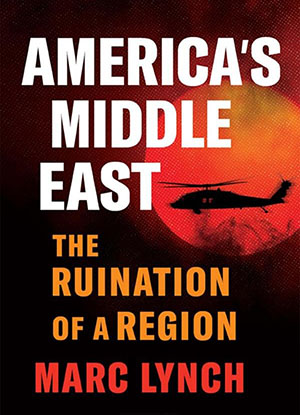
 Marc Lynch, America’s Middle East: The Ruination of a Region (New York: Oxford University Press, 2025, 272 pp.)
For decades, Marc Lynch, Professor of Political Science and International Affairs at George Washington University, has been a pioneer among US political scientists working on the Middle East. This book attests not only to his expertise, knowledge, and analytical skills, but also to his appreciation for the human dimensions of the Middle East—dimensions that are usually absent from discussions of US foreign policy in the region.
His earlier work—including his groundbreaking 2007 book on the Al Jazeera television network and its implications for the people of the Middle East—contributes to a better understanding of the region by engaging directly with its inhabitants. Lynch continued that approach in subsequent books, helping global audiences to better appreciate the sentiments and actions of Arab men and women and to better understand the power structures in this turbulent region. In this latest book, he turns a critical gaze to the legacy of American policies in the region.
This book attests not only to his expertise, knowledge, and analytical skills, but also to [Lynch’s] appreciation for the human dimensions of the Middle East.
The title explicitly states that Washington’s legacy of trying to shape the Middle East to its advantage has led to the region’s “ruination.” Lynch’s main argument is that, despite glimpses of serious peacemaking in the Arab-Israeli conflict or democracy promotion, US policy in the region has essentially been consistent since the 1970s. Washington’s goal of unsuccessfully shaping the region in its own best interests reflects several factors: the primacy of nonstop militarism (directly or through clients); the invisibility of Arab citizens and their rights; decision-making based on excluding rivals rather than fostering mutual interests; minimization of Washington’s role and responsibility (by assuming the constant troubles “over there” reflect indigenous miscreants or violent tendencies, while ignoring the psychological and political impact of its or its allies’ violence); and overly intense attachments to certain regional actors, most notably Israel. Lynch argues that, due to these flaws, the primacy of the United States “never truly achieved hegemony, a deeper and more robust level of domination, due to the inability of the US to establish legitimacy for its rule, and the continuous popular appeal and military capabilities of a counter-coalition defined by its resistance to Israel and America” (p. 52).
As a serious scholar who engages consistently both with people from the region and with the American political elite, Lynch supports this verdict with valuable evidence. He analyzes the consequences of US foreign policy in the region from Presidents Richard Nixon to Donald Trump to understand why the majority of Arabs (beyond their wealthy elites) have suffered consistently from approaches that only perpetuate regional instability and conflict. This is not a uniquely American policy, Lynch notes, since Washington’s policies have perpetuated “the core pathology that enabled European colonialism, the slave trade, the Holocaust and most of the great evils of world history” (p. xiii).
“It took me a long time to accept the ultimate core of the problem,” Lynch notes in the preface, “but after decades of close observation it became unavoidable. What America doesn’t seem willing to accept is that people in the Middle East are actually human beings. US actions over decades suggest that it does not consider Arab or Muslim lives to matter as much as American or Israeli lives. Too much of the American policy community and broader public seem to think that Muslims don’t mourn their children or think deeply about the cause of their suffering. They don’t think that Palestinians or Iraqis respond to oppression, injustice and occupation in the same way that any other people around the world—including Americans—would. They are seen as problems to be solved, audiences to be manipulated, assets to be mobilized, subjects to be studied . . . anything but people to be treated as fully equal human beings with rights, dreams, hopes and fears” (p. xiii).
Lynch’s review of successive US Mideast policies credibly documents two key points in his analysis: that Israel and its demands were always the “elephant in the room” that could not be challenged, and that the United States never seriously applied “strategic empathy” to understand how people across the region reacted to the US-Israeli assaults on their lands and rights. Every new policy attempt that sought to improve political or economic conditions in the region eventually failed to improve things, made them worse, or quickly reverted to the old playbook. Washington could not transform its military power into an enduring order, Lynch argues, “because it is unwilling and unable to make the necessary political accommodations. That’s because it has lost any shared sense of purpose that would command political consensus either at home or in the Middle East to intervene effectively. Put bluntly, how can the United States claim to act in defense of international law and a rules-based international order when it defends Israel against all accountability over Gaza? Why would any Arab want to live in an order whose leading power has defined their lives as dispensable” (pp. 233-4)?
“In a worldview defined by militarism, the dehumanization of Arabs and Palestinians and the inevitability of hypocrisy in the defense of American primacy, the genocide of Gazans is a footnote,” Lynch concludes, drawing parallels with other incidents of US-induced mass suffering, such as those experienced by Egyptians, Iraqis, Kurds, and Syrians. He writes, “Which matters more—management of regional order and the strategic balance of power, or the cost to human life and regional development—goes to the heart of this book” (p.229). Washington for the most part focused on the first, but the magnitude of the Gaza genocide has forced the second onto the agenda more than ever.
Lynch speculates on the different ways in which both US policy and conditions in the region could develop. But he does not hesitate to say that the Gaza genocide and the US-Israeli attack on Iran have brought the failure of the US-led regional order into undeniable focus, which is why he expects that Americans who cannot imagine a world, certainly not a Middle East, without US primacy are wrong. He notes that “When the American order dies, it will die alone, unmourned and unloved” (p. 232).
Dynamics in the Middle East are no longer something “over there.” In the United States, individuals and institutions that defended Palestinian rights and criticized the Israeli genocide were on the receiving end of an “outrageous and appalling” assault (p. 240), accompanied by pressure from the Trump administration on universities and other institutions. This has triggered serious backlashes across American society against such moves to restrict long-standing rights to protest or learn about important issues, mostly led by youth, who will continue to impact domestic politics. We can see signs of this trend in ongoing electoral contests in the United States, which reflect fundamental changes that may hasten the end of the US-led global order.
In his Afterword, written in July 2025, Lynch brings into his argument the US-Israeli attack on Iran, observing that, in line with decades of US policies, the Trump administration sought to use the conflict to bring about a “wholesale reconfiguration of the regional order” (p. 258). But Lynch feels that “nothing suggests that this reconfigured order will be stable, enduring, or transformative of the foundations of America’s Middle East” (p. 258). He sees Trump’s approach as “farcical” but notes again that it perpetuates the same brutish and repressive Middle East order that successive US presidents previously pursued (pp. 259-60).
Having lived through the past 60 years in the Middle East, I am delighted and impressed that a respected US political scientist has published such a hard-hitting and honest book. I recommend it strongly to anyone interested in understanding why our region is so volatile and violent. The blame must be shared widely, but this book clearly explains how American militarists, Middle Eastern autocrats, and Israeli extremists drive the pain and dislocation that we have endured for three-quarters of a century. It is a pain that grows only more intense with each passing year.
The views expressed in this publication are the author’s own and do not necessarily reflect the position of Arab Center Washington DC, its staff, or its Board of Directors.