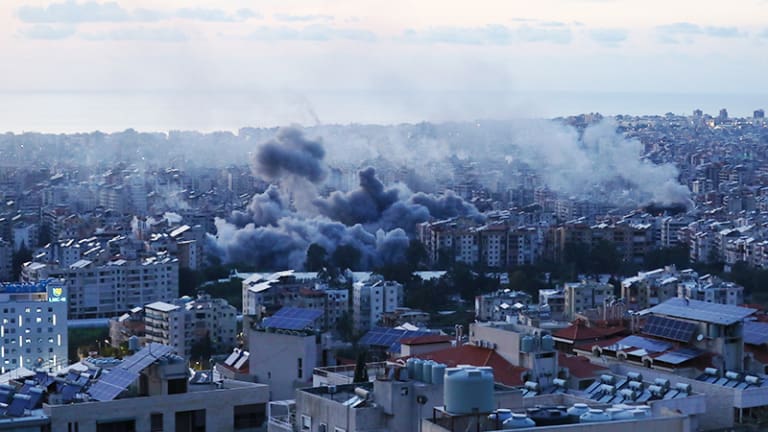
The widening of hostilities following the March 2026 US-Israeli attacks on Iran has placed Lebanon on a dangerous trajectory. Hezbollah’s decision to enter the fray in support of Iran has provoked large-scale Israeli strikes across Lebanon, including in densely populated civilian areas. Israeli ground incursions in the south, the rapid displacement of some 700,000 people from communities near the border and explicit Israeli warnings that entire districts, including Beirut’s southern suburbs, could face destruction have intensified fears that Lebanon may once again become the battlefield for broader regional struggles.
At the same time, the Lebanese state is facing a moment of profound internal tension. The government’s ban on Hezbollah’s military activities reflects a longstanding national debate about sovereignty and the state’s monopoly of force. Implementing this ban is fraught, particularly as the Lebanese Armed Forces (LAF) operate within a political system that has for years accommodated Hezbollah’s independent military power and fostered a culture of caution. So far, disarmament has proceeded guardedly, reflecting the LAF’s attempt to navigate a delicate balance between maintaining national stability and asserting state authority—an approach that critics argue is delaying decisive action.
The risks for Lebanon are evident. Military escalation threatens to devastate already fragile infrastructure, deepen displacement, and exacerbate the ongoing economic and humanitarian crisis. Political polarization could intensify, reviving narratives of sectarian enmity that have long troubled Lebanese society. Pressure from external actors, each pursuing different strategic objectives, worsens these domestic challenges. Amid these dangers, however, is the often-overlooked reality of Lebanese society’s capability for solidarity across sectarian divides. Today’s crisis thus may carry within it the seeds of a different kind of national response, one rooted in shared vulnerability and mutual support.
A Crisis at the Intersection of State and Non-State Power
The current escalation in Lebanon must be understood in the context of the country’s long struggle over sovereignty and the role of armed non-state actors. For decades, Hezbollah’s military capabilities have existed alongside state institutions, creating a complex political reality in which authority over war and peace is contested. Hezbollah supporters have framed the movement’s military power as a necessary deterrent against Israeli aggression; its critics argue that an autonomous armed force undermines state sovereignty and exposes Lebanon to regional conflicts beyond its control. These debates have only sharpened since March 2, 2026, when Hezbollah joined the US-Israel war with Iran by attacking northern Israel.
The Lebanese government’s March 2026 ban on Hezbollah’s military activities is one of its most significant political decisions, reflecting growing domestic and international pressure. But such declarations cannot immediately undo the fundamental imbalance of power that has defined Lebanon’s security order for decades. Hezbollah’s maintenance of a military capability beyond the authority of the state, as well as its extensive influence within key state institutions, has fundamentally constrained Lebanon’s sovereign decision-making power over war and peace, repeatedly exposing the country to regional confrontations. While successive governments have affirmed the state’s exclusive control over arms, a principle enshrined in law after the 1989 Taif Accords ending the civil war, they have largely failed to translate that rhetorical commitment into meaningful action. Implementing such a policy now requires both political will and enforcement capability.
The Lebanese Armed Forces remain central to any credible disarmament.
As years of economic deterioration and dysfunction have hollowed out many parts of Lebanon’s state, the LAF—one of the few official bodies that still enjoys broad national trust—remains central to any credible disarmament. But the army operates under acute financial and logistical constraints, relying heavily on foreign funding for its operations (with the United States as its main donor), and has been intent on preserving its cohesion and legitimacy in a polarized society. LAF commander General Rodolphe Haykal has repeatedly stressed that the army operates in a highly sensitive environment and must carry out its mission in a way that preserves “civil peace” and internal stability when implementing the state’s August 2025 decision to restore its monopoly over arms. His words can be interpreted as an indicator of unwillingness to undertake decisive action to disarm Hezbollah.
Israel’s Escalation and the Humanitarian Threat
Israel’s military response to Hezbollah’s March 2026 attack has dramatically raised the stakes. Israeli airstrikes have already caused significant civilian casualties and destroyed infrastructure across Lebanon. Israel issued urgent evacuation warnings for residential areas associated with Hezbollah, including Beirut’s southern suburbs, which it then bombed extensively—with grave implications given that these neighborhoods are home to hundreds of thousands of civilians. The attacks on densely populated districts have triggered mass displacement. Families have been stranded or forced to leave their homes and seek refuge in other regions of the country where they must fend for themselves. Municipalities, civil society organizations, and informal community networks have mobilized to provide shelter, food, and assistance. Already strained humanitarian resources risk being overwhelmed as Lebanon’s capital effectively becomes a new front line in the conflict.
Lebanon lacks the capacity to absorb large waves of displaced people. The country continues to grapple with the aftermath of one of the worst economic crises in modern history. Public services are limited, infrastructure is deteriorating, and large segments of the population already live under severe economic hardship. Further escalation will have consequences that extend far beyond the battlefield, likely triggering a broader humanitarian crisis, deepening social tensions, and increasing economic instability.
The Risk of Sectarian Fragmentation Versus Emerging Solidarity
Historically, periods of crisis in Lebanon often have been accompanied by sectarian mobilization. The May 2008 armed clashes in Beirut and Mount Lebanon over Hezbollah’s military communications network illustrated how quickly political disputes can be recast in sectarian terms that easily trigger violence. Political actors frequently have framed national challenges through the lens of communal identity, reinforcing narratives that portray one group’s security as incompatible with another’s. During the nationwide grassroots protests that erupted in October 2019, the leaders of several political movements, including Hezbollah, attempted to portray the protests’ demands for reform as a threat to their home communities, or as the product of foreign agendas, rather than what they were: a rare cross-sectarian mobilization against corruption across the entire political class. In 2021, tensions surrounding the 2020 Beirut port explosion investigation erupted into armed clashes in the capital’s Tayyouneh neighborhood, similarly demonstrating how quickly political disputes can be reframed through sectarian narratives and escalate into violence.
The current crisis could reignite such dangerous dynamics, but there are signs that Lebanese society is resisting this familiar trajectory. Public discourse has emphasized the shared costs of escalation, rather than sectarian blame, as criticism of Hezbollah for dragging the country into war has been common across many communities. As families flee South Lebanon to seek refuge elsewhere in the country, civil society networks and local volunteers from various groups have mobilized to provide assistance and to welcome them. Schools, community centers, and private homes have opened their doors, while municipalities and local organizations have coordinated shelter, food distribution, and other forms of emergency support despite limited resources. A new grassroots solidarity seems to be emerging.
As families flee South Lebanon to seek refuge, civil society networks and local volunteers have mobilized to provide assistance.
Such gestures may seem modest given the scale of the crisis. But they may signal a sense of shared vulnerability that could reshape how Lebanese society perceives itself. In the 2006 war between Israel and Hezbollah, hundreds of thousands of civilians displaced from southern Lebanon found refuge in other parts of the country, where local communities and religious institutions organized large-scale relief efforts in coordination with municipalities and humanitarian organizations. In the absence of a coordinated national response, local networks and volunteer initiatives played a crucial role in providing rapid assistance. In August 2020, similar patterns of civic mobilization after the Beirut port explosion saw volunteer groups, professional associations, and grassroots organizations organize rescue operations, debris removal, food distribution, and medical assistance, often acting more quickly than official state institutions. The nationwide protest movement that began in October 2019 likewise demonstrated the potential for cross-sectarian civic mobilization when protesters from different regions and communities gathered around shared demands for political reform and economic accountability, challenging entrenched sectarian narratives and highlighting the possibility of broader national solidarity.
Is this response evidence of the resilience of Lebanese civil society and its collective capacity to respond to national emergencies? It could well reflect a recurring pattern in Lebanon’s modern history: in moments when formal institutions struggle to respond effectively, local communities and civil society actors often step in to fill the gap. These forms of solidarity often operate independently of formal political structures and, in many cases, transcend sectarian or partisan affiliations. So, while sectarian politics continues to shape the country’s formal political system, episodes of crisis repeatedly reveal underlying social bonds rooted in mutual vulnerability.
This time, however, Lebanon’s grassroots solidarity movement is encountering a very different context. Lebanon is confronting a new military escalation as well as the cumulative effects of years of economic deterioration, political paralysis, and institutional depletion. (Lebanon’s financial crisis, according to the World Bank, ranks among the most severe globally since the mid-19th century, with profound social consequences across all communities.) In this environment, recognizing that instability affects all segments of society may reinforce the impulse toward cooperation. It is uncertain if this moment of solidarity can translate into more durable forms of social cohesion, but the responses across the country suggest that, even amid deep political disagreements, many Lebanese continue to recognize their shared stake in preventing further national fragmentation.
Social solidarity alone, of course, cannot resolve Lebanon’s underlying security challenge: restoring the state’s authority over decisions of war and peace. For decades, the coexistence of the state and a parallel non-state armed force has exposed Lebanon to regional confrontations beyond the government’s control. The current crisis has brought this dilemma into sharper focus. If the Lebanese state is to protect its citizens from recurring cycles of escalation, the principle of a single national authority over arms—long embedded in Lebanon’s constitutional framework and recently reiterated by the government—must become a reality.
A Different Future for Lebanon
Today Lebanon stands at a crossroads. The escalation triggered by regional conflict threatens to deepen the country’s already severe challenges. Military confrontation, mass displacement, and economic deterioration could push Lebanon into further instability. But the crisis has also revealed another dimension of Lebanese society, one that is defined by empathy, solidarity, and mutual support across communal lines.
Whether or not this solidarity becomes the foundation for a renewed national vision will turn on the choices made in the coming months. The Lebanese state must move beyond declarations and take credible steps toward reestablishing its sovereignty, including addressing Hezbollah’s parallel military apparatus. Here, political leaders must resist the temptation to instrumentalize fear and division; state institutions need to demonstrate their readiness to protect all citizens. Civil society has repeatedly shown its capacity for solidarity in times of crisis and must now continue to sustain cross-communal cooperation and to demand accountable governance.
Lebanon’s future stability largely will depend on whether this moment of shared vulnerability can be translated into a renewed commitment to a single national framework for security, sovereignty, and collective responsibility.
The views expressed in this publication are the author’s own and do not necessarily reflect the position of Arab Center Washington DC, its staff, or its Board of Directors.
Featured image credit: Shutterstock/Elie1993