
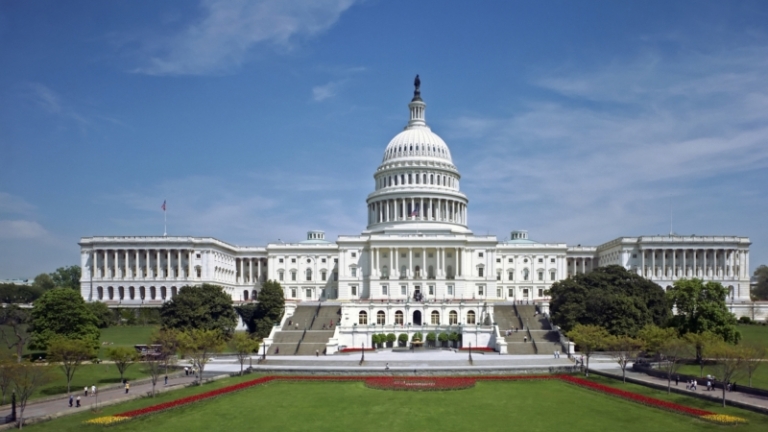
I. Legislative Branch
1) Legislation
Senate Resolution Seeks to Block Further US Military Action Against Iran Without Congressional Approval. On March 10, Sen. Tammy Duckworth (D-IL) introduced S.J.Res.123, another joint resolution seeking to block US military action against Iran not authorized by Congress.
Senate Bill Would Sanction Polisario Front Over Iran Ties. On March 11, Sen. Ted Cruz (R-TX) introduced S.4063, which would impose sanctions on the Western Sahara’s Polisario Front if it cooperates with an Iranian-affiliated organization.
Senate Resolution Calls for Federal Agents to Return to Primary Duties During Iran War. On March 11, Sen. Ruben Gallego (D-AZ) introduced S.Res.638, a resolution expressing the sense of the Senate that Department of Justice and Department of Homeland Security personnel temporarily assigned to civil immigration enforcement should return to their primary missions during periods of active hostility with Iran.
Bicameral Bill Seeks Investigation into Hind Rajab Killing. On March 12, Rep. Sara Jacobs (D-CA) introduced H.R.7903, which would require the Trump administration to investigate and hold accountable those responsible for killing five-year-old Hind Rajab, members of her family, and paramedics sent to rescue her in Gaza. The bill requires the administration “to provide comprehensive answers on the death of Hind and broader patterns of civilian harm in Gaza” and to “reassert the United States’ commitment to the Geneva Conventions and the prosecution of war crimes.” It also directs the Secretary of State and Attorney General to certify compliance with US war crimes laws and US “prohibitions on assistance to foreign security units credibly implicated in gross” human rights violations.
Sen. Peter Welch (D-VT) introduced companion legislation (S.4095) in the Senate.
House Resolution Seeks to Censure Rep. Ogles Over Anti-Muslim Comments. On March 12, Rep. Shri Thanedar (D-MI) introduced H.Res.1113 to censure Rep. Andrew Ogles (R-TN) for “spewing hatred and bigotry toward Muslim Americans and disrespecting America’s diversity,” citing recent posts on X in which Ogles wrote that “Muslims don’t belong in American society,” “pluralism is a lie,” and “Muslims are unable to assimilate; they all have to go back.” The resolution would also remove Ogles from the Homeland Security Committee.
2) Personnel and Correspondence
Lawmakers Worried About Possible US Troop Deployment in Iran. On March 10, in an interview with CNN, Sen. Jeanne Shaheen (D-NH) said that closed-door briefings on Iran with Trump administration officials had left lawmakers with more questions than answers, particularly regarding the cost and expected duration of the war and whether US forces could be deployed to Tehran. She also warned of the risks posed by Russian support for Iran’s military, saying that Moscow is already providing intelligence to Tehran.
Senate Democrats Raise Concerns Over Strike on Iranian Girls’ School. On March 11, Sens. Shaheen, Chris Van Hollen (D-MD), Tim Kaine (D-VA), Elizabeth Warren (D-MA), Brian Schatz (D-HI), and Chuck Schumer (D-NY), along with 40 other Senate Democrats, sent a letter to Secretary of War Pete Hegseth expressing “grave concern” about the February 28 strike on an Iranian girls’ school, amid preliminary findings from a US military investigation indicating that the United States was responsible. The lawmakers also criticized US and Israeli strikes on hospitals, cultural sites, civilian infrastructure, and Iranian cities.
On March 12, Reps. Sara Jacobs (D-CA), Jason Crow (D-CO), and Yassamin Ansari (D-AZ) led 121 other House Democrats in a letter to Secretary Hegseth demanding answers from the administration about the strike.
3) Hearings and Briefings
Senate Democrats Threaten to Obstruct Senate Business Over Iran War. On March 9, a group of Senate Democrats said that they would use procedural tactics to block Senate floor business unless senior administration officials, including Secretary of State Marco Rubio and Secretary of War Hegseth, testify under oath before the Senate Foreign Relations and Armed Services committees about the Iran war.
Last week, several of those senators introduced a series of War Powers resolutions and said that they plan to repeatedly force debate and votes on the measures, and possibly additional resolutions, on the Senate floor.
Pentagon: First Week of War Cost $11 Billion. In a March 10 closed-door briefing, Pentagon officials reportedly told lawmakers that the cost of the war on Iran had exceeded $11.3 billion in the first six days alone. According to the New York Times, the estimate does not include the full cost of the operation, such as the buildup of military hardware and personnel ahead of the initial strikes.
Senate Committee Holds Hearing on Foreign Influence in Higher Education. On March 12, the Senate Health, Education, Labor and Pensions Committee held a hearing on “exposing malign foreign influence in higher education.” Among the witnesses was Peter Wood of the National Association of Scholars, whose testimony included sections on “ideological capture through Middle East Studies Centers,” “the Boycott, Divestment, and Sanctions (BDS) Movement and Campus Networks,” and “Iranian Government Connections in Academia.”
II. Executive Branch
1) White House
Trump Speaks with Putin to Discuss Iran War. On March 9, President Trump spoke with Russian President Vladimir Putin to discuss the war in Iran. Putin’s foreign affairs adviser Yuri Ushakov said that Putin “voiced a few ideas aimed at a quick political and diplomatic settlement” following conversations with Gulf leaders and Iranian President Masoud Pezeshkian.
Trump Says Vance Was “Philosophically” Different on Iran. On March 9, President Trump said that Vice President JD Vance was “philosophically a little bit different” from him at the outset of the war but dismissed any notion of disagreement between the two. Trump noted that Vance was “maybe less enthusiastic about going,” but insisted that the decision to launch airstrikes alongside Israel was necessary, adding that “I felt it was something we had to do…I didn’t feel we had a choice.”
On March 13, Politico reported that Vance was skeptical of US strikes on Iran and had made his opposition known in the leadup to the operation.
Trump Says War Could End Soon, Leaves Door Open to Talks. On March 9, President Trump told Republican lawmakers that the war would be short-lived, calling it “a little excursion” to the Middle East “to get rid of some evil.” On March 10, Trump said that he was “not happy” with the selection of Mojtaba Khamenei as Iran’s new supreme leader, but left open the possibility of negotiations, saying he had heard officials in Tehran badly want to talk. Trump also asserted that Iran would have attacked the United States had he waited three more days to strike.
On March 11, Trump declared the war would end “soon,” claiming there was “practically nothing left to target” and that the initial campaign was planned as a six-week effort. He said that “the war is going great…We are way ahead of the timetable.” Israeli Defense Minister Israel Katz, however, insisted there was no time limit on the US-Israeli operation.
Trump Threatens Iran Over Strait of Hormuz; US Forces Destroy Minelaying Vessels. On March 9, President Trump warned that if Iran disrupts oil shipments through the Strait of Hormuz, it “will be hit by the [United States] TWENTY TIMES HARDER than they have been hit thus far,” adding that the United States could strike targets that would make it “virtually impossible” for Iran to rebuild. The following day, Trump warned of severe military consequences if Iran attempted to mine the waterway, and CENTCOM later confirmed that US forces had destroyed 16 Iranian minelaying vessels in the area.
On March 12, Trump claimed that the United States is benefiting from rising oil prices and added that his greater priority remains preventing Iran from obtaining nuclear weapons and destabilizing the Middle East.
Trump Says He’ll End Iran War When He “Feels It in My Bones”; Hegseth Claims Iran’s Leader Is “Wounded and Likely Disfigured.” On March 13, President Trump told Fox News that he did not think the war with Iran “would be long,” but said that it would end when he felt it “in [his] bones.” He also dismissed reports that the United States was facing a munitions shortage and wrote on Truth Social that US forces were destroying Iran’s military capabilities and had sufficient firepower, ammunition, and time to continue operations.
Trump also again downplayed potential economic consequences of the conflict, saying that the US economy was the greatest in the world and would “bounce right back, so fast.”
Earlier the same day, Secretary Hegseth criticized the press for what he described as unfriendly coverage of the war and claimed that Iran’s new supreme leader, Mojtaba Khamenei, was “wounded and likely disfigured.” He also suggested that some Arab states could join the US-Israeli strikes on Iran.
On March 14, Trump told NBC News that while Iran appeared ready to negotiate an end to the war, “the terms aren’t good enough yet.” He also questioned whether the Iranian leader is “even alive.”
Trump Calls for Allied Warships to Secure Strait of Hormuz After US Strikes on Kharg Island. On March 13, President Trump said on Truth Social that the US military had conducted a large bombing raid on Kharg Island, Iran’s key oil export hub. Trump said that the raid had “totally obliterated every MILITARY target” on the island but that the US attack spared vital oil infrastructure there “for reasons of decency.” He warned, however, that if Iran or anyone else interferes with ships passing through the Strait of Hormuz, he would reconsider his decision not to “wipe out the Oil Infrastructure.”
CENTCOM said that the operation struck more than 90 sites on Kharg Island, including naval mine storage facilities, missile storage bunkers, and other military targets.
The Wall Street Journal reported the same day that the Pentagon was deploying additional US Marines and warships to the Middle East to help protect shipping in the Strait of Hormuz, including an amphibious group and Marine expeditionary unit.
On March 14, Trump urged other countries to send warships to secure the Strait of Hormuz after Iran threatened retaliation for Washington’s bombing of the island. He wrote that “the Countries of the World that receive Oil through the Hormuz Strait must take care of that passage, and we will help — A LOT!” Trump also said he hoped that Britian, China, France, Japan, and South Korea would send warships to the strait.
On the same day, Trump told NBC News that the US strikes had “totally demolished” most of Kharg Island and warned that more attacks could follow, stating that “we may hit it a few more times just for fun.”
Meanwhile, the United States offered a reward of up to $10 million for information about senior Iranian military and intelligence officials, including the country’s supreme leader.
2) Department of State
Department Orders Evacuation of Nonessential Staff from Missions in Saudi Arabia and Turkey. On March 9, the Department of State ordered the departure of US nonessential personnel and their families from diplomatic missions in Saudi Arabia and from the US consulate in Adana, Turkey.
Department to Designate Sudanese Muslim Brotherhood as Foreign Terrorist Organization. On March 9, the Department of State announced the designation of the Sudanese Muslim Brotherhood (SMB) as a Specially Designated Global Terrorist entity and said that it plans to designate the group as a Foreign Terrorist Organization on March 16.
The SMB, which includes the Sudanese Islamic Movement and its armed wing the al-Baraa Bin Malik Brigade, was accused of receiving support from Iran’s Islamic Revolutionary Guard Corps and carrying out “mass executions of civilians.”
Rubio Speaks with German Foreign Minister and Iraqi Prime Minister. On March 9 and 12, Secretary Rubio spoke with German Foreign Minister Johann Wadephul to discuss Iran.
On March 9, Rubio also spoke with Iraqi Prime Minister Mohammed Shia’ al-Sudani, condemning attacks by Iran and Iran-aligned militia groups in Iraq, including in the Iraqi Kurdistan Region. The officials also stressed the need for the Iraqi government to safeguard US diplomatic personnel and facilities.
Rubio Speaks with Saudi Foreign Minister and British Foreign Secretary. On March 10, Secretary Rubio spoke with Saudi Foreign Minister Faisal bin Farhan Al Saud, condemning Iran’s attacks on Saudi Arabia and discussing ways to strengthen the kingdom’s defenses. On the same day, Rubio spoke with British Foreign Secretary Yvette Cooper to discuss Iran.
3) Department of War
CENTCOM Warns Iranian Civilians to Avoid Ports Along Strait of Hormuz. On March 11, CENTCOM warned civilians to avoid ports it said are used by the Iranian regime along the Strait of Hormuz “to conduct military operations that threaten international shipping.”
CENTCOM Confirms Use of “Advanced AI Tools” in War Against Iran. On March 11, CENTCOM commander Adm. Brad Cooper said that artificial intelligence is helping US forces process vast amounts of data, adding that “humans will always make final decisions on what to shoot and what not to shoot and when to shoot.”
AFRICOM Conducts Strikes in Somalia. On March 11, US forces conducted an airstrike against al-Shabab in Somalia.
US Refueling Aircraft Crash in Iraq; Others Reportedly Damaged in Saudi Arabia. On March 12, CENTCOM said that rescue efforts were underway after a US KC-135 refueling aircraft crashed in Iraq during Operation Epic Fury, stating that “this was not due to hostile fire or friendly fire.” On March 13, CENTCOM confirmed that all six crew members aboard the aircraft had died.
On March 14, the Wall Street Journal reported that five US Air Force refueling planes were damaged in an Iranian missile strike at Prince Sultan Air Base in Saudi Arabia. President Trump called the report “fake news” on Truth Social, saying that the “planes were not ‘struck’” and that four of the five aircraft “are already back in service.”
4) Department of the Treasury
Treasury Sanctions Charities It Says Fund Hamas. On March 12, the Department of the Treasury’s Office of Foreign Assets Control sanctioned four charities in Turkey and Indonesia that it said “directly fund” Hamas.