
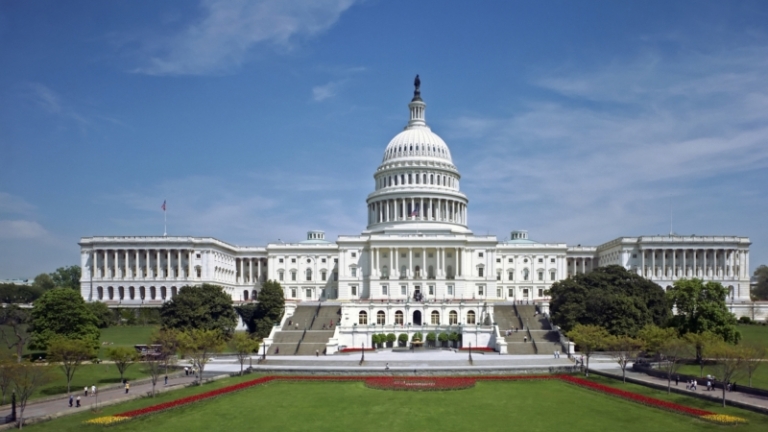
I. Legislative Branch
1) Legislation
House Resolution Condemns Israeli Settlement Expansion. On March 2, Rep. Ro Khanna (D-CA) introduced H.Res.1092, which condemns Israeli settlement expansion, settler violence, and related human rights abuses in the occupied West Bank.
House and Senate Reject War Powers Resolutions. On March 5, the House rejected H.Con.Res.38, the Khanna-Massie War Powers resolution, on a 212–219 vote, largely along party lines. A similar resolution failed to advance in the Senate the previous day, after a 47–53 vote.
House Democrats Introduce Alternative War Powers Resolution. On March 4, Rep. Josh Gottheimer (D-NJ) introduced H.Con.Res.75, a new war powers resolution that calls for an end to military operations in Iran within 30 days unless Congress provides authorization for the use of military force or a declaration of war.
House Resolution Reaffirms Iran as Largest State Sponsor of Terrorism. On March 4, Rep. Brian Mast (R-FL) introduced H.Res.1099 reaffirming that Iran remains the largest state sponsor of terrorism. The resolution passed the House on March 5, with 53 House Democrats voting against it.
Senate Democrats Introduce Series of War Powers Resolutions. On March 5, several senators introduced joint War Powers resolutions seeking to block US military action against Iran. The measures include S.J.Res.114 introduced by Sen. Tammy Baldwin (D-WI), S.J.Res.115 and S.J.Res.116 introduced by Sen. Christopher Murphy (D-CT), S.J.Res.117 introduced by Sen. Adam Schiff (D-CA), and S.J.Res.118 introduced by Sen. Cory Booker (D-NJ).
2) Personnel and Correspondence
House Democrats Demand Answers on Iran War. On March 3, Rep. Gregory W. Meeks (D-NY), Rep. Adam Smith (D-WA), Rep. Jim Himes (D-CT), Rep. Rosa DeLauro (D-CT), and Rep. Betty McCollum (D-MN) sent a letter to Secretary of War Pete Hegseth, Secretary of State Marco Rubio, CIA Director John Ratcliffe, and Chairman of the Joint Chiefs of Staff Gen. Dan Caine seeking information about US military operations against Iran.
Senate Democrats Press Administration for Accountability for Death of US Citizen in West Bank. On March 5, Sen. Chris Van Hollen (D-MD) led 30 other Senate Democrats in a letter to Secretary Rubio, Attorney General Pam Bondi, and US Ambassador to Israel Mike Huckabee pressing the administration for accountability and an investigation into the death of Nasrallah Abu Siyam, an American citizen who was shot and killed in the occupied West Bank by Israeli settlers on February 18.
Senate Democrats Say Administration Unprepared for Iran War Risks. On March 5, Sens. Jeanne Shaheen (D-NH), Chris Murphy (D-CT), Tim Kaine (D-VA), Jeff Merkley (D-OR), Cory Booker (D-NJ), Chris Van Hollen (D-MD), Tammy Duckworth (D-IL), and Jacky Rosen (D-NV) sent a letter to Secretary Rubio raising concerns about the administration’s “clear lack of preparedness for the predictable risks [the Iran war] would create for our personnel and assets abroad.”
House Democrats Request Investigation into Religious Justifications for Iran War. On March 6, Reps. Jared Huffman (D-CA), Jamie Raskin (D-MD), and Chrissy Houlahan (D-PA) led 27 other House Democrats in a letter to Department of Defense Inspector General Platte Moring III requesting an investigation into reports that US servicemembers filed anonymous complaints about military commanders “invoking religious prophecy and apocalyptic theology” to justify US military actions in Iran.
3) Hearings
Senators Question Iran War Strategy. On March 3, the Senate Armed Services Committee held a hearing on the Department of War’s 2026 National Defense Strategy. Several senators—including Mark Kelly (D-AZ), Elizabeth Warren (D-MA), Angus King (I-ME), and Jeanne Shaheen (D-NH) — pressed Under Secretary of War for Policy Elbridge Colby about the administration’s justification for the war against Iran.
II. Executive Branch
1) White House
Trump, Rubio Push Back on Narrative that Israel Forced US Hand on Iran. Last week, the Trump administration offered shifting and sometimes contradictory explanations for the operation. On March 2, President Donald Trump and Secretary of War Hegseth framed the war as a response to the threat posed by Iran’s missile and nuclear programs.
Trump’s stated timeline for the conflict has also shifted—from “four weeks, or less” to four to five weeks to an open-ended commitment tied to achieving objectives. On Truth Social, Trump claimed that US munitions stockpiles have “never been higher or better” and suggested that wars could be fought “forever” with existing supplies. He also left open the possibility of US ground troops.
The administration has also given conflicting accounts of how the war began. On March 3, Trump said that he believed Iran was preparing to attack first and suggested that he “might” have forced Israel’s hand to launch attacks on February 28. That differed from Secretary Rubio’s remarks the previous day, when he told reporters that the United States “knew that there was going to be an Israeli action, we knew that that would precipitate an attack against American forces, and we knew that if we didn’t preemptively go after them before they launched those attacks, we would suffer higher casualties.”
Rubio later backtracked on his suggestion that the United States entered the war on Israel’s behalf, stating that “I was asked very specifically…did we go in because of Israel? And I said no… this had to happen anyway.”
Trump Says “Big Wave” in Iran War Yet to Come. On March 2, President Trump told CNN that the US military is “knocking the crap” out of Iran but that the “big wave” is yet to come.
On Truth Social, Trump said that if he had not terminated “Obama’s horrendous Iran Nuclear Deal (JCPOA), Iran would have had a Nuclear Weapon three years ago.” A few hours later, he lashed out at “Radical Left Democrats” who opposed his decision to proceed with the US-Israel attacks on Iran.
United States to Insure Strait of Hormuz Shipping. On March 3, President Trump announced that the US Development Finance Corporation will offer insurance to ships in the Gulf after Iran largely shut down traffic through the Strait of Hormuz. He added that the US Navy will escort tankers through the strait if necessary.
Trump Criticizes UK, Threatens Spain Over Refusal to Allow Use of Military Bases in Iran War. On March 3, President Trump said he was upset with British Prime Minister Keir Starmer for initially not allowing the United States to use British bases to attack Iran.
Trump also said that the United States would cut off all trade with Spain after the country refused to allow the US military to use its bases for operations against Iran.
On March 7, Trump said that he rejected the United Kingdom’s reported offer to send two aircraft carriers to the Middle East, saying that “we don’t need people that join Wars after we’ve already won!”
Trump Says He Must Be Involved in Choosing Iran’s New Leader; Demands Iran’s Surrender. On March 5, President Trump said that he must be involved in choosing Iran’s next leader, and that appointment of the son of the late Ali Khamenei, Mojtaba Khamenei, would be “unacceptable” to him.
On March 6, Trump said that there would be no deal with Iran absent its “unconditional surrender.” He added that after Iran’s surrender, “and the selection of a GREAT & ACCEPTABLE Leader(s),” the United States and its allies would help rebuild Iran, making it “economically bigger, better, and stronger than ever before.”
On March 7, Trump warned that Iran would be “hit very hard,” a warning that came after Iranian President Masoud Pezeshkian rejected Trump’s demand for “unconditional” surrender.
The following day, Trump told the Times of Israel that the decision to end the war with Iran would be a “mutual” one with Israeli Prime Minister Benjamin Netanyahu.
Trump, Hegseth Say Iran, Not US, Bombed Girls’ School; Trump Opposes Kurdish Forces Joining War. On March 7, President Trump said that the United States was not responsible for a strike that killed more than 170 people at a girls’ school in Iran, instead blaming Iran. When pressed by a reporter on whether Trump’s assessment was accurate, Secretary Hegseth said that the Pentagon was “investigating,” adding that “the only side that targets civilians is Iran.”
Trump also told reporters he did not want Kurdish forces from Iraq to join the war against Iran, despite previously supporting the idea.
2) Department of State
Department Urges US Citizens to Leave 14 Middle Eastern Countries Amid Iran War. On March 2, the Department of State urged US citizens to leave 14 countries across the Middle East. US citizens were initially urged to leave “using available commercial transportation, due to serious safety risks.” However, the following day, the Department of State announced that it had begun facilitating charter flights from the United Arab Emirates, Saudi Arabia, and Jordan for US citizens and would “continue to secure additional capacity as security conditions allow.”
The Department also said it had ordered all non-emergency US personnel and their families to depart Bahrain, Iraq, Jordan, Kuwait, Qatar, and the United Arab Emirates.
Rubio Speaks with Regional Foreign Ministers on Iran Developments. On March 4, Secretary Rubio spoke with Italian Foreign Minister Antonio Tajani, Cypriot Foreign Minister Constantinos Kombos, Turkish Foreign Minister Hakan Fidan, and Saudi Foreign Minister Faisal bin Farhan Al Saud to discuss developments in Iran and the broader Middle East. Rubio also affirmed that attacks on Turkey’s sovereign territory were unacceptable and pledged full support from the United States.
On March 5, Rubio spoke with Egyptian Foreign Minister Badr Abdelatty to thank Egypt for its support in helping US citizens return home through Egypt and to discuss Iran and other regional developments. Rubio also spoke with Kuwaiti Foreign Minister Jarrah Jaber Al-Ahmad Al-Sabah, conveying his condolences for the loss of two members of the Kuwaiti Armed Forces and others who were killed or injured.
United States Condemns Iranian Drone Attack on Azerbaijan. On March 7, the Department of State released a statement condemning an Iranian drone attack on March 5 in Azerbaijan.
Department Bypasses Congressional Review to Approve Munitions Sale to Israel. On March 8, the Times of Israel reported, citing US officials, that the administration bypassed Congress by invoking emergency authority to expedite the sale of more than 20,000 bombs to Israel worth about $650 million. In a March 6 press release, the Department of State said Secretary Rubio determined that “an emergency exists that requires the immediate sale” to Israel of 12,000 large bombs for an estimated cost of $151.8 million. The sale also reportedly includes 10,000 additional bombs and 5,000 small-diameter bombs, along with related services and accessories valued at more than $500 million.
On March 6, Rep. Gregory Meeks (D-NY) said that Rubio’s use of emergency authority to bypass congressional review showed a lack of preparation for the war with Iran.
3) Department of War
Hegseth Says Iranian Regime Is “Toast.” On March 4, Secretary Hegseth said that the United States would have complete, uncontested control of Iranian airspace within days. He added that “we are just getting started,” and said that the Iranian regime is “toast, and they know it.”
Hegseth also said that a US strike had killed the Iranian official whom the Trump administration says ran the 2024 assassination plot.
Bahrain, United Kingdom, United States Hold Security Meeting on Iran. On March 5, representatives from Bahrain, the United Kingdom, and the United States held a meeting of the Comprehensive Security Integration and Prosperity Agreement Defence Working Group to discuss Iran and the regional security environment.
CENTCOM Warns Iran Civilians to Stay Home Amid Continuing Airstrikes. On March 8, CENTCOM issued a safety warning urging civilians in Iran to remain at home as US and Israeli airstrikes continued.
III. Judicial Branch
Judge Blocks DeSantis’s Declaration of CAIR as Terrorist Organization. On March 4, a federal judge in Florida ruled that Florida Governor Ron DeSantis’s move to declare the Council on American-Islamic Relations a terrorist organization was unconstitutional and violated the group’s First Amendment rights.
IV. Other
Newsom Calls Israel an Apartheid State. On March 5, California Governor Gavin Newsom, a likely 2028 Democratic presidential contender, said that the United States should reconsider its military support for Israel, which he described as an apartheid state.