
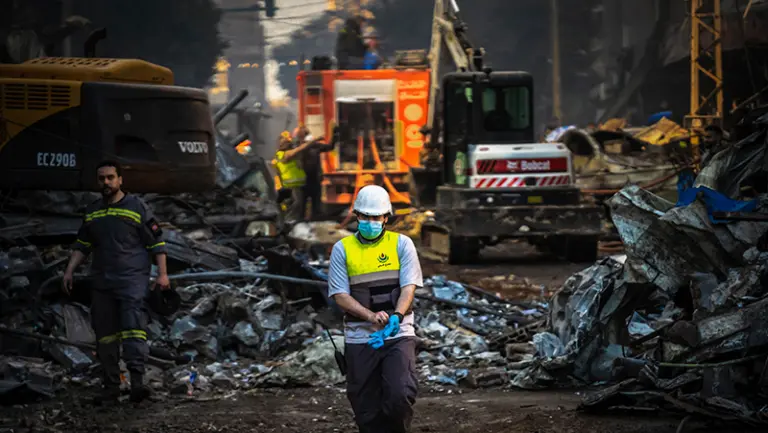
Following the expansion of its ground operations in South Lebanon in late March 2026, Israel has significantly intensified airstrikes across the country, including on central Beirut and other densely populated areas, killing over 1,700 people since Hezbollah first targeted Israel following the US-Israeli war on Iran, which began on February 28. Israel’s military campaign in Lebanon has now displaced over a million civilians and extensively damaged critical infrastructure.
The US clearly sees Israel’s operations in Lebanon as distinct from its conflict with Iran. President Trump reportedly said that Lebanon was not included in the two-week conditional ceasefire that began on April 8, 2026, and that Israel’s bombing of Lebanon was part of a “separate skirmish.” His comments coincided with a day in which a massive Israeli aerial attack killed more than 250 people in Lebanon. These developments have contributed to a growing sense that Washington considers Lebanon’s stability and humanitarian situation to be subordinate to wider regional considerations. Israel’s stated objectives in Lebanon go beyond repelling Hezbollah from the south and destroying its military capabilities to include bombing previously safe areas of the country further north. On March 31, 2026, Israeli Defense Minister Israel Katz announced plans to demolish entire towns, prevent residents from returning, and occupy South Lebanon indefinitely.
The Trump administration’s position suggests an alignment with Israel’s approach, particularly as Washington emphasizes the need to degrade Hezbollah while offering relatively limited public concern for the humanitarian implications of the conflict. While US and Israeli priorities may overlap in their focus on limiting Hezbollah, the adverse consequences of their actions on Lebanon’s stability call for a different approach. The US could pursue its goals more effectively by supporting the Lebanese government to disarm non-state militias, alongside actively promoting de-escalation and a sustainable ceasefire to prevent the further destabilization of Lebanon.
Understanding US Policy
The United States has historically viewed Lebanon’s stability as a strategic interest. A collapse of the Lebanese state would risk creating a vacuum that could be exploited by non-state actors such as Hezbollah and US adversaries, or even transnational militant networks such as the so-called Islamic State or groups linked to al-Qaeda. Instability in Lebanon carries implications for regional security, refugee flows, and broader geopolitical dynamics. Reflecting these priorities, the United States has provided more than $3 billion in security support to the Lebanese Armed Forces (LAF) since 2006 and some humanitarian aid in the years since the onset of Lebanon’s financial crisis. (The Trump administration continued some security assistance to the LAF but has scaled back much other aid to Lebanon). The scale of the current crisis, however, suggests that the United States needs to become more engaged with supporting a stable Lebanon.
The scale of the current crisis suggests that the US needs to become more engaged with supporting a stable Lebanon.
In recent years, Washington’s policy toward Lebanon has been characterized by two interconnected objectives: supporting Lebanese state institutions and countering Hezbollah’s influence. Washington has heavily invested in strengthening the LAF as a national institution, but has also maintained maximum pressure on Hezbollah, which it long ago designated as a terrorist organization. This dual-track approach reflects an attempt to reinforce state authority, especially the LAF, while constraining non-state armed actors with the broader goal of promoting a stable and independent Lebanon with greatly reduced Iranian influence and a Hezbollah unable to threaten Israel and US interests.
The current round of Israel’s confrontation with Hezbollah exposes the challenge of pursuing these goals. Israel’s objective is to neutralize Hezbollah’s military threat, which involves degrading the group’s missile and drone capabilities, pushing its forces away from the border, and preventing the group from reestablishing itself in South Lebanon. Israel has sought to redraw the map in the south through ground operations that may involve long-term security arrangements, which Israeli officials have described as a “buffer zone” that would essentially revive the Israeli military occupation of South Lebanon that existed from 1982 to 2000 and in opposition to which Hezbollah was originally established.
Washington’s objective of degrading and disarming Hezbollah aligns, in part, with Israeli objectives. While Israel has used expansive military operations to alter the balance of power on the ground, at least during the Biden administration, the United States emphasized the importance of preserving Lebanese state institutions and avoiding outcomes that could lead to state collapse or prolonged instability.
This distinction is critical because efforts to degrade Hezbollah’s capabilities through large-scale military action inevitably carry broader negative consequences for Lebanese territory and civilians. Hezbollah is integrated within populated areas and the Lebanese state has only limited capacity to assert control across all of its territory. The challenge for US policy lies in supporting Lebanese efforts to disarm Hezbollah, but in a way that does not cause major instability.
Hezbollah is integrated within populated areas and the Lebanese state has only limited capacity to assert control across all of its territory.
The devastating humanitarian impact of Israel’s military campaign against Hezbollah complicates the situation. Israeli airstrikes and evacuation orders have displaced an estimated one million people, primarily from South Lebanon, the Bekaa Valley, and Beirut’s southern suburbs. Many sought safety in Beirut, Mount Lebanon, and North Lebanon, where the more than 600 government-designated public shelters were rapidly overwhelmed. The scale of destruction has been significant. Entire residential areas have been damaged or destroyed, particularly in the south and in densely populated urban areas, alongside critical infrastructure including roads and bridges. The targeting of key infrastructure has further complicated relief efforts and access to basic services.
This mass displacement strains host communities and local institutions. Although municipalities, civil society organizations, and individuals have worked to accommodate displaced people, the sudden influx has already stretched limited resources and in some areas generated tensions given local concerns about the potential presence of Hezbollah members among those displaced.
In terms of US interests, a prolonged humanitarian crisis in Lebanon would not only exacerbate suffering, but also would undermine prospects for the country’s stability, which should be a major US concern.
The Disarmament Dilemma
At the core of the current Israel-Hezbollah conflict lies the question of Hezbollah’s arms. In January 2025 the Lebanese government committed to a US-backed, multi-stage process to reassert state sovereignty by dismantling unauthorized weapons and military infrastructure, particularly in South Lebanon. In August 2025, the cabinet tasked the LAF with implementing this plan.
In the first phase, the army expanded its deployment south of the Litani River to establish greater territorial control. In January 2026, the LAF commander declared this phase largely complete and outlined a second phase to extend state authority farther north. Subsequent progress was contested. Hezbollah rejected disarmament, which it argued was externally driven and incongruent with its mission to confront Israel. Yet divisions within the Lebanese government prevented a unified approach: Some elements supported a gradual or negotiated path, and others sought to avoid direct confrontation. Among the wider public, many Lebanese, especially those from Shia communities, are also wary of disarmament implemented under external pressure or ongoing attack from Israel. At the institutional level, the widely respected LAF needs to balance its mandate to enforce state authority with that of preserving internal stability and avoiding a direct confrontation that could fracture its ranks or trigger wider conflict.
Many Lebanese are wary of disarmament implemented under external pressure or ongoing attack from Israel.
The Lebanese state is in an untenable position. The government has officially banned Hezbollah’s military activities, but disarmament has been only partial. The LAF has expanded its presence in South Lebanon and seized some former Hezbollah positions and weapons caches, but has not tackled Hezbollah’s broader military infrastructure, command structure, or strategic weapons capabilities. At the same time, Hezbollah continues to evade full disarmament. Since the 2024 ceasefire, which UN monitors said Israel violated 10,000 times in two years, Hezbollah has actively rebuilt its military capabilities, with support from Iran’s Islamic Revolutionary Guard Corps. These moves included replenishing missile and drone stockpiles and reorganizing its command structure to operate in a more decentralized and resilient manner. The core issue of demobilizing a parallel armed force operating outside the authority of the state remains unresolved by the Lebanese government.
The Lebanese state is formally committed to restoring its monopoly over arms but is unable to enforce that commitment against a powerful non-state actor that continues to operate, rearm, and engage in regional conflict. It has become even more difficult for the LAF to do this while the country is under attack by Israel. The gap between the government’s objectives and its capabilities is significant in the context of Israeli plans to re-occupy south Lebanon. Israel argues that the failure of the Lebanese state to disarm Hezbollah justifies its reoccupation of South Lebanon. Hezbollah’s decision to rearm and to attack Israel has drawn the country deeper into confrontation and retaliation.
This dynamic puts all parties in a strategic bind. Hezbollah’s actions expose Lebanon to escalation while seemingly giving fodder to Israeli arguments; Israel’s military response weakens the Lebanese state and reduces its ability to assert authority over Hezbollah; and the Lebanese government, constrained by both internal divisions and limited capacity, struggles to translate its commitments into action.
While Washington continues to provide security assistance to the Lebanese Armed Forces and remains a significant humanitarian partner, US policy is focused now on degrading Hezbollah rather than on stabilizing Lebanon. This emphasis has contributed to a perception of US disengagement, particularly given the scale of the current crisis and the absence, so far, of US public expressions of concern about the humanitarian crisis unfolding in the country and the scale of Israel’s attacks. As long as the gap between state authority and reality persists, and as long as Hezbollah retains the capacity to operate independently of the state, Washington is unlikely to re-engage in a more sustained fashion.
The Need for US Caution
By retaining and actively rebuilding its military capabilities, and by engaging in regional conflict, Hezbollah has repeatedly exposed Lebanon to escalation while undermining the state’s ability to exercise sovereign control over decisions of war and peace. The Lebanese state’s failure to enforce its own commitments has compounded this dynamic. Formal declarations regarding the restoration of exclusive state authority over arms have not been matched by effective implementation. In this context, continued US support for Lebanese state institutions, especially the LAF, must be paired with clearer expectations for restoring state authority. Greater clarity in US public messaging during this war would also help shore up the perception that Lebanon’s stability, including the protection of civilians and infrastructure, is indeed a strategic objective for Washington.
US support for the LAF’s disarmament of Hezbollah must be sensitive to the significant challenges that the Lebanese state faces in pursuing this goal. A more forceful effort by the LAF to confront Hezbollah directly could trigger internal conflict in Lebanon, strain the cohesion of the army, and deepen sectarian divisions, particularly in a context of economic fragility and ongoing attacks from Israel. This prospect raises questions about both the feasibility and the potential costs of accelerated disarmament. For this reason, restoring state authority over arms cannot be achieved through coercion alone but requires a gradual approach that combines security consolidation, political consensus, and improved state capacity. US support for the LAF should therefore be understood not as an endorsement of immediate confrontation, but as part of a longer-term effort to strengthen institutions.
A Way Forward
Asking whether the United States has deprioritized Lebanon in favor of Israel reflects broader concerns about the direction of US policy in the Middle East. Although reality is always complex, perceptions matter and are shaped not just by US actions, but by dynamics inside Lebanon. Hezbollah’s decision to revitalize its military strength and to engage militarily have once again exposed Lebanon to regional conflict—and the Lebanese state’s inability to translate its commitments into effective authority has reinforced a gap between sovereignty in principle and sovereignty in practice.
As long as the question of Hezbollah’s arms remains unresolved, Lebanon will continue to be shaped by forces outside its control. This does not imply that a direct confrontation between the LAF and Hezbollah would offer a path to stability. Such a scenario could carry significant risks, including civil war and fragmenting the army, one of the country’s few remaining respected national institutions. The challenge for the United States is to support conditions for gradually and sustainably extending the authority of the state.
Lebanon’s future depends in part on whether its leadership is willing, and able, to move beyond the rhetoric and effectively restore the government’s authority over decisions of war and peace. Consolidating state authority will necessarily require neutralizing Hezbollah’s forces, restoring institutional capacity, and addressing communities such as the Shia that have not been adequately integrated into the state. The “day after” disarmament needs to be managed by a government able to provide credible security, governance, and economic stability across regions and communities. Without that, any gains in restoring the authority of the state may prove fragile.
The views expressed in this publication are the author’s own and do not necessarily reflect the position of Arab Center Washington DC, its staff, or its Board of Directors.
Featured image credit: Photo by NAEL CHAHINE / MIDDLE EAST IMAGES / MIDDLE EAST IMAGES VIA AFP