
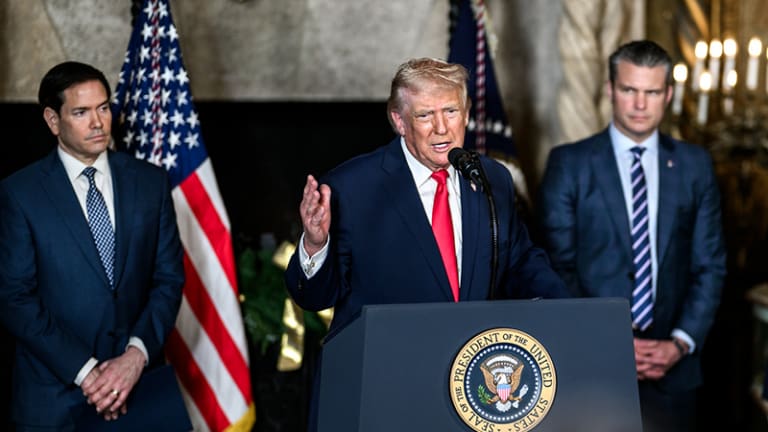
US President Donald Trump proclaimed total victory over Iran in his Oval Office address on April Fools’ Day, saying, “We’ve beaten and completely decimated Iran. They are decimated both militarily and economically and in every other way…the country has been eviscerated and essentially is really no longer a threat.” Yet for reasons best known to him, the Iran war is still not over. “We are going to finish the job and we’re going to finish it very fast,” said Trump. “We’re getting very close… over the next two to three weeks. We’re going to bring them back to the Stone Ages, where they belong.”
Americans—and others around the world—are right to be confused. If Iran has been decisively beaten, why do hostilities need to continue? Has Trump’s ever-evolving rationale for the war—for which he and members of his administration have provided numerous different versions—now come to include the civilizational destruction of Iran, as his “Stone Ages” quip seems to suggest? (The answers would appear to be yes.) Will Trump’s latest deadline for Tehran to reopen the Strait of Hormuz provide an exit ramp from “that little journey to Iran,” as he flippantly put it? Where does the war end—and how does the Trump administration know when it has achieved its goals? Without clear war aims, the conflict’s endpoint will be determined not by strategy but by the cross-pressures now bearing on the president—and by the off-ramps he chooses to take, or to ignore.
Is Trump Feeling the Pressure?
If President Trump is not feeling pressure from Congress over the war, he surely is feeling it from the American public as households start to absorb the economic effects of Iran’s closure of the Strait of Hormuz to “hostile” vessels. Prior to the war, some 20 percent of the world’s oil and gas freely transited through the Strait. Since the war began on February 28, 2026, the average price of a gallon of gasoline has risen to $4.02 nationally, the highest since 2022. Beyond the price at the pump, downstream effects are already being felt. A study by Purdue University’s Center for Commercial Agriculture notes that the energy shock “propagates through every link of the food supply chain at once…all face simultaneous cost pressure,” hiking up consumer prices that will come down only slowly. Goldman Sachs estimates that the energy crisis will boost the US inflation rate to more than 3 percent by the end of 2026, curbing economic growth and raising the odds of a recession to 30 percent over the next year.
Americans are understandably concerned. An Associated Press (AP) poll published on March 25, 2026, found that 59 percent of Americans think US military action against Iran has been “excessive.” Another report found that slightly over 60 percent of Americans disapprove of Trump’s handling of the war, with about the same percentage saying that the United States made the wrong decision to use military force.
Fifty nine percent of Americans think US military action against Iran has been “excessive.”
That said, polling also shows that a large majority of Republican voters support the Iran war. As long as his base sticks with him, Trump is unlikely to be swayed by pressure from sinking poll numbers among Democrats and independent voters. This is especially true if Congress, through whom public discontent should be channeled, remains largely supine. While Democratic lawmakers have spoken out strongly against Trump’s refusal to obtain congressional approval for the war, Republicans have remained mostly quiet and pushed back against Democratic calls for public hearings on the war despite increasing alarm over Republicans’ prospects in the November 2026 midterm elections. Fear of crossing Trump and his very loyal base of voters is a major factor keeping down Republican opposition.
Is the US Military Wavering?
If the US military leadership has misgivings about the war and Trump’s conduct of it, they are concealing it well. Operation Epic Fury has been conducted with great operational success so far. Pressure from Secretary of War Pete Hegseth and fear of being purged may motivate military leaders to keep their heads down instead of telling Trump what he does not want to hear. (The Army chief of staff, General Randy George, who was recently fired by Hegseth, is the latest head on a pike to serve as a warning to others). Hegseth himself remains largely a cheerleader and sloganeer, but does not appear to be playing a significant role either in the war’s strategy and conduct, or in defining the conditions that would allow the United States to declare victory and conclude combat operations.
Beneath the surface, however, there are anecdotal indications of rising discontent with the Iran operation in the military rank and file. One organization that works with would-be conscientious objectors in the armed forces reported a 1,000 percent increase in the number of service members who contacted it in March 2026 compared to the previous month. But so far there is no indication that this trend is influencing Trump’s decision-making.
Feeling It in His Bones: Possible Exit Strategies
Ultimately, no pressure point is persuasive to the president given his unshakable belief in the rectitude of his own instincts. Despite all the various timelines for ending the war that he and members of his administration have proposed, the only one that matters, as Trump told Fox Radio on March 13, 2026, is “when I feel it, feel it in my bones.” Trump is no doubt aware that by most of the metrics that he touts as a measure of his presidential effectiveness—the stock market, inflation, and consumer and gasoline prices—his administration is in trouble. The war is also a major drag on the Republican brand. Hence Trump’s constant reiteration that the war will be over “shortly, very shortly,” as he claimed on April 1—although that time frame shifts constantly.
However confident he seems in public, at this point Trump may seek an off-ramp sooner rather than later. The assorted rationales offered for the president’s war of choice provide numerous opportunities to do just that: The president could pick any one and use it, more or less plausibly, to make an exit.
Trump could, for example, focus attention on Epic Fury’s considerable military accomplishments and make a persuasive case that the achievements that he has claimed—destruction of the Iranian Navy and decimation of Tehran’s air force and ballistic missile capabilities—have significantly degraded Iran as a military power. While the particulars of such claims are open to question—much of Iran’s missile launch capacity and its armed drone arsenal reportedly remain intact, for example—the specifics may be easily glossed over by an administration looking for a way out.
The president could also point to the heavy damage that the US-Israeli campaign has inflicted on Iran’s nuclear program, in both their June 2025 attacks and the current campaign. In November 2025, the Institute for Science and International Security noted that after last summer’s war:
Iran’s uranium enrichment program had been significantly set back. At present, Iran does not appear able to enrich uranium in any significant manner or make gas centrifuges in significant numbers. Iran’s key nuclear enrichment facilities, its facility to produce uranium hexafluoride (UF6) and its centrifuge manufacturing and research and development facilities remain severely damaged or destroyed.
While a few additional strikes on Iran’s nuclear facilities have occurred during this current war, most of the damage was done in June 2025, since which time Iran reportedly has done little to excavate the remnants. Nevertheless, the Trump administration could choose to conflate the results of the two operations to assert that the destruction of Iran’s nuclear program is a goal achieved.
Regime change, another objective occasionally cited by the president, could also afford an off-ramp from this war. Trump has taken to proclaiming that, with the US-Israeli assassination of Supreme Leader Ayatollah Ali Khamenei and several second- and third-echelon officials, regime change is complete. During a March 29, 2026, flight on Air Force One, Trump told reporters that “the one regime was decimated, destroyed. They’re all dead. The next regime is mostly dead,” (apparently meaning the replacements for the Supreme Leader and other top officials). He added that Iran was now on to a “third regime,” which was “very reasonable.” Two days later he told ABC News that “we have complete regime change now” and that the United States is conducting negotiations with leaders who are “more moderate” and “much more reasonable.” He cited contacts with Mohammad Bagher Ghalibaf, the speaker of the parliament and a known hardliner with close ties to the Islamic Revolutionary Guard Corps, as a principal point of contact (the Iranian regime denies this).
The Iranian regime itself, of course, remains intact; only the nameplates have changed. The lesson that Trump seems to have drawn from his quick January 2026 invasion of Venezuela and removal of its leader—that his regime change operations are quick and easy—does not apply to the Islamic Republic. But a determined effort by the administration to claim that regime change is a key goal achieved could provide another justification to end the war, one that at least some Americans would accept.
Trump is no doubt aware that his administration is in trouble and that the war is a major drag on the Republican brand.
Trump also could simply proclaim “Mission Accomplished,” as President George W. Bush famously did in 2003 at the end of “major combat operations” in Iraq but before the grinding toll of the nearly nine-year occupation. In this case, Trump would simply declare that all US objectives have been met, without being specific, and that US forces will draw down. The president could rhetorically shift the burden of picking up the pieces to Gulf and European allies, and possibly to China and others too, as he did in his April 1, 2026, speech when he told “those countries that can’t get fuel” to “build up some delayed courage…go to the strait and just take it, protect it, use it for yourselves.” The next day the United Kingdom hosted a virtual meeting for the foreign ministers of 40 countries to discuss options for the Strait, to be followed by working-level meetings on specifics.
If Trump chooses any or all of these possible exit strategies and permanently ends US combat operations—an Iranian precondition for talks—there is a possibility of structuring a peace that will keep mutual hostility in bounds. This will probably require meaningful follow-up negotiations, perhaps via Pakistan’s good offices. The United States would need to commit to genuine compromise as well as sanctions relief. In doing so, Washington must also demonstrate strategic and diplomatic patience—which has repeatedly proven to be in short supply in this administration.
Will Trump Choose Escalation?
All these exit strategies leave unanswered questions. Will Iran maintain control over the Strait of Hormuz, whether through threat of closure or demands for tolls? Can Iran’s nuclear enrichment program, which experts believe the regime has buried deep underground for now, be reconstituted? Will Iran choose asymmetrical means to wreak havoc, either in the region or further afield? What about Iran-aligned armed groups in Iraq, Lebanon, and Yemen? Although the neutralization of Iran’s regional “Axis of Resistance” was among the many stated war aims, it has been degraded, but not eliminated.
Trump may therefore just as easily choose an escalation strategy. In the last few weeks, the United States has substantially augmented its troop presence in the Gulf—which stood at 40,000–50,000 before the war began—with additional deployments of two Marine Expeditionary Units and elements of the 82nd Airborne Division’s Immediate Response Force. These units are trained to seize and hold territory. While Trump and his administration remain coy, such an expensive and extensive buildup is more likely than not to be used, especially as the president himself has mused about taking Kharg Island, Iran’s most important oil terminus.
Trump’s growing ire about Iran’s ability to control the Strait of Hormuz and thwart his ambitions is becoming an outsized factor in determining Washington’s next steps. A profane and hysterical Truth Social post by Trump on Easter Sunday and additional menacing comments on Monday, April 6, threatened Iran with vast destruction of civilian infrastructure, including bridges and power plants—which could amount to war crimes—if it does not reopen the Strait by the evening of April 7, 2026. Trump’s statements suggest that the president’s emotional state may play as much or more of a role in the conduct of the war as strategy and statecraft.
This is not a sign that bodes well for de-escalation in the near term. But the exits are there to be taken.
The views expressed in this publication are the author’s own and do not necessarily reflect the position of Arab Center Washington DC, its staff, or its Board of Directors.