
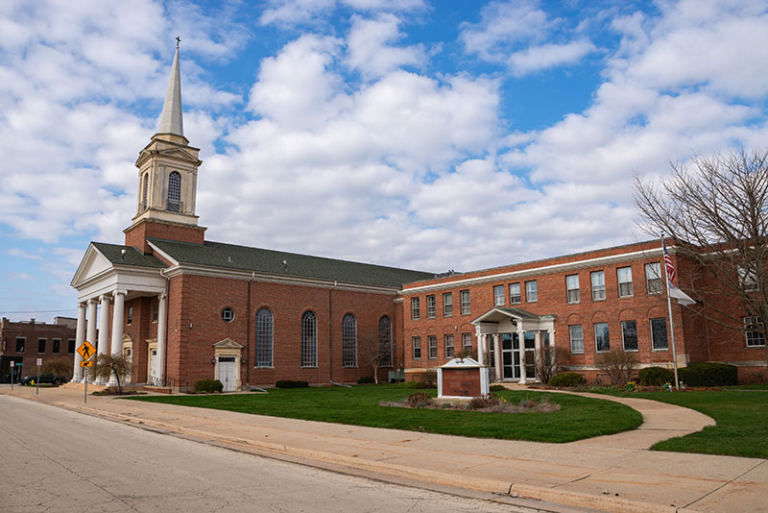
US churches have been at the forefront of the Palestine solidarity movement in recent years. On July 30, 2025, for example, the Evangelical Lutheran Church in America (ELCA)’s churchwide assembly passed a resolution calling on its members “to petition US leaders to recognize and act to end the genocide against Palestinians [and] halt military aid to Israel used in Gaza.” The resolution passed with a 95 percent majority—a landmark decision from one of the largest Protestant denominations in the United States. The resolution suggests that support for Palestinian rights may be moving from the fringes of the US political map to the mainstream, including in churches.
Church-based solidarity with Palestinians is not unique. In fact, it follows a longer tradition of Christian communities supporting progressive movements in the United States. Christian activists played prominent roles in the abolition of slavery, the promotion of the rights of workers, women, African Americans, and other minorities, as well as ending the Vietnam War and US support for apartheid South Africa. In each of these cases, church-based solidarity helped mainstream these progressive movements, eventually resulting in political victories. The Palestine solidarity movement in the United States appears to be following a similar trajectory today.
The Role of US Churches in Progressive Causes
Historically, churches have been a powerful force within US politics on a range of contentious social and political issues, even if they have stood on different sides of the debate. However, in many instances, progressive activists have succeeded in appealing to faith-based constituencies on moral and humanitarian grounds.
The role of churches in promoting workers’ rights in the United States offers a useful historical example. In 1908, the Methodist Church adopted the Social Creed, which called for fair wages for all workers and an end to child labor. During his 1912 campaign for the presidency, Teddy Roosevelt quoted the creed in his public speeches. Later, in 1932, when President Franklin D. Roosevelt won the presidency and announced the New Deal, he relied heavily on segments of the Catholic Church for support. Catholic labor organizers, including priests, played an important role in advocating for workers’ rights, including winning support for the landmark 1935 National Labor Relations Act.
US-based churches similarly mobilized to end Washington’s support for apartheid in South Africa. In 1953, the American Committee on Africa organized church-led solidarity with Black South Africans. Later, in the 1960s, US civil rights groups such as the Student Nonviolent Coordinating Committee, which drew significant support from Black churches, linked the struggles for racial justice in the United States to South Africa. The movement eventually expanded beyond Black churches to include the Presbyterian Church USA (PCUSA) and the United Methodist Church, which both passed anti-apartheid resolutions from the 1960s to the 1980s. In 1985, the General Synod of the United Church of Christ voted to “fully divest all financial resources from all corporations doing business with South Africa.” Eventually these movements’ demands reached the halls of power in Washington. In October 1986, Congress imposed sanctions on South Africa, signaling that the anti-apartheid movement had finally reached mainstream American politics. Soon after, the Reagan administration was compelled, despite its initial reluctance, to take a firmer stance against the apartheid government.
Are US churches today playing a similar role with respect to Israel by helping move Palestine solidarity into the mainstream of US politics?
Are US churches today playing a similar role with respect to Israel by helping move Palestine solidarity into the mainstream of US politics? Like the case of South Africa, early support for Palestinian rights in the United States came from groups often maligned as being too radical in mainstream politics, including the Black Panther Party and Students for a Democratic Society. However, from the mid-1970s, different Christian denominations and activists started speaking about the issue of Palestine, often in the context of advocating for greater peace between Israel and the Arab states, though some also openly criticized Israel’s occupation of Palestinian territories and its treatment of the Palestinians.
Since then, activists from mainline Protestant denominations—Methodists, Lutherans, Episcopalians, Presbyterians, and others—have lobbied to pass resolutions on Palestine at churchwide conferences where delegates vote on social and theological issues. Several of these Christian denominations, especially the Episcopalians and the Lutherans, maintain a significant presence in the occupied Palestinian territories, running schools and health facilities that provide services to both Muslim and Christian Palestinians. Not only do these churches hear testimony directly from Palestinians, but they also witness Israeli abuses of Palestinians firsthand. The fact that mainline Protestant churches also tend to reflect greater political diversity may explain their willingness to support Palestinians in larger numbers than the more politically conservative Evangelical denominations, which tend to be more supportive of Israel. A noteworthy example of this early mainline Protestant support was the 1988 churchwide resolution endorsed by the General Assembly of PCUSA, which called on Israel to “end the policies and practices of beatings and food and fuel embargoes in the attempt to subjugate . . . the Palestinian population… end the settlements policy and the acquisition of land within the occupied territories [… and…] end its occupation of the West Bank and Gaza.”
In the 2000s, mainline Protestant churches in the United States started to more vocally express their solidarity with Palestinians. PCUSA made history when in 2004 its General Assembly voted to start selectively divesting from companies that profited from the Israeli occupation. While a wave of outside criticism eventually led PCUSA to reverse its decision, it also shattered a major taboo in the US around divesting from Israel. In 2012, PCUSA revisited its divestment decision, and finally, in 2014, its members voted to proceed with divestment—a decision that made the front page of the New York Times. Other mainline denominations followed suit. In 2015, the General Synod of the United Church of Christ voted to divest from companies that profited from the Israeli occupation of Palestinian territories. In 2024, the United Methodist Church’s General Conference—which maintains one of the largest reported faith-based retirement funds in the world—voted overwhelmingly to divest from and exclude bonds of governments maintaining prolonged illegal military occupations, including Israel.
In addition to mainline Protestant churches, activists from peace churches such as the Society of Friends (Quakers) and the Church of the Brethren have also pushed forward denominational resolutions on Palestine through affiliated organizations like the American Friends Service Committee and Mennonite Central Committee, which support social justice causes around the world. Catholics affiliated with peace-oriented organizations, such as Pax Christi and the Franciscan Action Network, have similarly started advocating for Palestinian rights.
Growing Mobilization after October 7, 2023
Israel’s genocidal war on Palestinians in Gaza starting in October 2023 has led a number of these churches to go even further in their condemnation of Israeli policies towards the Palestinians. The ELCA was not the first US denomination to describe Israel’s violence in Gaza as a genocide. In February 2024, the African Methodist Episcopal Church sent a statement to its supporters calling on Washington to “immediately withdraw all funding and other support from Israel,” adding that the US government’s support for Israel’s “mass genocide…must not be allowed to continue.” In September 2024, the leaders of the Christian Church (Disciples of Christ) issued a pastoral letter pledging to “redouble our efforts…to bring an end to the horrific genocide taking place in front of our eyes.”
Christian solidarity groups have increased their lobbying efforts with elected representatives in the US to end the slaughter in Gaza.
Christian solidarity groups have also increased their lobbying efforts with elected representatives in the US to end the slaughter in Gaza. Some have even resorted to acts of civil disobedience to draw attention to the urgency of the situation. A few weeks after Israel’s genocidal war began, the newly formed, Catholic-led Christians for Ceasefire conducted a prayer vigil inside the Hart Senate Building in Washington, DC. The protesters called on the United States to push for a ceasefire in Gaza, citing the killing of over 10,000 people at the time. Five members were arrested for their involvement in the protest. On January 16, 2024, Mennonite Action, another recently formed group, led 350 Mennonites from all over North America in an interfaith protest on Capitol Hill, calling for an immediate ceasefire in Gaza. The protesters refused to leave the Cannon House Building, leading to the arrests of nearly 150 people singing peace hymns.
Support for Israel is even decreasing among Evangelical Christians—especially younger members—in the United States. A 2021 poll found that support for Israel among Evangelicals aged 18 to 29 fell to 33.6 percent, down from 69 percent in 2018. Similarly, a 2025 University of Maryland Critical Issues poll showed that only 32 percent of Republican Evangelicals under the age of 35 sympathize more with Israelis over Palestinians. The increasingly visible suffering inflicted on Palestinians by Israeli forces may explain some of this shift, as Israelis appear to be embracing more extreme forms of anti-Palestinian racism and violence, which has reached previously unimaginable heights after October 2023. Finally, Christian groups like the Friends of Sabeel and Churches for Middle East Peace (CMEP) are beginning to include some Evangelical groups in their efforts to support Palestinians.
A Unique Landscape: Challenges and Opportunities for Progress
In at least two important respects, church-led Palestine solidarity efforts in the United States differ from similar movements in the past. First, when compared to the South African case, the US government’s commitment to supporting Israel is far stronger than its past commitment to the apartheid regime. Back then, US popular pressure, including from churches, first moved Congress to act and then eventually pushed the executive to follow. Today, while there is an unprecedented and strong wave of criticism of Israeli policies in the US legislature, the Trump administration has not given any signs that it will change its support for Israel.
Second, US support for Israel is backed by far more powerful and historically entrenched civil society movements than in the case of South Africa. The pro-Israel camp, for example, is comprised of many more white Evangelical Christians than Jewish Americans. US Evangelicals have become an important voting bloc for the Republican Party in recent years. Many of them have organized powerful pro-Israeli groups such as Christians United for Israel (CUFI), which claims millions of members. The Palestine solidarity movement, therefore, still faces enormous challenges moving ahead.
We see that a major shift in US public opinion is empowering stronger voices to defy the pro-Israel lobby.
While some US officials have stood for a more balanced policy towards the Palestinians, until recently, they have been political outliers and often defeated by the pro-Israel lobby. Today, however, we see that a major shift in US public opinion is empowering stronger voices to defy the pro-Israel lobby.
In April 2026, Democratic senators overwhelmingly voted for Senator Bernie Sanders’s resolution to block the sale of bombs and bulldozers to Israel. While the resolution failed due to Republican opposition, it marked a major change for Democrats—one that would have been unimaginable a few years ago. The House of Representatives also has a significant and unprecedented bloc of members who are outspoken in support of Palestinians’ rights. In some key congressional races, pro-Palestinian candidates are winning, while support from the American Israel Public Affairs Committee (AIPAC) is becoming a liability for their opponents.
It is too early to judge whether the Palestine solidarity movement in the United States is on its way to achieving major policy changes. However, there are some promising signs that church-based solidarity is helping to shift support for the Palestinians from the radical fringes to the mainstream.
The views expressed in this publication are the author’s own and do not necessarily reflect the position of Arab Center Washington DC, its staff, or its Board of Directors.
Featured image credit: Eddie J. Rodriquez Via Shutterstock