
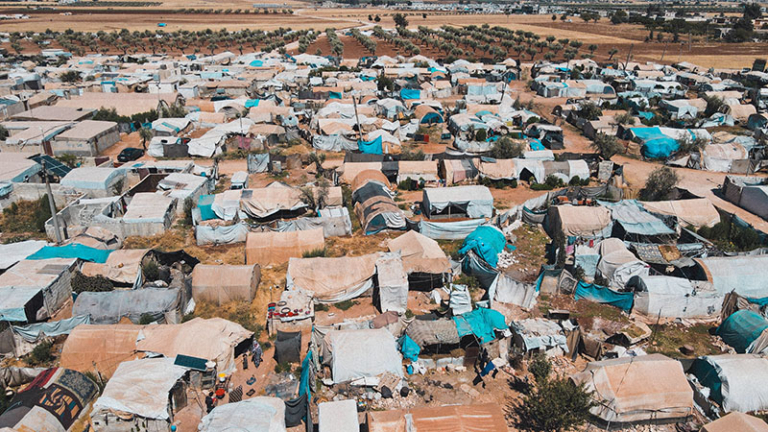
Two years after the end of a nearly 14-year war that resulted in one of the world’s largest and most protracted humanitarian crises, Syria is envisaging the historic closure of all its displacement camps. In April 2026, Syria launched the “Syria Without Camps” initiative with the aim of creating a long-term settlement plan for the nearly 800,000 people within the country still living in camps. By September 10, government officials were reporting that more than 200 of these displacement camps—containing 20 percent of the entire camp population—had been closed. Most of the remaining camps are in northern Syria. The governorate of Idlib has 786 camps, hosting close to half a million people, while Aleppo has 391 camps.
Reporting from Syrian state-run media has emphasized the joy and hope of those who return home after 14 years away. But leaving a camp and going home is not enough to meet people’s humanitarian needs. Internally Displaced Persons (IDPs) who reside in camps tend to experience higher levels of precarity than those living elsewhere. Seventy-five percent of the residents of Syria’s IDP camps are children. Simply closing these sites does not change the economic, humanitarian, or security problems that forced these people into camps in the first place. It also does not change the dangers they continue to face, as much of Syria remains buried under rubble, laced in unexploded ordnance and landmines, and with much of its infrastructure devastated. The World Bank has estimated that Syria needs at least $216 billion to rebuild, though some estimates go as high as $1 trillion —nearly ten times the country’s gross domestic product (GDP). Some investments have been announced for the country, including a $7 billion energy deal signed with Qatari, Turkish, and US companies. However, such investments fall far short of the sums Syria needs to ensure its long-term stability.
The Syrian government recognizes that the Syria Without Camps project requires broader reconstruction in the country to be successful, yet it is moving ahead without the prerequisite level of international support. Nongovernmental organizations (NGOs) both inside and outside Syria have warned that if the Syria Without Camps project is dictated by political timelines rather than humanitarian improvements, it could exacerbate the precarity of displaced Syrians.
Solving the Crisis: From Camps to Resettlement
The Syria Without Camps initiative followed the March 10 Presidential Decree 59, which proposed a holistic approach to the ongoing displacement crisis. The decree formed an interministerial committee chaired by the Minister of Emergency and Disaster Management and included the Ministers of Finance, Public Works and Housing, Social Affairs and Labor, and Local Administration and Environment, as well as the Governors of Aleppo, Hama, and Idlib, where most of the displacement camps exist. The committee’s mandate is to:
Prepare infrastructure in destroyed areas in anticipation of residents’ return and undertaking all measures and actions aimed at improving service levels for citizens residing in areas of internal displacement, as well as providing them with the necessary support to help alleviate the impact of displacement.
The government announced the Syria Without Camps initiative to end what was meant to be a temporary solution for Syrians whose homes had been destroyed during the war. At a September United Nations (UN) meeting, Raed al-Saleh, Minister of Emergency and Disaster, who had himself been displaced during the war, described efforts to close the camps as being motivated by the wish to eliminate the need for them, saying: “The return of displaced persons does not only mean moving them from tents to their villages, but also enabling them to live in a place that provides dignity and stability.” Displacement camps, in Syria and elsewhere, lack sanitation facilities and are often overcrowded—making the very infrastructure of these camps a threat to the population’s health and wellbeing, beyond the other forms of precarity that their residents face.
The government announced the Syria Without Camps initiative to end what was meant to be a temporary solution for Syrians whose homes had been destroyed during the war.
To roll out the initiative, the government is providing grants totaling $7.5 million to Syrian towns that receive returnees, including 84 projects across towns and villages in the Hama governorate alone. The funding is intended to restore schools, water sources, and health centers and rebuild other infrastructure to support the people returning home. Families are transported from the camps with their belongings along with non-food items funded by the grants. Residents in 40 percent of camps live in concrete housing units, which the government wants to convert into long-term residential housing. Syrian officials have stated that all those being moved from the camps are doing so voluntarily.
The Challenges of Return in a Time of Crisis
While these efforts are important, there is still cause for concern. In an open letter published on July 26, 2026, the Syria NGO Forum—a group representing 198 international and Syrian organizations—wrote to the UN Secretary-General upon his visit to Syria to warn that given the country’s urgent and devastating humanitarian needs, setting a fixed timeline for abolishing the camps could exacerbate hardships. The letter states:
The Government of Syria’s No Camps initiative reflects a legitimate ambition to move displaced families into safe and dignified living conditions—but the pace and framing of this initiative risk outrunning the enabling conditions that make return sustainable. Key prerequisites, including mine clearance, housing rehabilitation, restored basic services, civil documentation, and community-level security, remain absent or insufficient across large parts of the country. Where returns are driven by political timelines rather than conditions on the ground, they risk generating secondary displacement and deepening vulnerability rather than resolving it.
Camp closures and the return of IDPs continue a process that began in the immediate aftermath of the fall of the Assad regime in December 2024. In 2025 alone, over 1.9 million IDPs returned to their home regions. However, much like Syrians returning from abroad, the internally displaced came back to neighborhoods, housing, and infrastructure that had been destroyed. While some progress has been made to clear the rubble—a necessary first step to allow Syrians to rebuild—the overall costs of the war continue to amplify the problems facing these returnees.
Much like Syrians returning from abroad, the internally displaced came back to neighborhoods, housing, and infrastructure that had been destroyed.
It is hard to overstate Syria’s ongoing humanitarian crisis. According to the Syrian Observatory of Human Rights, the Syrian war claimed 656,493 lives; a number that does not include those who had been disappeared or whose whereabouts remain unknown. Families must rebuild their lives in the aftermath of such trauma. Meanwhile, damage to Syria’s infrastructure accounts for 48 percent of the country’s physical damage, with Aleppo, the rural areas surrounding Damascus, and Homs being the hardest hit areas. In Syria today, over 60 percent of the population—some 15 million people—rely on humanitarian assistance.
Returnees have reported immense difficulties trying to build decent lives. For example, in July 2026, the International Rescue Committee reported that many Syrians moved to areas without running water. Electricity continues to be rationed and is so expensive that many people cannot afford it. Housing stock is limited and astronomically expensive given the extent of the destruction. Property disputes rage as people try to make sense of who owns a specific piece of land or apartment in the aftermath of the war—with some returning to claim homes in which other people now reside. Due to the Assad regime’s exploitation of the civil registry, Syrians struggle to secure the correct documentation or to navigate the government’s bureaucracy given the lack of proper documentation.
These issues are compounded by broader humanitarian concerns. In April 2026, the UN Office for the Coordination of Humanitarian Affairs (OCHA) documented that gender-based violence is rampant in Syria, made worse by broad economic precarity. At the same time, healthcare is difficult to find, as just 57 percent of Syrian hospitals and 37 percent of primary healthcare centers are fully operational. OCHA found that though the majority of IDPs are children, Syria’s schooling infrastructure has not yet been rebuilt, resulting in a third of those children not attending (or rarely attending) schools. Another million children are at risk of dropping out. Given the limited protections available, most people are unable to withstand climate shocks. A 2025 drought threatened over 16 million people across the country as wheat production significantly declined.
In addition to these humanitarian problems, returnees face ongoing security risks. Nearly 30 percent of the million explosive munitions that were used during the 14-year war have not been detonated, creating unsafe conditions throughout the country and dramatically limiting where people can safely shelter. Children, who play with shiny objects they find on the ground, are at the highest risk of death or mutilation.
Syria also continues to face military violence. Israel bombed Syria 600 times between December 2024 and 2025 and resumed attacks in August 2026, bombing an airbase in Idlib and conducting a drone strike outside of Damascus. In addition, Syria is impacted by Israel’s war on Iran, as interruptions to natural gas have resulted in yet more rationing of electricity. Then there is the violence within Syria, which never entirely ended with the fall of the Assad regime. In January 2026, there were clashes in Aleppo between government forces and Kurdish forces, displacing an estimated 260,000 people. Across the country, there are reports of lingering clashes.
Funding is Not Forthcoming
In their 2026 Syria Humanitarian Needs and Response Plan (HNRP), OCHA asked for $2.92 billion to meet the country’s humanitarian needs. To date, only 31.5 percent of their total request has been funded, with only a fraction of their funding requests for nutrition (11 percent), food security (13.8 percent), and education (16.9 percent) being met. When compared to previous years, such a discrepancy represents a major funding gap. Most of the 2026 funding is going to camp management. While in theory this money could be redirected when people leave the camps, in practice, it is unclear how those who leave will survive and what it will mean for them to return to places where food and housing are scarce.
Without substantial funding, the Syria Without Camps project cannot ensure those who leave the camps can lead dignified lives.
The dismantling of the United States Agency for International Development (USAID) has also severely reduced what limited humanitarian support existed for war-ravaged places like Syria. Without substantial funding, the Syria Without Camps project cannot ensure those who leave the camps can lead dignified lives. But even the available funding is structured in a way that limits local NGOs’ effectiveness. According to Syrian NGOs, foreign assistance is characterized by “disproportionate compliance burdens, short grant cycles” and restrictions on fund-use that make it difficult to respond to immediate needs. Their critiques echo frustrations that local NGOs report worldwide.
In May 2026, Syria’s leadership celebrated Saudi Arabia’s pledge of $1.5 billion to the Syria Without Camps initiative—the single largest announced commitment from the kingdom to Syria’s post-war recovery. While this contribution is by no means small, it still amounts to less than 1 percent of the total that the World Bank estimates is necessary to rebuild Syria’s infrastructure. Syria’s Deputy Minister of Emergency Management and Disaster Relief Ahmad Qaziz characterized the Saudi pledge as a sort of seed grant, which could convince other countries to get involved by demonstrating the Syrian government’s capacity to tackle large-scale projects.
Conclusion
The goal of the Syria Without Camps initiative is admirable and necessary given the protracted displacement that Syrians have suffered for well over a decade. The Syrian government’s vision for this process also clearly demonstrates its commitment to rebuild the country and to not only eliminate the camps but also address the underlying humanitarian and security issues that made the camps necessary in the first place. However, as NGOs have warned, the rapid pace at which the Syrian government is closing these camps—which appears to be based more on a political timeline—coupled with the trickle of support coming from the international community, could exacerbate rather than resolve the precarity of those being voluntarily moved from the camps. The mass exodus of people out of the camps will likely continue, even though it has become clear that the mandate of the decree is currently not being met. Syria is still largely under rubble, the mines are still unexploded, and the basic needs of Syrians remain woefully unmet.
The views expressed in this publication are the author’s own and do not necessarily reflect the position of Arab Center Washington DC, its staff, or its Board of Directors.
Featured image credit: Mohammad Bash via Shutterstock