In May 2026, Hussein al-Sharaa, the father of Syria’s interim president, Ahmed al-Sharaa, described the people of Deir al-Zor as “a group of savages with loud voices.” The reaction from the president was decisive: he called the governor of Deir al-Zor to apologize, saying that his father’s words had hurt him before they had hurt the people of Deir al-Zor. The recording of their conversation circulated widely on social media. This incident was not just an embarrassing episode between an indiscreet old man and a son trying to contain the damage: it was symbolic of the disdain with which much of Syria’s urban elite has long regarded the country’s peripheral regions. The negative words of Hussein al-Sharaa are precisely the kind of sentiments that could strain Damascus’s fragile control of eastern Syria.
In January 2026, Damascus gained control of the region after the collapse of the Syrian Democratic Forces (SDF), the US-backed and Kurdish-led coalition of primarily Kurdish and Arab fighters established in 2015 to combat the so-called Islamic State (IS). Importantly, the region changed hands not because Syria’s newly established national army proved more capable, but because Arab tribes switched sides, defecting from SDF military structures and handing the region to the Damascus government on a golden platter. Yet control has not delivered inclusion. Arab tribes that helped the central authority regain control are now largely ruled by outsiders, and many feel that the capital benefits from the region’s natural resources without giving local people their fair share. In consequence, the same grievances about regional inequality that existed under Bashar al-Assad—and that contributed to Syria’s 2011 uprising—are now building up against the new government.
An Eastern Periphery
Eastern and northeastern Syria comprise three governorates: Deir al-Zor, Raqqa, and Hasaka. The region contains most of Syria’s oil and gas fields and is central to its wheat production. Most of the population of Deir al-Zor and Raqqa are Arab tribes, while Hasaka is ethnically mixed, with large Kurdish and Arab communities alongside a dwindling Christian population. Variations are worth noting: Deir al-Zor is the oil center, while Hasaka stands in the Kurdish heartland where self-administration during the civil war became most deeply embedded and where the remaining units of the SDF retain ground.
The trigger for conflict has often been new forces trying to control the east and its resources while denying a role for its local people.
The relationship between this peripheral part of Syria and the capital has rarely been stable. Protesters in the region joined the 2011 uprising against the Assad regime; in 2014, when the Sheitat clan rose up against IS’s attempts to control the al-Omar oilfield, fighting killed as many as 1,000 people. In 2023-24, Ibrahim al-Hefl, one of the sheikhs of the Uqaydat tribe, led an insurgency against the SDF on the grounds that it was seizing the region’s oil while neglecting its people. The trigger for conflict has often been new forces trying to control the east and its resources while denying a role for its local people. The recent grievances against Damascus are part of this same pattern.
How Damascus Took the East
Syria’s transitional government initially supported tribal leaders from the east who had spoken out against the SDF, calling for the restoration of state sovereignty over their territories and even hinting at encouraging the tribes to rise up against the SDF. In January 2026, those hints finally materialised into action. Arab tribes that had constituted the backbone of the SDF defected from its military bodies, heralding its total collapse within a matter of days. The decisive factor in the Arab-majority east was not the Syrian army, but the area’s Arab tribes.
In Deir al-Zor, on January 17, 2026, the Shu’aytat and al-Bukair clans defected from the Deir al-Zor Military Council, the Arab-majority armed group that had served as the SDF’s local force in Deir al-Zor. On January 18, 2026, Arab tribes in Raqqa turned against the SDF, and Damascus-aligned tribal fighters moved into the city. These tribal elements raised the Syrian flag in Deir al-Zor before the first pro-government units had even arrived. The rapid wave of defections revealed how shallow the SDF’s multi-ethnic coalition had been.
After losing Raqqa and Deir Ezzor, the SDF had little leverage left. In a 14-point agreement with Damascus, the SDF ceded Raqqa and Deir al-Zor to the central government. The move gave al-Sharaa’s regime access to these governorates’ oil and gas fields and border crossings, as well as to the vast wheat-producing Jazira (the agricultural plains stretching across Hasaka, Raqqa, and northern Deir al-Zor). The tribes that had delivered these gains to Damascus then waited to see what they would receive in return.
Inclusion Without Representation
One prominent figure in the al-Sharaa regime is the director of the General Intelligence Service, Hussein al-Salama, known as Abu Musab al-Shuhail, who belongs to the Abu Jamel clan of the Uqaydat tribe from the town of al-Shuhail near Deir al-Zor. Other members of his clan have been promoted to important official positions in Damascus. Nevertheless, the appointment of one man from Deir al-Zor and his inner circle does not mean that eastern Syria has a meaningful say in how it is governed. In practice, al-Shuhail’s rise has chiefly benefitted his own clan, the Abu Jamel, while members of other Uqaydat clans and other eastern tribes are less well represented. The complaint is not just about whether Eastern Syria is represented in Damascus, but about which eastern voices get heard and which do not.
Many people in the region continue to speak of marginalization. In June 2025, activists and intellectuals from Deir al-Zor wrote an open statement to President al-Sharaa, condemning nepotism and appointments based on tribal loyalty and calling for the full inclusion of the governorate in managing its internal affairs. Ammar al-Haddawi, a prominent figure from the al-Uqaydat tribe, has argued that the new government in Damascus is reproducing old patterns of centralization, exclusion, and resource extraction. He proposes decentralization to address the region’s long-standing marginalization.
The complaint is not just about whether eastern Syria is represented in Damascus, but about which eastern voices get heard and which do not.
The city of Raqqa largely welcomed the end of SDF rule but was disappointed by what followed. On January 19, 2026, Damascus appointed the then-deputy governor of Aleppo, Abdulrahman Salameh, as the governor of Raqqa, rather than selecting a candidate from Raqqa itself. The interim head of the city’s municipal council, also an outsider from Aleppo governorate, has acknowledged that his appointment has caused tensions, and has said that he will stay only until an election is held or a suitable local replacement is found. On May 22, 2026‚ hundreds of Raqqa residents protested a government-affiliated reconstruction program that involved the demolition of thousands of homes‚ demanding the sacking of Governor Salameh․ Relief that the SDF is gone has been coupled with the old grievance that outsiders were deciding Raqqa’s fate․
In Hasaka, Damascus did not impose an outsider, but accepted a Kurdish governor, Nour al-Din Issa Ahmad, whose name had been proposed by the SDF under the January 18, 2026, agreement that guaranteed the post to them. The move may have seemed to reflect a representative policy. But while the Kurds, who have maintained their bargaining power, could secure their own choice for governor, Arab tribes see themselves as being governed by outsiders, despite their loyalty in handing the eastern provinces to Damascus. The SDF-Damascus understanding risks planting the seeds of a new grievance. For many Arabs, appointing a Kurdish governor to rule the mixed governorate of Hasaka risks reproducing the pattern of Kurdish dominance familiar from the days of the SDF.
Extraction Without Return
Capturing eastern Syria has enabled Damascus to seize the biggest part of the pie: the country’s largest oil and gas fields, which were transferred from the SDF to Damascus under the January 2026 14-point agreement. In 2025, the Syrian Petroleum Company had signed deals with US-based Conoco Gas, the United Arab Emirates’ Dana Gas, and Saudi and Qatari companies to restore and develop the fields. By April 2026, with Damascus in control, production had reached more than 105,000 barrels per day and generated nearly $450 million in revenue for the central government.
Little of that revenue is making its way back to eastern Syria. People in Deir al-Zor have always argued that every ruler who came to the region—whether the Baath Party, IS, the SDF, or the al-Sharaa government—repeated the mistake of monopolizing the wealth from natural resources while neglecting local populations. The details of oil revenue sharing have always been shrouded in secrecy. Excluded from working in this sector by the Assad regime, which reserved jobs to loyalists from other regions, some locals in Deir al-Zor built informal refineries to process crude oil and to make a living. However, in February 2026, the Ministry of Energy ordered the closure of these informal refineries to centralize oil production and refining, but failed to provide any economic alternatives for the community. The region witnessed protests, tire burnings, and clashes during security raids. As one figure from the al-Uqaydat tribe had earlier put it, if Deir al-Zor’s oil is transported to be refined in Baniyas, a port on Syria’s Mediterranean coast, why should a refinery not be built where the oil is produced before it is transported?
The same logic applies to wheat, the other main product of the Jazira. On May 16, 2026, the Ministry of Economy set the procurement price at 46,000 Syrian pounds ($3.54) per ton of wheat, a figure that farmers said was well below their production costs. In response, protests erupted across Raqqa, Deir al-Zor, and Hasaka. Damascus quickly yielded and introduced a price closer to the farmers’ demands. The concession was real yet revealed that the regime was willing to pay to settle a protest but not to change the top-down decision-making process that had triggered it. Prices for the eastern governorates are still being set in the capital, without consulting those who bear the costs. Concessions by the state may have bought quiet, but they have not delivered trust.
The Bridges That Were Not Built
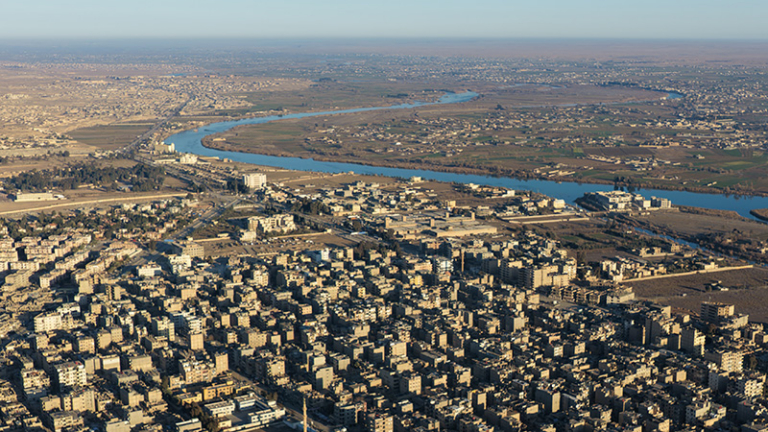
In May 2026, a writer on local issues in Deir al-Zor, Muhammed Khalaf al-Ujayl, commented that in more than a year Damascus had not built a single bridge linking the Jazira to the western bank of the Euphrates River. Instead, people are forced to cross the Euphrates in worn-out boats while their oil and wheat pass safely to the capital. “A state that remembers the east only when it needs oil,” he said in a Facebook video, “resembles a tax collector more than a national government.” His statement reflected the general mood of frustration that plans for Syria’s reconstruction focus on Damascus, Aleppo, and the Mediterranean coast, not the interior.
The Syrian government has proposed that the country should become a regional transit corridor linking Turkey, Jordan, and the Gulf countries, attracting billions of dollars in investment projects—most of which are expected to focus on Damascus, the coast, and Aleppo. The major Emirati company Emaar Properties’ reported investments of $12 billion in Damascus and $7 billion on the coast made the headlines. Among the early projects are coastal developments in Tartous and Lattakia, as well as the rebuilding of Aleppo’s airport. Eastern Syria, however, is rarely included in such plans for reconstruction.
The bridges that the central government is considering for rehabilitation are not those most used by local residents.
In late May 2026, bridges in Deir al-Zor collapsed in Euphrates floods that drowned many people. But the bridges that the central government is considering for rehabilitation (the Siyasiya and Mayadeen bridges) are those that connect the city to its oil-producing eastern bank, not those most used by local residents. Damascus proposed studies for two new bridges in Raqqa and Deir al-Zor, with road maintenance plans totalling 872.7 million Syrian pounds ($67,000). The disparity with multi-billion dollar investment commitments to tourism projects on the coast seems only to confirm the basis of local complaints.
Avoiding the Old Pattern
Damascus has seized the east, but so far has made no real effort to include it in governance. It rules the three eastern governorates through outsiders, draws on the region’s natural resources, and responds to protests with concessions rather than with inclusion. This relationship risks reproducing the same dynamic that existed between the center and the periphery under the Assad regime. Unless Damascus offers the east a real share of power and revenue, it will recreate the same grievances that led to earlier revolts in this region.
The social fabric of the region facilitates tribal mobilisation and popular protests. Bonds of kinship can quickly turn local grievances into collective action. Yet a new uprising does not appear imminent. Eastern Syria is exhausted by nearly 14 years of the civil war and wary of involvement in sustained conflict. Defiance here has never been uniform: the same family that produced a leader of the 1920 Raqqa rebellion against French colonial occupation also produced a brother who was honored by the occupiers. The same fragmentation continues today, which is why any unrest is more likely to take the form of scattered local episodes rather than a single coordinated revolt.
Breaking the pattern would require more than concessions. Damascus should begin by appointing credible local figures based on merit, rather than on loyalty or favoritism, and who possess a deep understanding of their region’s challenges. The central government should create a transparent mechanism for sharing the profits of oil and ensure proper policies are in place to support the agricultural sector. It should also direct significant reconstruction investment to eastern infrastructure—bridges, roads, water—on the same footing as Damascus, the coast, and Aleppo. Above all, Damascus should give the people of eastern Syria a reason to see the post-Assad government not as the latest exploiter of local resources, but as a state in which they too have a meaningful stake.
The views expressed in this publication are the author’s own and do not necessarily reflect the position of Arab Center Washington DC, its staff, or its Board of Directors.
Featured image credit: Mohammad Bash via Shutterstock