When Fatima, a mother of two in Yemen, went into labor with her third child in May 2025, there was initially little cause for concern.
But Yemen is a poor country—one of the poorest in the world—and many residents live in rural areas that can be up to 12 hours away from a medical facility. Other factors, including high levels of malnutrition and economic hardship, complicate childbirth further, even for otherwise healthy mothers. As such, Yemen has the highest maternal mortality rate in the Arab region, and among the highest rates globally. The United Nations estimates that around three women die every day in Yemen due to complications with pregnancy or childbirth; some two-thirds of these deaths could be prevented if women had ready access to a doctor or midwife.
Just weeks before Fatima went into labor, the United States had announced a massive cut to humanitarian programming, including $377 million to the United Nations Population Fund (UNFPA), the UN agency that focuses on reproductive and sexual health. Several of the grants that were cut had previously received humanitarian waivers to exempt them from the Department of State’s earlier January 2025 pause on foreign aid, since they were “considered lifesaving interventions for the world’s most vulnerable women and girls.” The consequences of these two waves of stop-work orders soon trickled down to local service providers in countries around the world, including throughout the Arab region. In Yemen alone, US funding had supported 60 percent of UNFPA’s work.
While in labor, Fatima began to feel unwell, and the baby’s heart rate was slowing. The first medical facility she went to was unable to deal with high-risk births. The nearest hospital that could help Fatima was a ten-minute drive away. But according to Fatima’s family, the hospital said that it could not provide emergency obstetric care at the time due to UNFPA funding cuts that left the hospital without needed diesel for its generator, as well as shortages of medications and staff. In fact, the hospital was unable to perform any surgical services at all.
Fatima was instead sent by ambulance to the closest functional hospital, well over an hour away. En route, her condition deteriorated. By the time they arrived, Fatima and her baby were dead. She had suffered a uterine rupture, a serious birth complication that requires immediate surgery and repair. “A shorter transfer time could have saved her life,” her doctor told the Guardian.
Across the Arab world. . . US foreign assistance could mean the difference between life and death.
When questioned about the humanitarian impact of the cuts during a May 2025 congressional briefing, Secretary of State Marco Rubio insisted that “no one has died.” Meanwhile, a dashboard tracking the projected deaths in just the first year of the funding cuts estimated that 262,915 adults and 518,428 children would die due to the termination or disruption of US Agency for International Development (USAID)-funded projects. Many of those projected deaths would be caused by additional cases of malaria, tuberculosis, diarrhea, malnutrition, pneumonia, and HIV. Oxfam analysis suggests that one child under five could die every forty seconds by 2030 due to the cuts. Meanwhile, a paper published in The Lancet estimated that more than 14 million people, primarily in sub-Saharan Africa, could die by 2030 as a result of such cuts.
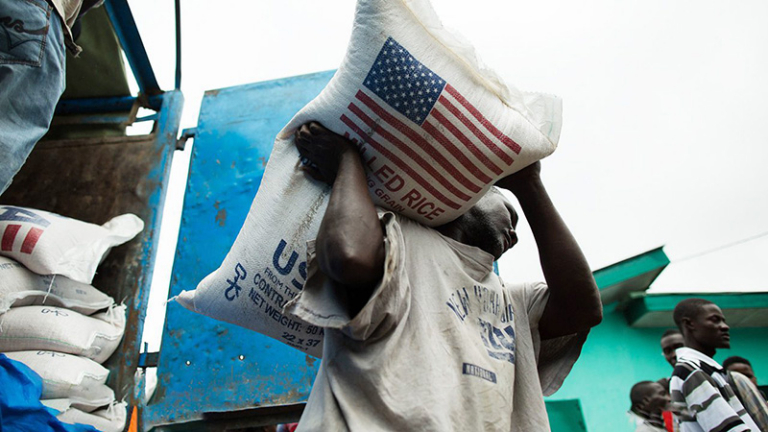
Since fiscal year (FY) 2001, US foreign aid has amounted to between 0.7 percent and 1.4 percent of federal outlays annually. During that time, foreign assistance peaked at $74 billion in FY 2022. The Trump administration’s rescissions took back about $8 billion in aid. In contrast, the United States reported $916 billion of military spending in 2025 alone. For policymakers who lauded these aid cuts, the lives they affected were likely nothing more than abstract numbers in a report. But across the Arab world, for people like Fatima and her family, the health and humanitarian work supported by US foreign assistance could mean the difference between life and death.
The Weight of the Cuts Across the Arab Region
When US President Donald Trump began his second term in January 2025, it was immediately clear that his administration would utilize severe actions to enact its so-called “America First” policy. On his first day in office, he utilized executive orders, memoranda, and proclamations that, despite questions about their legality, fundamentally reshaped US policy and the country’s role in the world.
In the realm of global health and humanitarian policy, Trump withdrew the United States from the Paris Agreement on climate and the World Health Organization, suspended refugee resettlement, and repealed multiple environmental protections. Among the most disruptive, however, were the simultaneous actions of establishing the “Department of Government Efficiency” (DOGE), a new government office headed by Elon Musk tasked solely with cutting government spending, and issuing an executive order that initially called for a “pause” in US foreign development assistance.
DOGE leadership quickly decided that USAID would be one of its first targets, freezing aid distributions, recalling staff, and issuing stop-work orders to active grants while terminating others altogether, seemingly overnight. The remains of the agency were placed under the purview of the State Department.
The cuts, however, were not distributed evenly across all beneficiaries of US money. Shortly after Trump enacted the freeze, Secretary Rubio sent out a memo indicating that while groups that had previously received humanitarian grants needed to stop work immediately, and military assistance to nations like Lebanon and Ukraine was halted, military aid to two of the United States’ largest beneficiaries, Egypt and Israel, would continue. In fact, the Rubio-led Department of State quickly cleared a shipment of 2,000-pound bombs to Israel—part of an arms sale worth nearly $3 billion paid for in part by US security assistance to Israel—that had been temporarily paused by the Biden administration in one of its few acts meant to constrain Israel’s actions during the Gaza genocide.
Almost all the assistance cuts to the region were made to economic, development, and humanitarian aid.
Indeed, the cuts affected multiple types of US financial assistance, most of which did not fall into the category of development or humanitarian assistance. JordanJordan, for example, primarily receives economic and military aid, much like Egypt, while countries such as Palestine, Syria, and Yemen have received humanitarian funding due to war, hunger, and displacement. Countries like Iraq and Lebanon receive a combination of security and development aid ostensibly to bolster stability. As such, each country was differently impacted by these aid reductions—especially as data suggests that security funding to the region remained relatively stable. Almost all the assistance cuts to the region were made to economic, development, and humanitarian aid. Even before these latest decreases in aid, the overwhelming majority of US aid to the Middle East and North Africa (MENA) was security assistance to just three countries: Egypt, Israel, and Jordan. This imbalance is even more stark now.
Cutting Aid Amid Humanitarian Emergencies
The Arab region includes multiple countries facing dire humanitarian conditions, including some of the highest civilian death and injury tolls in modern times. As a result, many of the countries in the region were heavily dependent on foreign aid, with the United States often as the primary contributor. In 2022, for example, nearly 40 percent of the roughly $13.8 billion in MENA development and humanitarian aid provided by all bilateral donors came from the United States, with 27 percent from USAID alone. In 2024, USAID and the Department of State spent more than $2 billion on humanitarian assistance in the MENA region, primarily in Syria, Yemen, and the West Bank and Gaza. Between October 2023 and January 2025, just before the first cuts, USAID had spent more than $2.1 billion just in Gaza.
Funding shortfalls have also meant that agencies that typically have a heavy footprint across the region have had to cut their own operations. The UN Refugee Agency (UNHCR) announced in June 2025 that it had to cut global staffing by around 30 percent and warned that they remained dramatically underfunded, severely limiting their ability to support displaced people in countries like Afghanistan, Lebanon, and Syria. In Iran, Israel and the United States launched a war that has displaced up to 3.2 million Iranians and increased the price of fuel and food, further straining aid distribution and UNHCR’s limited remaining financial resources.
Aside from curtailing available vaccines and treatments, aid cuts limit healthcare in two ways. First, the closure of grant-supported clinics and hospitals across territories means that needed medical care is farther away, leaving many patients and families to travel in precarious conditions on potentially dangerous roads. Second, even if patients are able to reach a hospital, the additional demand means that those hospitals are often overcrowded and under-resourced.
US aid cuts have placed additional pressure on conflict-affected countries across MENA.
As a result, US aid cuts have placed additional pressure on conflict-affected countries across MENA, where millions already depend on humanitarian assistance for food, healthcare, shelter, and other basic needs. Reduced US funding has forced aid organizations to scale back programs and services, leaving vulnerable populations with fewer resources and increasing the risk of hunger, displacement, and preventable illness. Humanitarian agencies have warned that the funding reductions are particularly damaging because they come as conflicts and humanitarian needs remain severe across the region. Indeed, needs have only increased as the US war on Iran continues, and Israel expands its attacks beyond Palestine to Iran, Lebanon, and Syria.
In Yemen, where 21 million people are dependent on aid, the United States provided $768 million in support in 2024—a full half of Yemen’s humanitarian response. Now, lack of aid funding has meant that since the beginning of 2025, 453 health facilities have been closed across the country, and essential services, including the type of maternity care needed by women like Fatima, are out of reach for many. Many workers at these facilities were locals who have now lost their jobs, further deepening economic troubles. Yemen continues to face food crises, infectious disease outbreaks, and climate shocks, including floods, with limited capacity to manage them.
Syria has long been heavily dependent on US aid and is currently in a period of rebuilding. More than 3.5 million refugees have returned after the fall of the Assad regime, including those returning from neighboring countries and those who had been internally displaced. Conditions are still fragile, however, with more than 16 million Syrians dependent on humanitarian assistance. The US initially cut an estimated $237 million in aid to Syria, and though some sanctions have been lifted and some aid has been reinstated since then, reportedly no funds have been received. But due to cuts to food assistance programs, 416,000 children are at risk of severe malnutrition, while around half a million are water insecure. Educational services funded by aid have also been canceled.
The Occupied Palestinian Territories have faced an unstable aid landscape for decades, highly dependent on political developments and donor motivations. However, in the shadow of the Gaza genocide and an unprecedented campaign of military and settler violence in the West Bank, cuts to aid have been particularly harsh. Aid gaps had already been felt through the halting of US funding to the United Nations Relief and Works Agency (UNRWA), which had been paused by President Joe Biden in January 2024 and was stopped completely by President Trump in February 2025. While aid was supposed to be distributed to Gaza by Trump’s Board of Peace, to which donors had pledged $7 billion by February 2026, reports from May 2026 found that less than 1.8 percent of funds had been received.
A Reckoning with Reality
The consequences of the abrupt restructuring of US foreign aid are clear. While the administration has framed the cuts as an effort to eliminate waste and reshape US assistance around national interests, the experience on the ground seems more punitive. In many countries, the withdrawal of US funding has disrupted essential services, strained already fragile institutions, and left governments and humanitarian organizations scrambling to fill gaps that cannot easily be replaced. At the same time, the administration’s subsequent efforts to restore or redirect portions of that assistance suggest a growing recognition that dismantling the existing aid infrastructure carries costs of its own.
In response to criticism, the Department of State has indicated that it was pursuing a “co-investment model,” signing memorandums of understanding (MOUs) directly with countries, bypassing nongovernmental organizations, to ensure “greater country ownership and accountability.” Yet, MOUs signed thus far comprise less funding than was previously granted through USAID to the same countries. Further, even if the money is reinstated at previous levels, the disruption caused by the suddenness of the stop-work orders has itself caused incalculable damage. As one expert told NPR, the new funding scheme “could have done much more good if there was a transition from the before-times into the current MOU because we wouldn’t have had that disruption of services.”
There are signs that the administration is realizing that foreign aid was not the “woke, weaponized, and wasteful spending” it portrayed in the early days. In late 2025, the administration signed an agreement with the UN to distribute $2 billion to its Office for the Coordination of Humanitarian Affairs (OCHA). While not at the same levels as previous funding, the aid is earmarked for 17 conflict-affected countries, including Sudan, South Sudan, and Syria. Months later, the administration committed a further $1.8 billion. The Department of State has also committed to release $40 million in emergency funds to Lebanon.
These funds make up part of the nearly $5 billion in macro awards that the Trump administration has committed to giving directly to UN agencies, including around $220 million to the United Nations Children’s Fund (UNICEF) and $800 million to the World Food Program. Notably, Afghanistan and Yemen were excluded from the disbursement, citing threats of diversion by groups like the Taliban and the Houthis. When the United States rehomed its Food for Peace program, it bypassed Sudan, the country with the worst hunger crisis in the world, as well as Afghanistan, Lebanon, and Yemen, where millions are close to famine. As such, there are serious gaps in humanitarian aid, despite the improved funding situation in general.
Whatever its flaws, aid has become a lifeline for millions of people living in conditions they did not create.
Foreign aid certainly deserves scrutiny. Policymakers should confront the uncomfortable reality that US foreign policy has often helped create or deepen the crises that aid is asked to alleviate. But acknowledging Washington’s involvement in that should not lead to abolishing all foreign aid. Whatever its flaws, aid has become a lifeline for millions of people living in conditions they did not create and cannot simply escape.
To dismantle that lifeline abruptly—with no transition plan, no meaningful warning, and no serious accounting for what happens next—is not reform. It is recklessness with the lives of tens of millions of the world’s most vulnerable people. Criticizing the system that made aid necessary is a legitimate act of accountability. Cutting it off without a plan for those who depend on it, however, is something else entirely: a policy choice that compounds political failure into human catastrophe.
The views expressed in this publication are the author’s own and do not necessarily reflect the position of Arab Center Washington DC, its staff, or its Board of Directors.