
Israel’s December 2025 decision to recognize Somaliland’s unilateral declaration of independence was of grave concern to Saudi Arabia. Riyadh sees Somalia’s territorial integrity as essential to security in the Red Sea and Gulf of Aden. From the Saudi perspective, Israeli and Emirati support for Somaliland threatens Riyadh’s interests as well as regional stability. Reports of Israeli plans to establish a military presence and to secure port access in the breakaway territory have created unease in Saudi Arabia about fragmentation and even chaos along key maritime trade corridors surrounding the Arabian Peninsula.
To counter this perceived threat, Saudi Arabia is strengthening its defense ties with Mogadishu. Egypt, Qatar, and Turkey, which also consider the preservation of Somalia’s territorial integrity vital, strongly support Riyadh’s stance in defense of Somalia’s unity. Such alignments speak to the extent to which Saudi Arabia’s alliance with the United Arab Emirates (UAE) is fracturing as Abu Dhabi and Tel Aviv expand their influence by offering support to non-state actors in fragile states. Tensions over Somaliland highlight a complicated struggle between various Middle East powerhouses as they compete for influence in the Gulf of Aden, Red Sea, and Horn of Africa against the backdrop of unresolved conflicts in Sudan and Yemen.
Security in the Horn of Africa
Strategically located between the Indian Ocean and the Suez Canal, and guarding access to the Gulf of Aden and Red Sea, the Horn of Africa is situated along one of the most important trade routes in the world. This geography helps to explain the vested interests of Saudi Arabia and other Gulf Cooperation Council (GCC) members in this part of Africa. Somalia is especially important as it provides opportunities for these powers to project influence throughout the Horn of Africa and over trade corridors linking multiple continents. In this context, the Saudi leadership sees Israeli and Emirati involvement in the self-declared breakaway republic of Somaliland as a major threat to Riyadh’s interests in defending the territorial integrity of Somalia.
On December 26, 2025, Israel became the first country to officially recognize Somaliland’s independence. This controversial move was swiftly condemned by international organizations such as the African Union, the Arab League, the European Union, the GCC, and the Organization of Islamic Cooperation (OIC). Riyadh responded at once, leveraging its influence to mobilize a regionwide censure of Tel Aviv’s action. Saudi Arabia’s response highlighted Riyadh’s sensitivity to Somalia’s sovereignty and territorial cohesion, as well as its determination to work with Mogadishu to thwart foreign agendas to carve up the state.
Saudi Arabia’s response highlighted Riyadh’s sensitivity to Somalia’s sovereignty and territorial cohesion.
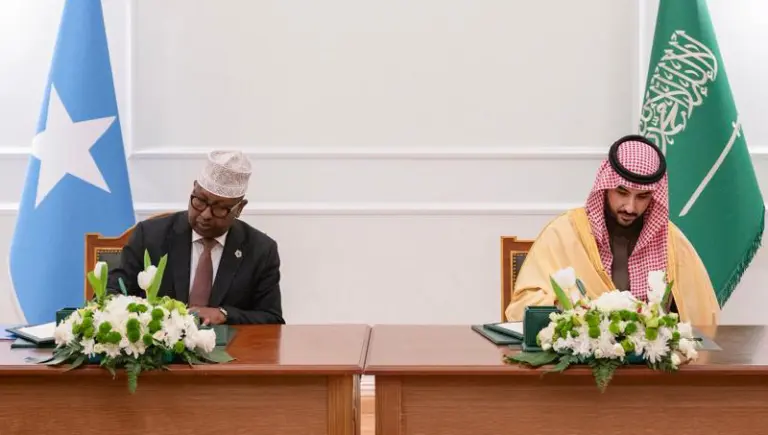
On February 9, 2026, Riyadh took a concrete step to defend Somalia when it signed a memorandum of understanding on military cooperation with Mogadishu. This agreement is intended to strengthen bilateral defense cooperation via enhanced technical support, training, and force development, but stops short of a formal treaty of mutual defense. Mogadishu depicted the accord as evidence of Saudi Arabia’s commitment to Somalia’s territorial integrity.
In light of the post-October 7, 2023 Israeli military campaigns, most GCC members have concluded that Israel—not Iran—poses the gravest threat to Gulf security. Given Somaliland’s close geographic proximity to the Arabian Peninsula, Saudi officials see the possibility of Israel’s further encroachment on Somali territory and strategic depth as a grave threat. Israel’s September 9, 2025, attack on Qatar underscored the Gulf’s vulnerability to Tel Aviv’s borderless aggression. This unprecedented Israeli strike occurred despite the presence of US CENTCOM’s forward headquarters at Qatar’s al-Udeid Air Base, raising questions about the utility of Washington’s security guarantees for GCC states. Saudi concerns about Tel Aviv’s future plans in Somaliland are also informed by recent reports about Israel’s plans to establish a military base in the territory, as well as by the February 6, 2026, statement by its president that his separatist administration had “not ruled out the possibility of granting an Israeli company a port” in the territory.
As Riyadh sees it, Israel’s recognition of Somaliland raises the prospect of other secessionist causes across the Arab and Islamic worlds gaining strength. Saudi Arabia has become increasingly sensitive to fragmentation in the neighborhood, as evidenced by its late 2025 military operations against Yemen’s separatist Southern Transitional Council (sponsored by Abu Dhabi), its support for the Sudanese Armed Forces in Sudan’s civil war, and its backing for Syrian interim president Ahmad al-Sharaa in his efforts to reassert the authority of the central state. The kingdom’s leadership clearly views separatism as a major threat to regional stability. Today, Saudi Arabia is focused on advancing Vision 2030 to achieve economic development and diversification, which requires stability at home and in neighboring countries. Saudi officials therefore perceive Israeli and Emirati support for fragmentation as a threat to Crown Prince Mohammed bin Salman’s vision.
The UAE Factor and Geopolitical Fractures
The UAE has not officially recognized Somaliland’s independence, instead maintaining a certain ambiguity on the issue. Abu Dhabi refused to sign a joint Arab League-OIC statement condemning Israel’s recognition of Somaliland, but in January 2026 it issued a joint statement with the African Union in defense of “Somalia’s sovereignty, territorial integrity, security and stability.” The UAE has over the years made major investments in Somaliland without regard for Mogadishu’s sovereignty, and its position may have contributed to Tel Aviv’s December 2025 decision to recognize Somaliland’s independence.
This has infuriated the leadership in Mogadishu. On January 12, 2026, the Somali cabinet announced the cancellation of all defense, security, and port operations deals with the UAE. Minister of Defense Ahmed Moallim Fiqi said the decision was based on evidence that the UAE was undermining the sovereignty, national unity, and political independence of the Republic of Somalia.
The break between Mogadishu and Abu Dhabi must be seen in the wider context of the fracturing Saudi–Emirati alliance.
The break between Mogadishu and Abu Dhabi must be seen in the wider context of the fracturing Saudi–Emirati alliance. Across multiple regional faultlines, friction has emerged between Saudi Arabia and what has emerged as a UAE-Israel “axis of fragmentation.” After Yemen became a major flashpoint in tensions between Riyadh and Abu Dhabi in late 2025 and early 2026, Somalia–Somaliland is now the focus of their strategic competition.
Tensions between the two Gulf powerhouses are evident in several arenas. Many Saudis, as well as people all over the Arab region, criticize the UAE for being too willing to indulge the Israeli government while it carries out the Gaza genocide and continued land theft and allows settler violence in the West Bank. Saudi officials have raised concerns about Abu Dhabi’s alleged alignment with Tel Aviv vis-à-vis the Druze in southwestern Syria. Saudi Arabia views Abu Dhabi’s support for Sudan’s Rapid Support Forces, a paramilitary group, as a threat to the government in Khartoum and to security in the Red Sea basin more broadly.
With Somalia’s territorial integrity under attack from Israel and the UAE, the issue of Somaliland is likely to cause more friction in Saudi–Emirati relations. The UAE will no doubt continue its assertive foreign policy in the Gulf of Aden, the Red Sea, and the Mediterranean, with support for various separatist elements and growing alignment with Ethiopia in the Horn of Africa. In turn, Riyadh likely perceives UAE moves in Somaliland as a serious threat to its maritime security interests.
Regional Alignments
To counter the UAE–Israel axis, Saudi Arabia has strengthened coordination with Egypt, Qatar, and Turkey, which share similar threat perceptions of Abu Dhabi and Tel Aviv.
Because of the importance of the Red Sea and the Suez Canal to Egypt’s economy, Cairo understands the high stakes when it comes to maritime security in these waters. Egypt’s interests rationally converge with Saudi interests in countering the UAE’s policies toward Somalia, Sudan, and Israel.
The UAE’s growing economic, military, and political ties to Ethiopia are a significant factor in this equation. Abu Dhabi has facilitated ties between Somaliland and Ethiopia, including Red Sea access for Addis Ababa. This involvement has exacerbated tensions caused by the ongoing dispute between Egypt and Ethiopia over the Grand Ethiopian Renaissance Dam (GERD), which has heightened Cairo’s anxieties over water security. Egypt thus is steadfast in its support for Somalia and its opposition to Ethiopian and UAE backing for Somaliland.
This background helps explain why Cairo was enthusiastic about signing its 2024 defense pact with Somalia, and why it has aligned so closely with Riyadh’s position. Coming months may see the further institutionalization of a trilateral (Saudi Arabia–Egypt–Somalia) security framework aimed not only at protecting Red Sea stability but also at counterbalancing Ethiopia–Israel–UAE policies in Somalia and Sudan.
For its part, Qatar has firmly condemned Tel Aviv’s recognition of Somaliland and concluded a defense accord with Somalia several weeks before Riyadh and Mogadishu formalized their defense agreement. Doha’s agreement with Somalia centers on military training, the exchange of expertise, the development of defense capabilities, and enhanced security coordination aimed at strengthening regional stability.
Qatar and Saudi Arabia are converging on key regional security questions.
Doha’s relationship with Mogadishu underscores the extent to which Qatar and Saudi Arabia are converging on key regional security questions just five years after they resumed diplomatic relations after ending the blockade of Doha. Their realignment is also illustrated by the Qatari and Saudi roles in affirming Syria’s territorial integrity, which some Saudi officials maintain is threatened by Israeli and alleged Emirati backing of Druze separatist groups. While Qatar will likely be keen to avoid the perception that it wants to marginalize or isolate the UAE, the parallelism between Doha and Riyadh’s stances reflects their overlapping concerns over Abu Dhabi’s pro-fragmentation strategies.
Turkey was also quick to join Saudi Arabia in unequivocally condemning Israel’s recognition of Somaliland. Turkish support for Somalia’s UN-recognized government has been important to Mogadishu’s efforts to assert sovereignty and stand against foreign initiatives designed to fragment the country. With Turkey maintaining a military presence and institutional partnerships in Somalia, Ankara is an important partner for Mogadishu. The Turkish commitment to defending Somalia’s territorial integrity may draw Ankara and Riyadh into closer geopolitical alignment at a time when Turkish–Israeli tensions are already high.
Broader Implications for Regional Stability
Tensions stemming from Somalia–Somaliland illustrate significant shifts in the geopolitical landscapes of the Gulf and Horn of Africa. Increasingly concerned about Israeli and Emirati engagement with Somaliland, Riyadh has prioritized the defense of Somalia’s territorial cohesion. Riyadh’s partnerships with Ankara, Cairo, and Doha demonstrate Saudi Arabia’s efforts to push back against the UAE–Israel axis. These alignments highlight a vision in which the cohesion of fragile states such as Somalia, control over critical maritime corridors, and the prevention of separatist precedents are imperatives for Riyadh.
The UAE–Israel axis has an alternative approach based on leveraging the forces of fragmentation to project influence in fragile states across the region. Tensions between Saudi Arabia and the Abu Dhabi–Tel Aviv partnership thus play out in complicated ways, highlighting the interplay between national sovereignty, regional security, and foreign influence. In response, Saudi Arabia is likely to deepen cooperation with actors who support its vision of a regional security architecture that respects internationally recognized borders, national sovereignty, and the authority of central governments.
The views expressed in this publication are the author’s own and do not necessarily reflect the position of Arab Center Washington DC, its staff, or its Board of Directors.
Featured image credit: X/MoD of Somalia