Israel’s December 26, 2025, recognition of the Republic of Somaliland showed that it will continue to threaten the security architecture of the Arab world, disorganized and penetrated as it is today. Somaliland, a secessionist federated state in Somalia, is not at the heart of the region but occupies a strategic landscape that opens doors for its destabilization. Abutting the Arabian Peninsula and the entrance to the Red Sea, Somaliland provides an opportunity to influence maritime trade flows and allows largely unimpeded access to the Horn of Africa. This reality makes Israel’s recognition of its independence and sovereignty a major threat in a geostrategic theater that extends from Egypt in the west to Iraq in the east, and includes the Arab world’s economic heartland in the Arabian Peninsula.
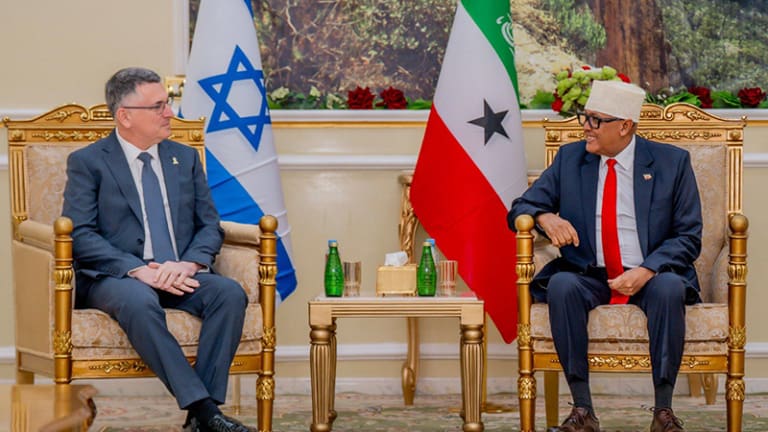
Israel was the first country to recognize the independence of Somaliland and Israeli leaders have already begun building a strong strategic relationship with the breakaway region. On January 6, 2026, Israeli Foreign Minister Gideon Saar visited Hargeisa, the capital of the self-proclaimed republic, and met with President Abdirahman Abdullahi to discuss what he called “the entirety of our relations.” Such relations could include politics, economics, science, or military cooperation, in line with Israel’s vision for the region. But Saar’s visit can also be chalked up as yet another Israeli attempt at forging ties with regions and militias at odds with national governments in the ultimate interest of Israeli security.
Following its invasion of Lebanon in 1982, Israel helped establish the South Lebanon Army, which controlled the security belt that Israel set up across its northern border. But that militia was left to disintegrate when Israel was forced to withdraw from South Lebanon in 2000. Israel had strong ties with Iraq’s Kurdistan region even before the US-led invasion of the country in 2003, despite the fact that Iraq and Israel are still technically in a state of war. While part of federated Iraq, the Kurdistan Regional Government today operates as an autonomous state that maintains independent political and economic relations with states such as Israel. Since the December 2024 collapse of the Bashar al-Assad regime in Syria, Israel has worked to foment rebellion among the Druze of southern Syria and has even supplied weapons and materiel to a local sectarian militia in its ongoing battles with the central authorities in Damascus. While various reasons are offered to justify Israel’s behavior, such relations negatively affect the national security of all these Arab states.
Lying as it does along the coast of the Gulf of Aden, Somaliland provides Israel with the opportunity to establish military outposts that can help it extend its strategic reach and operational capabilities across Saudi Arabia and the rest of the Gulf Cooperation Council (GCC) countries. Establishing military bases in Somaliland would help Israel in its war with Yemen’s Houthis, who since the start of the war on Gaza have launched missiles and drones at Israeli targets. Naval bases could also host warships that could hinder free passage in the Bab al-Mandab waterway or patrol Yemen’s western coast. With such an armed presence, Israel would assure itself of influence or control in the Red Sea and the Gulf of Aden, to the detriment of the national security of Egypt, Saudi Arabia, Sudan, and Yemen.
What may have impeded Israel’s pursuit of these strategic objectives, albeit perhaps temporarily and in limited fashion, was the January 2026 collapse of the Southern Transitional Council (STC) following Saudi Arabia’s forceful intervention in Yemen and the United Arab Emirates’ apparently complete withdrawal of military assets from the south of the country. UAE-backed STC leader Aidarous al-Zubaidi had previously announced that a Republic of South Yemen would join the Abraham Accords and normalize relations with Israel. The timing of Israel’s recognition of Somaliland was curious but telling: It came just as the STC had taken over two governorates neighboring Saudi Arabia—Hadramawt and Mahra—in preparation for a declaration of independence from the Yemeni state. Forging relations with Somaliland and a potentially independent South Yemen would have paved the way for Israel to fully control the stretch of water from the Horn of Africa to the Red Sea.
Although Israel cares little about its reputation as a violator of international law—which proscribes any legal recognition of Somaliland’s independence—its diplomatic opening to Hargeisa is unlikely to garner Arab or international support. The government of Somalia has rejected the move out of hand, as did the League of Arab States and the GCC, as well as many European and other countries. There has been speculation that Ethiopia will venture into recognizing the breakaway region, but thus far not much has transpired about this from Addis Ababa. While Ethiopia may have a strategic interest in establishing official relations with Hargeisa because Somaliland offers a coveted passage to the Gulf of Aden, Addis Ababa must also weigh its relations with Arab nations such as Saudi Arabia and the large group of African nations that have rejected Israel’s move.
Israel’s recognition of Somaliland also is unlikely to serve its putative interest in relocating dispossessed Palestinians to the breakaway Somali state. Somaliland leaders have denied that opening relations with Israel was in exchange for agreeing to host Palestinians expelled from Gaza. Although Hargeisa could well reverse this position in the future, it is hard to believe that Somaliland will be any different than Egypt or Jordan—two countries with diplomatic relations with Israel—whose leaders resisted heavy Israeli, US, and European pressure to allow displaced Palestinians to relocate to their countries. While open to relations with Israel, Somaliland’s population still adheres to a pan-Islamic solidarity with Palestinians that is not likely to allow its leader to accept resettling displaced Palestinians.
Nevertheless, Israel’s recognition of Somaliland’s independence allows it to establish whatever relations serve its strategic interests—at the expense of Somalia’s national security as well as that of the collective security of the Arab world. Diplomatic recognition is only the political component of the equation; what is of greater concern is the economic and military cooperation that will chip away at whatever security architecture the Arab world, and especially the Arabian Peninsula, has been able to construct. It is high time that the Arab world, through both the League of Arab States and the GCC, start working seriously toward protecting its flanks from Israel’s incursions and interventions. It is also high time for the international community to reestablish the primacy of the laws that purportedly exist to protect the sovereignty and territorial integrity of its member states.
The views expressed in this publication are the author’s own and do not necessarily reflect the position of Arab Center Washington DC, its staff, or its Board of Directors.
Featured image credit: x/ President of Somaliland.