
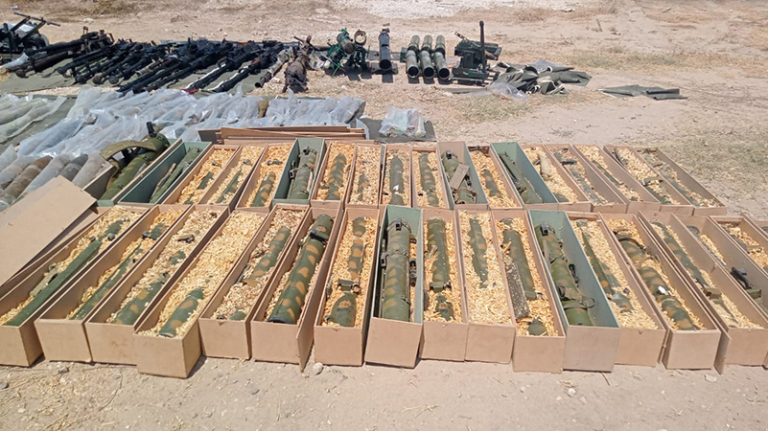
On August 21, 2025, Palestinian factions in the Burj al-Barajneh refugee camp near Beirut transferred light weapons in pickup trucks to the Lebanese Armed Forces (LAF). A week later, Palestinian factions in three camps near the southern city of Tyre handed over a second batch of arms—this time including heavy and medium weapons. The transfers were the first steps in a wider disarmament campaign launched by the Lebanese government following its commitment to the US-backed November 2024 ceasefire between Israel and Hezbollah, an agreement intended to leave the LAF as the only armed actor in southern Lebanon. The government has tasked the army with producing a plan to take control of all weapons in the country by the end of the year. While much analysis has been devoted to the highly sensitive question of disarming Hezbollah, Palestinian militias also possess armed capabilities that the Lebanese government intends to remove as part of efforts to assert its national sovereignty.
Disarming the Factions: What Is at Stake
The need for Palestinian armed factions to transfer their weapons to the state has for decades dogged relations between the Lebanese government and the 200,000 inhabitants of the country’s 12 designated Palestinian refugee camps. Palestinian factions control the camps, which are effectively off limits to Lebanese security and military personnel, although Lebanese forces monitor all movement of people and materiel in and out of the camps.
Palestinian factions have been reluctant to hand over their weapons without guarantees, ever since the late Palestine Liberation Organization (PLO) chairman Yasser Arafat relinquished heavy and medium weapons in a 1991 agreement with the Lebanese state. That handover ended the independent armed PLO presence outside the 12 camps, but the Palestinians in Lebanon never received the civic rights (home ownership, work permits, social security, etc.) or protections that they expected. Today, armed Palestinian groups fear disarming even their limited weapons without ironclad assurances that they will gain rights or security. Some hesitate to disarm in case Israel assumes full control of Gaza and the West Bank, leaving them as the last remaining pockets of possible armed resistance—even though it is not clear how their small numbers in Lebanon could effectively challenge Israel or its backers.
The weapons collected recently include personal rifles, pistols, Grad surface rockets, rocket-propelled grenades, machine guns, and hand grenades. The handover symbolizes the desire of Lebanese and Palestinians to implement the May 2025 agreement between Palestinian Authority President Mahmoud Abbas and Lebanese President Joseph Aoun on disarmament and refugee rights, which envisions that the initial collection of weapons from the camps eventually will lead to full Palestinian demilitarization in Lebanon. That agreement followed decades of discussions on demilitarizing the camps and on granting Palestinian refugees civic rights and security guarantees in the country. Previous attempts never produced results because both sides appeared hesitant to take the first step. Lebanon feared that permanently allowing Palestinian refugees—who are overwhelmingly Sunni Muslims—to live and work in the country would upset the country’s delicate national sectarian balance. For their part, Palestinians were reluctant to disarm because of past experiences in which they relinquished their weapons only to be attacked by combinations of Israeli or Lebanese sectarian or state forces. Such attacks include the 1976 events in Dbayeh, Jisr al-Basha, and Tall al-Zaatar camps and the 1982 massacre in Sabra and Shatila.
Challenges of the May 2025 Disarmament Agreement
The May 2025 Lebanese-Palestinian accord is hampered by the fact that neither Abbas nor Aoun possesses the political and military capabilities necessary to implement its terms. Neither leader enjoys full political support at home or sufficient control over the actors on the ground to force implementation. Abbas is widely shunned by a majority of Palestinians and in effect only speaks for part of his own party, Fatah; he does not control the grassroots Fatah organization in the camps. Aoun is managing a delicate and complicated set of political and economic challenges in the country that impede the Lebanese state’s full assertion of sovereignty.
The August weapons transfers reflect these dynamics. The arms turned over from the Burj al-Barajneh camp, for example, were not from Fatah’s official forces but from a renegade member, Shadi al-Far, who had only recently brought these arms into the camp following his dismissal from the party. It remains unclear whether Fatah will fully relinquish its store of weapons in the camps, or how severe the disagreements were within its ranks regarding the implementation of the May accord.
Both sides billed the first handover of truckloads of arms as an initial step that would be followed by more negotiations and transfers in the coming months, with the aim of achieving full disarmament by the end of 2025. This gradual schedule is largely the result of other armed groups’ rejection of the agreement because of its failure to include any tangible gains for Palestinians’ rights or security. Hamas and Palestinian Islamic Jihad said that the arms transfers were an internal Fatah issue. Some smaller radical Islamist groups that include both Palestinians and Lebanese, such as Usbat al-Ansar and Jundallah, are present in a few camps but are not involved in current discussions.
Caught up in its own potential disarmament, Lebanon’s Hezbollah has denounced the government’s plan to centralize all arms under state control as “a grave sin.” It views any actual or symbolic disarmament by Palestinians or by itself as a direct threat to the mission of “resisting” Israel.
Arms transfers from the factions are managed by the 20-year-old Lebanese-Palestinian Dialogue Committee (LPDC), a Lebanese government agency. Its head, Ramez Dimashkieh, announced on August 28, 2025, that he was preparing legislation for later this year to address refugee demands on issues such as obtaining work permits and legally owning property, albeit without acquiring Lebanese citizenship. Dimashkieh said that the Palestinian camps should eventually be patrolled by Lebanese security forces while being governed by civilian Palestinian officials. LPDC is constrained because it reports to the Lebanese prime minister’s office and lacks the independent authority of a government ministry. The serious discussions coming from the LPDC have so far failed to generate the political support needed to change the laws in ways that meet the concerns of both sides.
The Regional Dimension
The arms transfers inevitably raise the issue of the appropriate role of external actors in achieving the widely desired goal of disarmament.
The Lebanese government wants to assert its full state sovereignty as part of a disarmament deal with Hezbollah, which would be more complex than such a deal with Palestinian factions because Hezbollah enjoys the support of Iran. But Beirut also needs to show that it is serious about taking control of all arms in the country, which will send a signal to the United States and Gulf states that Lebanon merits the reconstruction and development aid on offer. Lebanon also wants to signal to Israel its desire to end the recurring Israeli-Hezbollah wars that have repeatedly shattered the country’s infrastructure and killed or displaced thousands of citizens. Without progress, the Lebanese government fears the imposition of sanctions from the United States and other countries. It also wishes to secure the end of the Israeli-imposed border buffer zone in South Lebanon (Israel has bombed into desolation most of the 5-kilometer-wide Lebanese strip along the border, and its troops remain in five hilltop sites inside the country) and is wary of being excluded from lucrative contracts for Syrian reconstruction in the future.
For his part, Palestinian President Abbas wants to strengthen his weak hand among his own people by showing that he can improve the refugees’ status in Lebanon. He desperately needs the support of American and Arab donors who support disarmament, as well as leverage over Israel to strengthen his claim to play a role in post-war Gaza. If Abbas can gain Lebanese agreement on implementing past memoranda on improving Palestinian refugee rights in Lebanon, his status—and that of Fatah—would be considerably boosted.
Problematically, Lebanon has never acknowledged the Palestinians as refugees who are entitled to the economic, civic, and human rights outlined in various international refugee law and human rights accords. Making the leap to seriously improving Palestinian refugees’ access to work, education, property, and health rights in Lebanon will require major political shifts in the country that do not yet appear to be on the horizon.
Many Lebanese inside the country and abroad hope that bringing all weapons in the country under the state’s control could move Lebanon’s political leaders toward improving Palestinian rights, which is why the August arms transfers are important—and potentially even historic. A key factor shaping progress appears to be whether regional and international actors will buy into the new vision of a Lebanon free of the perpetual wars that have had such a negative impact on the country’s stability and development.
The views expressed in this publication are the author’s own and do not necessarily reflect the position of Arab Center Washington DC, its staff, or its Board of Directors.
Featured image credit: Facebook/LAF