From late September to mid-October 2025, Moroccans across the country descended into the streets to once again demand change from their government. Under the banner of a leaderless youth coalition dubbed the Gen Z 212 Movement (after Morocco’s international telephone code), protesters called for improved conditions in hospitals and schools, fair job opportunities, infrastructure that meets social needs, and an end to government corruption. While Gen Z 212’s slogans and hashtags are new, the underlying message of citizens weary of government indifference is not. The grievances remain unchanged from the 2017 Hirak Movement and the 2011 February 20 Movement before it—as is the state’s carrot-and-stick response to popular unrest.
What has changed are the stakes. As questions loom over King Mohammed VI’s health, 22-year-old Crown Prince Moulay Hassan has taken on a greater public role, suggesting that the monarchy is laying the groundwork for a leadership transition. One of Moulay Hassan’s most recent appearances was the September 4, 2025 inauguration of the new Prince Moulay Abdellah stadium in Rabat, which happened just months before Morocco hosts the African Cup of Nations in December 2025. In 2030, Morocco will co-host the World Cup, the world’s most-watched sporting event. As such, Morocco may be undergoing a critical period of potential leadership transition and popular discontent at a moment when it is under an unusually bright international spotlight.
In previous years, Morocco has been able to contain citizen discontent. By addressing deep structural problems with only superficial solutions, the regime has maintained the appearance of stability without conceding the status quo— but that policy only released the steam from the pressure cooker without turning down the flame. Despite its name, the Gen Z 212 Movement is driven by long-standing questions of governance, not only the anxieties of a new generation. For Gen Z 212, Morocco’s old formulas for managing dissent may no longer suffice.
The Outbreak of Protests in 2025
In the weeks leading up to the first major Gen Z 212 protest on September 27, 2025, two developments stirred simmering popular frustration into a rolling boil of outrage. The first took place in August 2025. The maternity ward of the Hassan II Hospital in Agadir became a scene of grief when eight women died due to birth-related complications within the span of just ten days. As family members found themselves having to make funeral arrangements instead of celebrating new life, outrage spread throughout the local community and beyond. Morocco’s Minister of Health appeared on television and framed the deaths as anomalous, pointing instead to favorable figures and planned healthcare projects. For the public, shocking images of stray cats and strewn garbage in the hospital’s operating rooms spoke louder than his excuses.
The second development unfolded on September 4, 2025, in the city of al-Hoceima in the Rif region, nearly one thousand kilometers away from Agadir. Authorities had granted the leader of the Hirak Movement protests, Nasser Zefzafi, a brief humanitarian release to attend his father’s funeral. Zefzafi, who is serving a 20-year prison sentence for leading protests, is widely venerated in the Rif and is seen as carrying on the legacy of Abdelkrim al-Khattabi, an anti-colonial icon of the mid-twentieth century from the Rif who inspired other revolutionary icons including Che Guevara and Ho Chi Minh. Large crowds gathered outside Zefzafi’s family home, where he addressed the public from the same place he had last spoken to protesters just days before his arrest in May 2021. At the cemetery, the crowd grew and what began as a funeral ended in thousands spontaneously protesting for his permanent release.
Despite its name, the Gen Z 212 movement is driven by long-standing questions of governance.
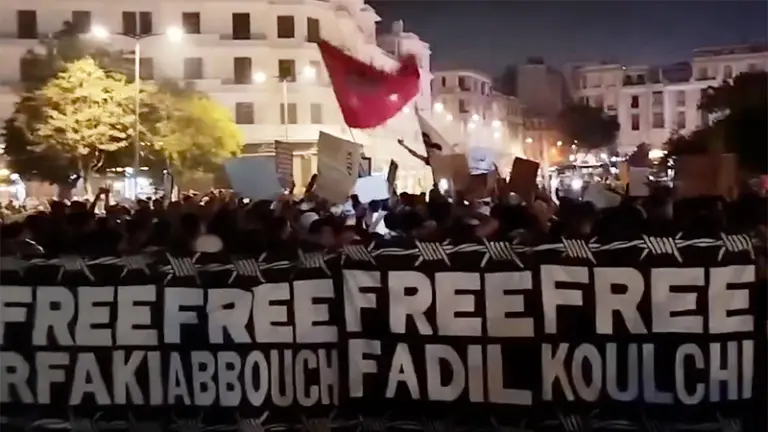
In terms of their timing and circumstances, the developments in Agadir and al-Hoceima were not directly connected. But in terms of the root causes and the sentiments shared among people, they were one and the same—a reality recognized by participants in the Gen Z 212 protests. In mid-September 2025, a group of anonymous individuals came together on Discord, a popular gaming and digital messaging platform. Initially, the platform served as a space to share reactions over the Agadir mothers who died in childbirth. Within two weeks, this online community had expanded to thousands of members, who reached a consensus on the need to take action through coordinated and nationwide protests. The first such protests took place on September 27, 2025 in multiple major cities including Rabat, Casablanca, and Marrakech. By the sixth consecutive night of protests, security forces had killed three protesters, causing public anger that was amplified by extensive media coverage.
On October 10, 2025, King Mohammed VI delivered his annual speech to mark the opening of parliament. Although the king steered clear of directly addressing the protests, he called for the swift implementation of reforms and programs that echoed protesters’ demands, including job creation to combat youth unemployment and the improvement of public services in both urban and rural regions. The very next day, the Gen Z 212 Movement announced that it was temporarily halting protests to re-organize. Since then, focus on the streets has steadily waned as protesters have taken their fight to the courts, where more than 2,400 protesters face criminal charges.
Continuity Beneath the Hashtags
The Gen Z 212 movement has evoked parallels with recent youth-led protests elsewhere, including Nepal, Madagascar, and Indonesia. Such a comparison emphasizes a youthful spirit harnessing the technological tools of its age—as well as their anger over youth unemployment, which has reached 35 percent in Morocco. Yet, the protests signal the ongoing of tension between ruler and ruled that began in 2011 with Morocco’s iteration of the “Arab Spring” and the 2017 Hirak Movement. In 2011, Moroccans across the country organized under what they dubbed the February 20 Movement. While the movement shared the spirit and energy of other protest movements in the region, the February 20 Movement called for political reforms rather than an end to the monarchy. In response, King Mohammed VI announced constitutional reforms and a new government was elected that same year. At the time, some observers lauded Morocco for avoiding the turbulence that hit other Arab Spring countries, but in 2017 the Hirak Movement emerged to remind onlookers of underlying public discontent in the country. The Hirak Movement grew out of an October 2016 event—reminiscent of Tunisia’s December 2010 revolution-sparking incident of state abuse of a vegetable seller—in which authorities confiscated and then threw out the wares of fish vendor Mohcine Fikri. Desperate to salvage his only source of income, Fikri leapt into the garbage truck to retrieve his stock. Police ordered the driver to initiate the compactor, and within seconds Fikri was crushed to death in a heap of garbage. The Hirak Movement lasted until summer 2017 when its leader Zefzafi was arrested.
In addition to the political discontent, three devastating crises have hit Morocco—and the government has failed its people on all three occasions. While the root causes of these crises were beyond the control of the state, government mismanagement has compounded the disasters with human-made failings.
The first crisis has been caused by the ongoing drought. The worst on record in decades, the drought reduced the country’s 2024 wheat harvest by half, severely hurting Morocco’s agricultural sector—the country’s largest employer—and contributing to skyrocketing food prices. Morocco’s famed and widely-used public baths have had to close three times a week to preserve water for more critical uses. For the first time during his 26-year reign, King Mohammed VI urged Moroccans to forgo the Eid sacrifice, citing dwindling livestock numbers.
Second, overlapping with the drought was the COVID-19 pandemic that began in March 2020 and which by March 2023 had claimed more than 16,000 lives in Morocco. Like elsewhere in the world, a series of lockdowns and curfews were put in place to limit the spread of the virus, but Moroccan authorities’ enforcement of the emergency response was especially carceral. Between July 2020 and April 2021, authorities arrested some 1.5 million people for violating COVID measures.
Three devastating crises have hit Morocco—and the government has failed its people on all three occasions.
The third crisis was the 6.8 magnitude earthquake that struck the High Atlas in September 2023, killing nearly 3,000 people. A critical factor in the high death toll was that officials failed to coordinate emergency response measures until the following day because they had to wait for King Mohammed VI to arrive from Paris.
The human cost of these crises is an aggravating factor resulting from and contributing to urban-rural disparities in Morocco. One metric that acutely reflects these circumstances is the disparity in average household incomes. The average income in urban households is 105,320 dirhams ($11,192), whereas rural household incomes stand at 56,047 dirhams ($6,059). Not only are urban households earning at least 80 percent more than their rural counterparts, but much of the labor force and raw material that sustains urban development comes from Morocco’s rural regions. Agadir, for example, is the largest city in the Souss region, an alluvial basin that is the country’s primary source of agricultural yields and that regularly outperforms all of Morocco’s other regions in terms of economic growth. The more than 13 million people who live in Morocco’s rural regions share more than just poor socioeconomic prospects. Rural regions are predominantly home to the indigenous Amazigh population, an ethnically distinct and diverse community of North Africa that have endured decades of marginalization under state-led Arabization policies. Rural regions also suffer from a dearth of basic infrastructure, which isolates them from such vital national arteries as the railway and highway systems. In the most extreme cases, the medieval state of basic utility services in rural areas limits daily access to running water and electricity. It is these factors, not a newfound wielding of technology, that explain protests in Morocco, both recent and past.
Conclusion
The events leading up to the Gen Z 212 protests reflect what Moroccans refer to as hogra, a term that expresses the denial of dignity and that captures the difficult daily conditions of a growing number of Moroccans. The ecological disasters of droughts and earthquakes pose enough challenges on their own. But poor governance and authoritarian policies have worsened what were already abysmal circumstances. The persistence of the underlying demands fueling protests in Morocco is symptomatic of the state’s approach to dissent, best described as deferred containment: preventing the spread of dissent through appeasement and violence, buying time to consolidate power through symbolic gestures, and redirecting public attention to a spectacle.
At first, such a strategy was effective insofar as the Moroccan public regarded the state with trust, as was the case following King Mohammed VI’s March 2011 speech promising constitutional reforms. It was also successful in presenting the international community with the façade of stability and progress. But since then, the king has delivered versions of the same formulaic speech as he did in July 2017 with the Hirak Movement, October 2023 with the earthquake, and October 2025 with the Gen Z 212 protests, to name a few. This strategy has entrenched the regime’s grip on power while deferring the important and difficult work of meaningful change. Today, that long-deferred day of change may finally have arrived as a drought-stricken populace thirsts for dignity and justice.
The views expressed in this publication are the author’s own and do not necessarily reflect the position of Arab Center Washington DC, its staff, or its Board of Directors.
Featured image credit: Social Media

