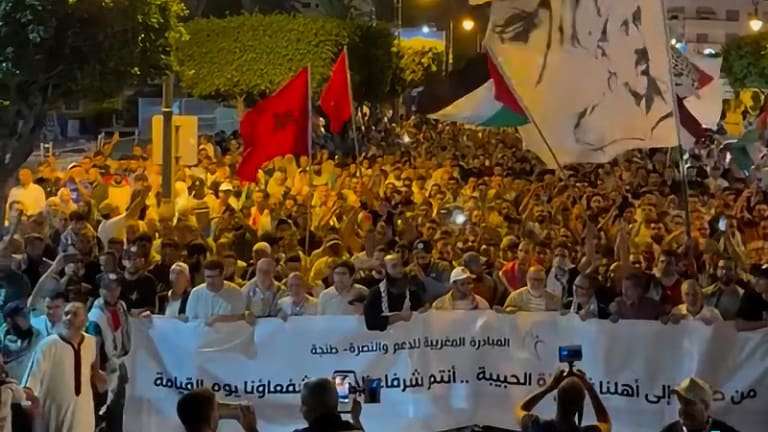
Certain signs are undeniable. When a generation born in the digital age stops swapping memes and instead mobilizes en masse to declare “enough is enough,” it warrants serious attention. In Morocco, the Generation Z movement (Gen Z 212)—spreading through digital platforms like Discord and TikTok—has gained such momentum since it erupted on September 27, 2025, that it now poses a direct challenge to the kingdom’s executive power in its core domain: the management of public services.
Triggered by the tragic deaths of eight pregnant women within ten days at the Hassan II Regional Hospital Center in Agadir, these demonstrations are visible symptoms of a deeper systemic crisis. Their origins lie in years of disillusionment with an authoritarian regime and the persistence of a two-speed Morocco. On one side stands a showcase nation—ultra-modern, with high-speed trains and gleaming new stadiums; on the other, a marginalized Morocco where 45 percent of rural households report having no access to local health services.
This wave of unrest is particularly significant as it revives a powerful collective memory: the 2011 Arab Spring. At that time, Morocco successfully cast itself as an exception. While Tunis and Cairo underwent regime change, Rabat chose reform. King Mohammed VI introduced a constitutional reform hailed as a model of “smooth transition.” Fourteen years later, however, the façade of stability is cracking. The reforms proved largely cosmetic; real power never shifted, and social inequality has only deepened. The so-called Moroccan exception is reaching its limits. Today’s youth—many too young to have marched in 2011—have neither the patience nor the illusions of their elders. Where the Arab Spring generation dreamed of a reformist monarch, Generation Z demands an accountable state.
Their frustration is well founded. In 2024, youth unemployment exceeded 35 percent, and nearly half of Morocco’s university graduates are considering emigration. The gap between personal ambition and political reality has never seemed wider. Generation Z sees its future narrowing before its eyes. Confronted with this bleak horizon, thousands of young people have taken to the streets across Morocco to demand jobs, decent public services (especially healthcare and education), and an end to corruption in government institutions. They have also questioned why Morocco should co-host the 2030 FIFA World Cup—projected to cost the kingdom around $5 billion—while the country continues to neglect its pressing socioeconomic needs.
The Disjuncture Between the Social and the Political
The Moroccan government has struggled to address these growing expectations. Its political discourse—rooted in notions of order, sovereignty, and reform—stands in sharp contrast to the language of Gen Z, which highlights dignity, solidarity, and justice.
The royal address of October 10, 2025, made this tension explicit. In his speech to parliament, King Mohammed VI made no mention of the Gen Z movement, instead calling for the acceleration of social and political reforms. Shortly afterward, the government announced that the 2026 budget would allocate 140 billion dirhams—roughly 10 percent of GDP—to health and education, representing a 16 percent increase over the previous year. The government also approved legislation to encourage youth and women’s political participation by lowering candidacy thresholds and by subsidizing up to 75 percent of campaign expenses for candidates under 35.
While these measures amount to the most significant policy concessions since the 2011 reform process, they also reveal the limits of the monarchy’s adaptive capacity. The king’s discourse frames the crisis as a problem of efficiency rather than legitimacy, yet the movement’s demands reach far beyond administrative reform. They challenge the enduring imbalance between an inward-looking monarchy and a Moroccan society that has grown increasingly globalized and self-aware through comparison with other countries.
This tension is further reflected in the movement’s mobilization around the Palestinian cause. In a context where Morocco normalized relations with Israel in 2020, many young people see this policy as emblematic of the widening gulf between state and society. Public opinion has remained largely opposed to normalization: a 2022 Arab Opinion Index survey by the Arab Center for Research and Policy Studies in Doha found that only 20 percent of Moroccans supported recognizing Israel while 67 percent opposed it. According to a 2024 Arab Barometer study, a shrinking minority of Moroccans approved of normalization between Israel and the Arab world in 2022, only 31 percent supported normalization—a figure that in 2024 dropped to 13 percent after the Gaza conflict had begun.
Solidarity with Gaza, omnipresent in the rallies, has intertwined with domestic grievances under the slogan “no justice there without justice here.” For Moroccan youth, condemning corruption or failing hospitals at home is a way of indicting a broader global system of injustice. The Palestinian cause has become a mirror reflecting their own local struggles with power, injustice, and unfulfilled promises.
The authorities’ response to the demonstrations follows a familiar pattern in Moroccan governance: a dual strategy that pairs reformist rhetoric with coercive enforcement. Security services have arrested more than 2,000 protesters, with several sentenced to prison for “inciting unrest.” Clashes between demonstrators and security forces continue in cities such as Lqliâa, Oujda, and Safi, where at least three deaths were reported in early October. The regime’s fear is evident in the severity of its judicial response. On October 14, 2025, the Agadir Court of Appeal handed down to 17 youth a total of 162 years in combined sentences.
The Global Resonance of Social Demands
The government’s inability to engage with social concerns is not unique to Morocco; societies are increasingly emerging as political actors in their own right. Populations are no longer passive recipients of state policies—they are producers of legitimacy, capable of challenging traditional sovereignty and imposing their own narratives. Local grievances now reverberate across borders, creating a global resonance of social frustration. What we are witnessing in Morocco is part of this wider dynamic.
From Indonesia to Nepal, from Madagascar to Peru, Generation Z is making similar demands: transparency, social justice, and an end to entrenched political and economic privileges. These mobilizations are leaderless, hyper-connected, and adept at linking local grievances to global narratives—among them corruption, cost of living, and censorship.
The Gen Z movement has spread globally, adopting similar digital mobilization strategies, symbolic occupations of public spaces, and collective pressure on discredited elites. Platforms such as Discord, Telegram, and TikTok enable this digital-native youth to bypass traditional structures—political parties, unions, and NGOs—and forge a new political imagination, often rallying around pop culture symbols like One Piece from Japanese comics. From Peru to Madagascar, Morocco to the Philippines, the pirate flag inspired by this manga hero has become an emblem of a generation fighting for social justice, solidarity, and rejection of corruption and capitalism, while aspiring for a better life.
Often caricatured as screen-addicted and apolitical, this youth is proving the opposite through its actions. It is reclaiming public space—both physically and symbolically—transforming repression and humiliation into acts of resistance. Social networks have become their headquarters, providing spaces for organization, archiving, and subversion. They allow movements to inspire one another, to share images of uprisings from Indonesia, Nepal, or Morocco, and to nurture the belief that victory is possible—as seen in the fall of the Nepalese government on September 9, 2025.
What Lessons Can Be Drawn?
Exhausted by their efforts to contain this diffuse force, governments are discovering that every heavy-handed measure only reinforces the legitimacy of the anger they seek to suppress. One of the key lessons from Gen Z mobilizations is that government responses can no longer rely on repression or technocratic management alone—they must become genuinely social. States have no choice but to restore meaning, to renew a sense of justice, and to reinvent a collective narrative that can engage their youth. Failure to do so risks a dual erosion, of internal legitimacy and international credibility. In this reshaped political landscape, technology plays a central role. Social networks are no longer just communication tools—they have become new infrastructures of power and political actors in their own right. Governments must reckon with this reality, or risk facing forces they can no longer control.
For Morocco, the survival of the regime will hinge less on repression or redistribution than on its capacity to restore meaning to the social contract with its citizens. Generation Z has already transformed the grammar of protest: it communicates through networks rather than hierarchies and demands accountability rather than benevolence. How the state chooses to respond—whether it views this movement as a threat or an opportunity—will likely determine not only Morocco’s internal stability, but also the broader trajectory of reform politics across the region and, potentially, in Europe.
The views expressed in this publication are the author’s own and do not necessarily reflect the position of Arab Center Washington DC, its staff, or its Board of Directors.
This Viewpoint was originally published in French by the Centre arabe de recherches et d’études politiques (CAREP) in Paris, France.
Featured image credit: Social Media/Genz212.Moroccan