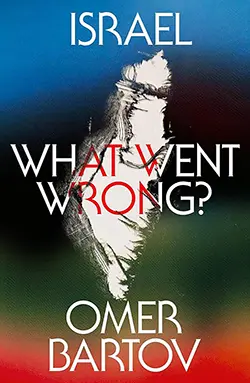
 This timely book by a distinguished historian and leading genocide and Holocaust scholar is a must-read because of its explicit tone, factual multi-sectoral analysis, and historically grounded and honest discussion of the most sensitive, but urgently relevant, dimensions of modern Zionism, Judaism, and Israel. It revolves around how we should understand—and end—Israel’s US-enabled, slow-motion genocide in Palestine.
The book’s message is clear from the very beginning. The title, Israel: What Went Wrong?, does not really pose a question. It instead stands as a declarative statement to clarify the book’s focus on the question of why Israel has become such a violent, divisive land.
In his opening paragraph, Bartov outlines how in recent decades Israel and Zionism have become a genocidal danger to Palestinians as well as to Israelis and Jews themselves. Bartov writes, “This book explores the tragic transformation of Zionism, a movement that sought to emancipate European Jewry from oppression and persecution to a state ideology of ethno-nationalism increasingly focused on the exclusion and violent domination of Palestinians under Israeli rule” (p. 3). He asks why a state founded after the Holocaust is accused of widespread war crimes, forcible displacement of civilian populations, and crimes against humanity. Other questions include why Israel is committing a genocide with near impunity—80 years after the passage of an international legal regime set up to end the practice—and why Israel’s conduct is supported by most of its Jewish citizens.
Bartov assesses critical dimensions of Israel and Zionism that evolved from the Nazi genocide against the Jews to the Israeli genocide against Palestinians. These dimensions include Jewish culture, Judaism as a religion, antisemitic discrimination, subjugation, attempted annihilation, and the collective responses of many Israeli and Jewish subgroups, as well as politics, global alliances, militarism, constitutionalism, citizenship, and telling the truth about themselves and their Palestinian victims–turned–foes.
The book first reviews why Hamas attacked Israel in October 2023 and why Israel in turn unleashed its genocidal annihilation of human life in Gaza. Bartov believes that this outcome was not inevitable: Israel could have evolved in a more humane direction after its founding in 1948. He asks, “How is it that the appeal to humanitarianism, tolerance, the rule of law, and protection of minorities that characterized the beginning of Jewish self-emancipation gradually acquired all the traits of the relentless, remorseless, and increasingly racist ethno-nationalisms from which Zionism sought to liberate European Jewry?” (p. 4).
A leading expert on genocide and the Holocaust that largely wiped out his Jewish family in the Polish–Ukrainian borderlands, the Israeli–American Bartov is a tenured professor at Brown University who completed his compulsory service in the Israeli military. His background and personal experience amplify his value as a historian, writer, and concerned human being.
In more than 200 pages of examples and explanations of how, when, and why Israel’s ruling political elite moved the state onto the path of racist, militant, and exclusivist Jewish ethno-nationalism, Bartov systematically traces the key forces that effected this transformation. These include historical antisemitism, Zionism, the Holocaust, the Palestinian Nakba, Israel’s Declaration of Independence, and its post-1967 military occupation of more Palestinian lands. He discusses Israel’s constitution that was never written, the promise of equal rights to all citizens that was never attempted, and the commitment to share the land with a Palestinian state that was never sincere. The profound post-Holocaust ethic of “never again” apparently applied only to protecting Jews, who were free to ignore UN decisions and international law if they felt threatened.
After October 7, 2023, Netanyahu and his extremist allies saw an opportunity to end the Palestine question in Gaza under the guise of self-defense. Their genocidal assault unfolded with near-total impunity, threatening the relevance, if not the continued existence, of the entire edifice of international law. Bartov argues that the United States bears the greatest responsibility for this situation.
As a historian, Bartov believes that the first step toward a better future is understanding the hopes, errors, and sins of the past. He wrote this book neither to praise nor condemn Zionism and the State of Israel, he says, but in the hope that his text might open minds and allow all to recognize “how we got here in the first place, and perhaps even how we might clamber out of the abyss” (p. 26).
Bartov sees the 1967 June War and Israel’s occupation of all Palestinian lands as the development that fundamentally transformed Israeli politics, mentality, and norms. He notes that when Jewish citizens encounter Palestinians, it is most commonly as soldiers enforcing the occupation, and their conduct is intended to show who is the boss. “The occupation has thus dehumanized the occupied and the occupiers alike,” he says (p. 18).
Bartov’s most striking and useful analyses explain how antisemitism, the Holocaust, and a heightened and perpetual sense of vulnerability caused Israel to turn steadily to far-right extremists for its rulers. The result was that “[e]ventually the catastrophe of the Holocaust became for most Israelis, a vast fig leaf, its lamentable effect to combine self-victimization and self-pity with self-righteousness, hubris, and the euphoria of power, with one side of the equation justifying the other” (p. 106).
Any criticism of Israel was branded as antisemitic, with genocidal intentions, Bartov says. As we witness on an almost daily basis, the Palestinian struggle is tarred with the same brush.
In Israel’s unwritten constitution, Bartov sees the unresolved tension in the state’s efforts to maintain simultaneously its democratic and its Jewish character. These irreconcilable objectives left Israeli politics prone to extremism and repression. Israeli laws favor its Jewish citizens, making Israel today a state of the Jews. Consequently, the forces of ethno-nationalism and religious fanaticism have grown ever stronger. As Bartov argues, “The realities of the state constantly sharpened the edges of this state ideology in ways that no one could have predicted in 1948, making it more bloody-minded, more paranoid, more violent, and eventually even more racist” (p. 182).
Bartov concludes with a lament that most Israelis whom he encountered on his last visit to Israel exhibited resignation, indifference, and even despair, but little empathy for Palestinians. He captures the mood in Israel by quoting Zeev Smilansky, who had once told the Israeli press that he had no place in his heart for the fate of the children of Gaza, but wrote in Haaretz in February 2025 that, “We fought in vain in Gaza. We spilled blood in vain. Because we cannot stare the truth in the face. Because we don’t know how to do anything but to bomb.” (p. 196).
Bartov’s antidote to all this is to dislodge the incumbent Israeli government, to reach a regional peace agreement, to open a peace and reconciliation process, and to enhance security, equality, the rule of law, and unity. He mentions many available proposals on these aims but does not believe that Israel today can accomplish all these goals. He therefore calls for coordinated international intervention. He characterizes US President Donald Trump’s “Board of Peace” as an initiative to, in effect, oversee the crime of forced population transfer. If international pressure proves insufficient to produce change, Israeli apartheid system eventually will implode just as South Africa’s did, and the Zionist dream will become a nightmare.
France, Germany, Poland, and other countries in Europe notably experienced wartime catastrophes after which they developed new mentalities and transformed their societies. Bartov says that, in retrospect, “[t]he enormous shock of October 7 should have been the moment to start this kind of transformation in Israeli society—to realize that the very paradigm of Zionism had to be drastically changed” (p. 218). The book ends with Bartov’s heartfelt plea that “[o]nly the assurance of equal rights to all inhabitants of the land can put an end to this calamity. As long as seven million Jews rule over seven million Palestinians without any prospect of equality, peace will not come” (p. 219).
The views expressed in this publication are the author’s own and do not necessarily reflect the position of Arab Center Washington DC, its staff, or its Board of Directors.