
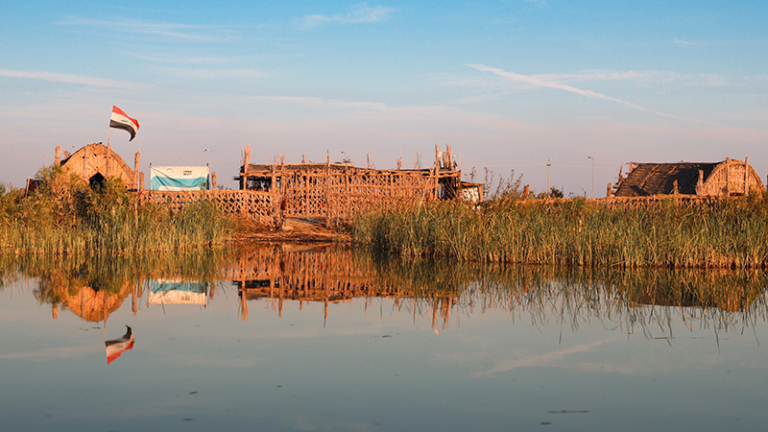
In 2025, Iraq experienced what its Ministry of Water Resources described as the worst drought since 1933. National water reserves fell to just eight percent of their total storage capacity, and the government banned summer and winter cropping across four million hectares as water shortages made irrigation nearly impossible. Dhi Qar, the southern governorate where communities have been historically dependent on the Euphrates marshlands for their agriculture and livestock, was among the hardest hit by the drought. More than 10,000 families were displaced there as rivers shrank to a fraction of their normal levels. In January 2026, the Deputy Special Representative of the United Nations (UN) Secretary-General for Iraq warned that “eight million people face water-related life-threatening risks if bold and coordinated action is not taken now.” By May 2026, those same rivers had begun flooding, first submerging farmland across eastern Syria before pushing southward into Iraq’s reservoir network, temporarily raising national reserves nearly six times what they had been in the previous year.
The swing from catastrophic drought to sudden flood surplus in less than twelve months perfectly captures Iraq’s water problems. Iraq has long faced variable rainfall. Its rivers originate largely beyond its borders, making the country vulnerable to upstream dams in neighboring Turkey and Iran. Climate change has also contributed to Iraq’s uneven water supply. However, none of these factors are the primary cause of the country’s current inability to solve its water problems. At its core, Iraq’s water crisis is a governance crisis. Water authority is split across government ministries that do not coordinate. The government’s infrastructure procurement process has been captured by political interests rather than directed by technical need. And successive administrations have found it easier to subcontract essential water management to upstream neighbors rather than to fix what is broken at home.
Only by addressing these governance issues can Iraq begin to resolve its water problems. Iraqi leaders now have a rare opportunity to make changes, given that the country is experiencing an unexpected water surplus from the floods and the immediate pressure of acute water scarcity has been lifted. For once, there is space for the kind of institutional reform that is difficult to pursue mid-drought. Iraq has also recently acceded to an international water convention that provides new tools for domestic coordination. Such a window of opportunity will not stay open for long.
How Institutional Failure Produced the Crisis
Since 2008, responsibility for governing Iraq’s water has been divided across multiple ministries and local authorities that lack the necessary funding, staff, and authority, producing a system that is informal and ineffective. The country lacks a comprehensive national water law that would establish clear priorities, assign responsibility between ministries, and require them to share data and coordinate planning. The water laws that do exist were written when Iraq’s primary challenge was flooding rather than water scarcity. An updated draft national water law has reportedly circulated for years, but it was only in April 2026 that parliament completed the first reading of a proposed National Water Council Law aimed at establishing a unified national strategy for water management. This new law has still not been ratified.
This institutional and legal incoherence has been exacerbated by Iraq’s muhasasa system, the informal ethno-sectarian power-sharing arrangement that has dominated the country’s political system since the 2003 US-led invasion. Under muhasasa, ministries are divided among Iraq’s main political and sectarian blocs as part of the process of forming a coalition government. Government posts often go to political loyalists rather than the most qualified candidates, and procurement contracts are effectively agreed upon behind the scenes before any formal tender process has been initiated. For the water sector, the result is that technical staff are often sidelined, while contracts go to politically connected firms regardless of expertise.
The human cost of these governance issues is clearest in Basra. A 2022 study found that Basra city’s main treatment plant was staffed by only three maintenance engineers who managed dozens of aging units. In 2019, Human Rights Watch reported that despite a 2008 commitment from the Japan International Cooperation Agency to spend $395 million improving the city’s neglected water systems, the city’s infrastructure projects were still years behind schedule and mired in allegations of fraud. In 2018, ongoing water contamination sent 118,000 people to hospital and triggered mass protests. Similarly, a $220 million desalination plant in the city of al-Hartha was commissioned in 2014 but not completed until 2019, as contractors faced extortion and labor disputes.
The Ministry of Water Resources budget shrank from $1.7 billion in 2014 to just $15 million in 2018.
Nationally, the Ministry of Water Resources budget shrank from $1.7 billion in 2014 to just $15 million in 2018, as the central government redirected funds to its military campaign against the so-called Islamic State. This reallocation reflects how, for Baghdad, military security has long trumped water security. The 2023–2025 drought revealed the high cost of government neglect. In September 2025, the UN Iraq Water Task Force estimated that 186,006 people had been displaced due to water-related issues, with 63 percent of them having left rural areas where rivers have dried up. 98 percent of Dhi Qar’s wetlands and agricultural areas had reportedly become barren land, more than 15,000 buffalo had died, and nearly 90 percent of fish stocks had been lost. All the while, Dhi Qar’s water system has remained dependent on a single open canal that has lost about half of its water, in part from evaporation and unauthorized extraction before it reached treatment plants. In many neighborhoods of Basra city, rising salinity in the water supply made tap water unusable for drinking or cooking. Families that could afford to buy water privately did so, while those who could not went without. Across the country, Iraq’s irrigation network, built largely in the 1970s, was operating at around 60 percent efficiency. The lesson from the drought is that Iraq’s institutions are incapable of cushioning its effects, even when the means to do so exist.
Why Blaming Backfires
Iraqi officials have often looked beyond their borders to alleviate their country’s water crisis. Baghdad has blamed Turkey’s upstream dams, especially the Ilisu Dam on the Tigris, completed in 2020, which has significantly reduced downstream flows, as well as Iranian diversion projects on the Diyala and other tributaries. Flows from the Tigris and Euphrates have fallen by 40 percent over the past four decades, in part because of this upstream dam construction.
Although Iraq may have grounds to seek more predictable and equitable flows from its neighbors, it is not faultless. As analysts have pointed out, Iraq’s own irrigation systems are among the least efficient in the region. The country loses enormous amounts of water due to leakage, evaporation, and outdated flood irrigation techniques before it reaches farms or households. Some Iraqi officials have acknowledged their reluctance to discuss these domestic water losses out of concern that it would weaken their negotiating positions with Turkey. Yet Ankara can counter Baghdad’s position by asking why it should release more water to a country that cannot properly manage what it already receives. Iraqi delegates to water negotiations can offer no credible defense.
Iraq’s own irrigation systems are among the least efficient in the region.
Despite such tensions, in November 2025, Baghdad reached a new oil-for-water deal with Ankara. For the Iraqis, the desperation behind the deal was real. With reserves at eight percent capacity, Iraq had no real domestic reform initiative to address its water shortage. Under the signed framework agreement on water management, Iraq committed its oil export revenues to fund water infrastructure projects that would be built by Turkish companies, effectively creating a closed loop in which revenues from oil sold to Turkey flowed back into Turkish-built projects. Iraqi officials have insisted that the agreement ensures that water management remains under their control and that existing Iraqi technical staff will be retained. But independent experts have warned that granting Turkish firms primary responsibility for building Iraq’s water infrastructure for years at a time—at a moment when Iraq’s own institutions remain underfunded and understaffed—risks creating external dependencies without addressing the water mismanagement issues within Iraq that prevented an adequate drought response in the first place. The deeper problem is that Turkey gained leverage over its neighbor’s most vital resource at a moment of acute vulnerability. One Baghdad-based water policy expert warned that the deal “departs from internationally recognized principles of water diplomacy.” In other words, the endpoint of the deal reflected institutional incapacity rather than a diplomatic achievement.
What Reform Would Require
Iraq has no shortage of plans for improving its water sector. In 2015, one long-term plan proposed $180 billion in investments in the water sector by 2035, but the necessary financing did not materialize. In 2024, Iraq announced plans to build ten rainwater-harvesting dams and finalize a major Basra desalination project, both years overdue. However, the Iraqi government has lacked the institutional machinery to implement these plans.
There are, however, three changes Iraqi leaders could implement that are both realistic and—given the current moment of relative water abundance—more politically achievable than in prior years. The current water surplus has temporarily removed the pressure of acute crisis that previously made reform feel impossible. The question now is whether the government uses this window of opportunity or waits for the next drought to reopen the debate.
First, domestic coordination can be improved using Iraq’s 2023 accession to the United Nations Economic Commission for Europe (UNECE) Water Convention as a springboard. The convention is a binding international legal framework for countries sharing transboundary rivers and requires parties to cooperate on water management and exchange information. Upon accession, the Iraqi government established an Inter-Ministerial Committee on the Water Convention to implement its legal obligations under the convention. The committee is chaired by the Minister of Water Resources and brings together ministries that previously operated independently. UNECE has supported the committee with technical assistance, and in 2024–2025 helped facilitate national water dialogues among representatives from the government, civil society, and private sector. The Iraqi government should now give this committee a formal legislative mandate, through either a parliamentary decision or a prime ministerial decree, to publish a shared annual water-action plan designating which institution is responsible for each project along with its budget, timeline, and measurable targets.
Domestic institutional reform is a precondition for successful regional water diplomacy.
The second change should address greater procurement transparency, which offers a direct way to begin disrupting the dynamics of muhasasa that have repeatedly caused projects to collapse in Basra. Major water infrastructure contracts, including those financed under the Turkey agreement, should be publicly tendered with an independent technical audit before and after completion. Iraq’s Federal Commission of Integrity (Nazaha), the independent government body tasked with investigating corruption, currently lacks the enforcement power to impose transparent procurement processes within ministries. The Iraqi parliament should pass legislation giving the commission such authority, specifically over water infrastructure procurement. International partners financing water projects should also condition such transparency as a prerequisite for fund disbursement.
Finally, Iraq must rebuild its negotiating credibility with Turkey and Iran. Turkey signed a deal with Iraq that gave it extraordinary leverage over its neighbor largely because Iraq had no institutional alternative and no credible domestic water management plan. A future Iraqi government that has ratified a national water law, empowered a coordinating authority over its water policy, and cleaned up its procurement processes will be in a stronger position for future negotiations. Iraq could demand binding, equitable water-sharing arrangements with its neighbors rather than emergency oil-for-water deals, while demonstrating its capability to effectively use the downstream flow of water. Domestic institutional reform is a precondition for successful regional water diplomacy.
Conclusion
The 2026 spring floods have subsided, and Iraq’s reservoirs, which had recovered to around 34 billion cubic meters after a wetter-than-normal winter, are already being drawn down. The next drought will likely be harsher than the last: climate change will make the swings more severe, and Turkish and Iranian dams are not going anywhere. What can change—and what the current moment makes possible—is how well Iraq’s institutions can manage the water it has, store what water arrives in abundance, and arrive at future negotiations ready to offer something besides desperation. The country that once gave the world irrigation now imports water management. With some changes, this dynamic does not have to be Iraq’s future.
The views expressed in this publication are the author’s own and do not necessarily reflect the position of Arab Center Washington DC, its staff, or its Board of Directors.
Featured image credit: Dave Primov via Shutterstock