
Speakers
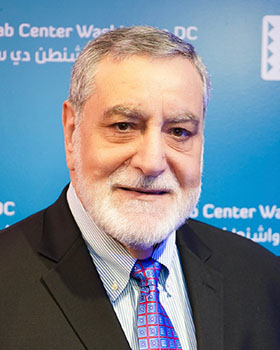
Khalil E. Jahshan
Chairman of the Board of Directors and Founding Consultant
Arab Center Washington DC

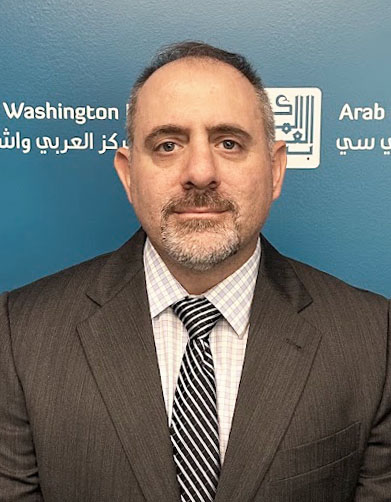

Moderator

About this Event:
Arab Center Washington DC experts examined the trajectory of US policy on Palestine one year into Donald Trump’s second presidency, assessing whether his administration’s approach represents a temporary disruption or a deeper, institutionalized shift in American foreign policy. Speakers analyzed Trump’s personalized and transactional “America First” doctrine, its far-reaching implications for US engagement in the Middle East, and its unequivocal alignment with Israeli objectives, particularly in Gaza and the West Bank. The discussion explored the administration’s proposed reconstruction framework for Gaza, the erosion of traditional diplomatic norms, and the broader dismantling of international and domestic policy structures. Panelists also examined profound changes within US domestic politics, including the Democratic Party’s growing internal rupture over Palestine, shifting public opinion across ideological lines, the evolving role of the Israel lobby, and the rise of grassroots, youth-led, and campus-based movements confronting repression and redefining Palestine as a central domestic political issue in the United States.
This panel was part of the Fourth Annual Palestine Forum held by the Arab Center for Research and Policy Studies.
Speaker remarks:
Trump and the Palestine Issue: The Pursuit of American Hegemony in the Middle East
Khalil E. Jahshan
On January 20, 2026, Donald J. Trump celebrated the completion of his first year as 47th president of the United States. In this symposium presentation, I will discuss his administration’s main stand on Palestine and explore whether his policies throughout his tenure as president are a passing phase in American politics or a long-term trend that might eventually be institutionalized in US policy toward the Middle East.
I would like to begin with brief remarks on Trump’s foreign policy in general, because his stance on Palestine and his overall Middle East policy are not formulated or implemented in a political vacuum. Both are part and parcel of an aggressive, personalized, reckless, imperial, media-hyped, and—to put it mildly—highly unconventional approach that marks a substantive as well as stylistic change in US foreign policymaking as it has developed in the years since the end of World War II.
Historically, US foreign policy has been guided by a set of bipartisan-endorsed core interests aimed at securing the country by safeguarding its borders against external aggression, advancing its strategic objectives (including securing economic prosperity and military dominance over its enemies), and guaranteeing the security and stability of both international allies and world regions that are deemed strategic. In addition, there is a whole assortment of other principles, values, and commitments that haphazardly appear on America’s political radar, among them the worldwide promotion of democracy, human rights, and of a clean environment.
Although these national interests have been modified sporadically to accommodate both domestic and international developments affecting Washington’s relations with the world, the overall list has remained relatively intact for decades. Any occasional shuffling by successive American administrations has affected the order of these priorities, without radical or substantive change in content.
But as a Washington outsider, Trump considered this foreign policy paradigm to be archaic and ineffective; he refused to play the game by its established rules. Indeed, he despised the political system that he wanted to control and viewed it as dominated by petty politics focused on insignificant pursuits. He consequently showed contempt for its principles and its players and their modus operandi. Trump’s contempt and defiance ripped up domestic and foreign policy norms alike.
Throughout his first term in office as the 45th president (2017-2021), and since the beginning of his current second term, Trump displayed little patience with the conventional core interests and values of foreign policy that were previously sacrosanct. Without much political fanfare, he replaced them with a combination of zero-sum thinking, combative power politics, a personalized, transactional style of deal-making, and his own unique mishmash of undisciplined populism and American nationalism that is encapsulated by the “America First” slogan.
Trump’s Political Mindset
Clearly, Donald J. Trump is not a typical American politician who built a professional political career in Washington. As a wealthy businessman and media personality, Trump is part of America’s financial elite, yet the established ruling class widely deems him as an outsider. In turn, Trump despises this old elite and has sought to manipulate and control its members through bullying and dealmaking to serve both his own personal financial interests and those of his friends and associates.
Tension between Trump and the established political and bureaucratic elite in the formal institutions of government, whether run by Democrats or Republicans, persists today as he continues to reduce their impact on decision-making and marginalize their influence on policy outcomes. Under Donald Trump, gone are the constitutional constraints on executive power, including the constitutionally mandated equality with the other branches of government, the legislative and the judiciary.
Gone are the conventional tools of diplomacy, including the Department of State, which is now only a shadow of its former self. The Secretary of State effectively has been reduced to the status of a national security advisor who acts at the behest of the White House, rather than the president’s chief foreign policy adviser.
Gone is the US Agency for International Development, with its humanitarian aid as a once-vital component of US foreign policy.
Gone is the lip service paid to the promotion of democracy, human rights, economic cooperation, peacebuilding, and environmental protection, even if these were mostly pro-forma commitments by previous administrations.
Gone is American cooperation with the international community in numerous vital arenas as the US administration withdraws from dozens of UN bodies and other multilateral organizations.
Gone are traditional alliances such as NATO, which look as if they will be replaced by ad hoc, transactional partnerships that primarily serve narrow US interests through compulsive and rambling posts on his own Truth Social media platform. This is Trump’s concept of “America First.”
Frankly, the current Trumpian slogan of “America First” is the only way we can understand President Trump’s antagonistic speech at the World Economic Forum in Davos on January 21, 2026. Trump wants Greenland and wants eventually to have the United States take it over from Denmark “one way or the other,” as he likes to say. For Trump, it really is “America First,” above all allies, all treaties, and all other commitments.
The $64,000 question that worries many political analysts is: when will President Trump apply his Greenland foreign policy model or that of Venezuela to other parts of the world, including the Middle East?
Trump Always Took Sides in the Arab-Israeli Conflict
Despite his outwardly businesslike, non-ideological background, Donald J. Trump took sides with Israel before he even delved into American national politics. His business background in New York brought him into close association with many colleagues, clients, partners, legal counsels, and other employees who deeply identified with Zionism and pro-Israel positions. These business associates clearly helped mold Trump’s perception of the Middle East in general.
Although the State of Israel has had many friendly presidents in Washington who catered to its whims and demands, whether or not they were justified, Israeli Prime Minister Benjamin Netanyahu has repeatedly described Trump as “Israel’s greatest friend” and has credited him for having “done more for Israel” in the past decade than any other American president ever.
During Trump’s first and second terms, US policy contributions and concessions to Israel included the following, to name just a few:
- The formal US recognition of Jerusalem as Israel’s capital on December 6, 2017, and the decision to move the US Embassy from Tel Aviv to Jerusalem, which began on March 4, 2019.
- The US acknowledgement on March 25, 2019, of Israeli claims to sovereignty over the Syrian Golan Heights, which Israel occupied in 1967.
- The jettisoning of the position held by successive US administrations since 1967 that Israeli settlements in the occupied West Bank are illegal, harmful to peace efforts, and inconsistent with international law.
- The decision to distance the United States from developing closer relations with the Palestinian Authority by closing down the PLO diplomatic mission in Washington on September 10, 2018, and by cutting US funding for various Palestinian and UN organizations serving Palestinian refugees.
- The release of his Peace to Prosperity Plan on January 28, 2020, which proposed giving Israel the option of granting Palestinians local autonomy in return for Israel’s annexing 30 percent of the West Bank.
- The campaign to pressure the PA and the PLO against pursuing legal action against Israel at the United Nations, the International Court of Justice, the International Criminal Court, and other relevant international forums.
- The presentation of the Abraham Accords on September 15, 2020, as the centerpiece of US policy in the region, and pressure on various Arab countries to normalize relations with Israel.
- In early 2025, the increase of US military aid to Israel and the resumption of shipments of certain weapons systems that had been paused by the Biden administration.
- The recent appointment on January 16, 2026, of the Board of Peace (BOP) and affiliated organizations aimed at demilitarizing, reconstructing, and governing the Strip, following the Trump Gaza ceasefire plan developed in coordination with Israel.
Clearly, based on this long list of favorable policies in support of Israel, Trump has earned his credentials as Israel’s greatest ever friend at the White House. His political bias toward Israel is pronounced, provocative, and unrelenting. The war in Gaza since October 7, 2023, gave him an opportunity to display that bias in no uncertain terms, rendering the United States an active partner to Israel in its pursuit of the permanent domination of Gaza and the ethnic cleansing of its civilian population, and in preventing the emergence of an independent Palestinian state in any part of Palestine.
Trump’s Gaza Ceasefire Plan and the Board of Peace
President Trump’s 20-point plan announced on September 29, 2025, and designed to end the genocidal war in Gaza, is neither a cohesive plan nor a diplomatic framework for a serious political agreement. It is a half-baked document that lacks adequate detail and has enough gaps to hinder its full implementation. The 20-point list touted by the White House as a roadmap aimed at achieving a historic and comprehensive peace throughout the Middle East, not just in Gaza, is purely a media hype that stands little chance of a prompt and full implementation, as borne out by events on the ground in the past four months.
From a Palestinian perspective, three major objections to the plan and its direct sequel, the Board of Peace, stand out:
- From its inception, the architects of the plan sought to “absent” the Palestinians from the process and to minimize their role in its proceedings. The Palestinian-Israeli conflict was not named as such by accident. It is a conflict created by the dispossession and dispersion of the Palestinian people whose role in determining their own future is universally acknowledged. That role should be central and all-encompassing within any peace process, not limited to narrow technocratic tasks or third-tier leadership, as provided by the Board of Peace Charter.
- The plan has acknowledged the need to stop the two-year genocidal war in Gaza and has toned down Trump’s earlier statements about the need for the total ethnic cleansing of the civilian population in the Strip. However, it is not at all clear about continuing retail ethnic cleansing or ending Israeli occupation according to a set schedule. Consequently, Israeli occupation forces remain in military control of an estimated 50-60 percent of the Strip and continue to conduct military activities throughout the rest of the area at will.
- Any plan that seeks to end war in Gaza, or elsewhere, needs to provide for a viable, permanent peace. The Trump plan did mention deradicalization, the release of hostages, aid distribution, governance, stabilization, redevelopment, and reconstruction of Gaza in the earliest phases of the plan, but it somehow relegated the issue of peace, referred to as “a political horizon for peaceful and prosperous co-existence,” to the very last point in the plan. This fact by itself has diminished the plan’s prospects for success by indefinitely delaying the advent of this “political horizon.” Considering the extent of damage and costs of reconstruction, what if the current chaos lasts for 10 years or more? Is it fair or just to expect the Palestinians in Gaza to spend yet another decade in humanitarian, political, and societal limbo?
Conclusion
Are Trump’s actions, declared positions, and practices a passing phase or a permanent fixture in US foreign policy? Although Trump has publicly expressed his wish to seek a third term as president, his options are quite limited as long as the US Constitution remains valid and relevant. Most likely, his presidential tenure will end on January 20, 2029. However, his political legacy and the political changes he has brought about definitely will survive him, regardless of who succeeds him. The more than 445 executive orders that he has issued since 2017 have made a significant impact on government reform, national security, economic tariffs, foreign policy, health care, education, immigration, the environment, and more. The positive impact or damage done by these measures will be felt for generations to come.
As far as US foreign policy in the Middle East is concerned, he has clearly shifted the historically biased policy even more conspicuously in favor of Israel in a way that makes it risky or even unconceivable for future presidents to attempt to reverse. Objective analysis shows that his policies have contributed long-term and significant damage to regional security and stability in the Middle East. This includes national security matters relevant to Palestine, Lebanon, Iraq, Somalia, Syria, and Yemen, among other places.
Palestine and the Democratic Party Crisis: Drivers and Impacts of Shifts in US Public Opinion and Discourse
Tamara Kharroub
In the first weeks of Israel’s current war on Gaza, later commonly recognized as a genocide, a group of US diplomats at the Department of State submitted a formal memorandum of dissent that warned that unconditional US backing of Israel would fuel a humanitarian disaster and damage US credibility. But the Biden administration refused to change its policy: it would continue arms transfers and block ceasefire efforts at the UN, despite growing dissatisfaction with President Biden’s handling of the conflict.
When Kamala Harris became the Democratic nominee in July 2024, many voters expected a shift, but she basically espoused Biden’s approach. The Democratic National Convention’s refusal to feature a Palestinian-American speaker became emblematic of the party’s failure.
The political cost became clear after the November 2024 election: 29 percent of Biden’s 2020 voters who did not vote for Harris in 2024 said that their top reason for not supporting Harris was Gaza—a response more common than the economy, immigration, or healthcare. In the battleground states that flipped from Biden to Trump in 2024, 1 in 5 voters cited Gaza as their decisive issue.
In the end, Harris received six million votes fewer than Biden had received in 2020. The genocide in Gaza was a central reason: Not because foreign policy decides elections, but because millions of Democratic voters felt that their party had abandoned its moral authority.
In essence, policy under both Democratic and Republican administrations has established the US duty to defend, supply, and protect Israel at the expense of international law and the rules-based global order of which the United States was the main architect, in the process eroding the rights and freedoms of its own citizens and of US democracy more generally.
But the Democratic Party specifically, which evolved over time into a liberal coalition focused on economic equality, civil rights, and justice, has repeatedly failed when it comes to Palestine. This is not just a policy failure, it is now an identity crisis—a widening rupture between what Democratic voters demand and what Democratic leaders are willing to say or do, and between the progressive and establishment wings of the Party.
This crisis did not appear overnight and did not start with the presidential election in 2024. It has been decades in the making.
I will briefly outline three moments in the party’s history that reveal this trajectory in Democratic politics and its significance with regard to Palestine. Those moments are Jesse Jackson’s presidential run in 1988, Bernie Sanders’ in 2016, and Kamala Harris’s in 2024. In these three separate time periods, Democratic Party leaders deliberately turned away from justice, dismissed public sentiment, and abandoned their own stated principles.
I. Jesse Jackson in 1988
Jesse Jackson’s Democratic presidential campaign in 1988 exceeded all expectations for a progressive candidate. It was also unprecedented with regard to Palestine. Jackson spoke about the occupation, challenged unconditional support for Israel, and garnered a sizable base of supporters: His campaign won 13 primary contests, garnering 6.9 million votes and securing close to 30 percent of Democratic delegates. The Jackson campaign managed to get language on Palestinian rights and self-determination included in 10 state party platforms.
Although his Palestine policy did not make it to the final Democratic National Committee platform, the Jackson campaign succeeded in bringing the first-ever debate on Palestinian rights to the floor of the 1988 Democratic Convention. It shattered the silence and forced the Democratic Party to move away from a ‘no talk’ policy on the issue.
This small opening—the mere discussion of recognizing Palestinians as human beings—became a source of worry for pro-Israel Democrats and triggered an intense counterrevolution by both the party elites and the Israel lobby. The reaction from the party leadership was swift and aggressive. Jackson was smeared as reckless and dangerous and was accused of threatening party unity.
The decades that followed saw increased monetary, military, and diplomatic support for Israeli policies in the Democratic Party, and the party’s pursuit of a strategy of what became known as ‘Progressive Except for Palestine (PEP)’ while engaging in empty rhetoric about the peace process. This culminated in President Barack Obama’s 2016 signing of the largest military aid commitment to Israel in US history.
II. Bernie Sanders in 2016
The second milestone was the Bernie Sanders campaign in 2016. Democratic voters were re-energized and motivated by the Sanders campaign after being disappointed by Obama’s establishment policies and the failure to effect the change that he had promised. During the Obama years, grassroots movements grew, Democratic voters organized, and younger voters, raised on social media outside the confines of the control of mainstream media institutions, saw Israel and the occupation for what they were. By the time Bernie Sanders ran for president in 2016, the gap between the base and the leadership had widened even further.
Although Sanders’s foreign policy platform at the time was thin and his views on Palestine were far from revolutionary, he was the first mainstream presidential candidate to talk about Palestinian rights and to criticize Israel. For the first time in history, the Democratic National Convention’s 2016 platform included recognition of Palestinian independence, sovereignty, and dignity.
Yet once again, the party leadership was not pleased. Even though polling was showing Sanders to be more electable than Hillary Clinton against a Republican candidate—in fact, polling revealed Sanders as the most electable presidential candidate in either party—Democratic Party leaders worked aggressively to marginalize him through tactics involving superdelegates, debate scheduling, and media narratives. Email leaks showed party staff discussing ways to undermine him. Stopping Sanders was the unifying priority for Democratic party elites.
But the Bernie effect persisted. He succeeded in creating a significant shift in the Democratic Party. His campaign intensified voters’ disillusionment and distrust in party institutions, and, even more important, Sanders brought progressive issues to the national public agenda. He was able to move the party leftward not only on domestic issues but also on Palestine: He made recognition of Palestinian rights and criticism of Israel mainstream in Democratic politics and thereby paved the way for progressive Democrats to be elected to Congress in the 2018 midterm elections, including Ilhan Omar, Rashida Tlaib, and other members of what later became known as ‘the Quad.’
III. Kamala Harris in 2024
The third and final moment that I want to discuss is the era of genocide. In 2024, the Democratic Party, supposedly the party of justice, totally lost its credibility when a Democratic president, Joe Biden, presided over the genocide of our time.
The party’s refusal to reconsider its genocidal policies in Gaza and its unconditional support for Israel in defiance of not only international law, but also of US laws, US freedoms and democracy, not to mention the wishes of Democratic voters, has exposed a deep disconnect between the party leadership and its base, between progressive Justice Democrats and the party elites, and between the party’s professed principles and its actual.
By 2024-2025, it was clear that the tide was turning:
- Polling showed majorities of Democrats (59 percent) expressing greater sympathy for Palestinians than for Israel (21 percent);
- Seventy-seven percent of Democrats said that Israel is committing genocide in Gaza;
- Seventy-five percent opposed sending additional military aid to Israel; and
- Seventy-eight percent of Democrats supported recognizing the State of Palestine.
This was a turning point for the Democratic Party that ultimately led to (among other things) Zohran Mamdani’s victory in the 2025 New York City mayoral race (even though party leaders withheld endorsement). Mamdani’s victory showed that explicit support for Palestinian rights can mobilize, not turn away, voters.
At the same time, other dynamics were taking shape that reflect the shift within the party.
Progressive Democrats in Congress have pushed measures to restrict US weapons transfers to Israel, such as Bernie Sanders’s Senate resolution, which was backed by over half of Senate Democrats, and the “Block the Bombs” bill with nearly 50 co‑sponsors in the House of Representatives. These signs provide evidence of a growing mid-level progressive bloc, despite resistance from party leadership.
Looking to the Future
Ahead of this year’s midterm elections, pro‑Israel incumbents are already facing primary challenges in such places as New Jersey and New York; Justice Democrats and pro‑Palestine candidates are challenging incumbents in Michigan, Illinois, and elsewhere.
The Palestine issue has become a litmus test in the Democratic Party to assess candidates’ commitment to civil liberties, anti-racism, and international law. Support from AIPAC or other Israel lobby groups has become a liability: In competitive Democratic primary districts, nearly half of voters say that they “could never” support a candidate backed by a pro-Israel lobby group like AIPAC.
The Democratic Party’s strategy and performance in the 2026 midterms and the 2028 presidential election will be pivotal for the future not only of the party but also of the United States—and arguably of the world. Whether Zohran Mamdani’s victory will be replicated elsewhere remains to be seen, but we can be sure that there are three significant trends in the Democratic Party that, in my view, are irreversible and consequential:
- A growing liberal, progressive, and young electorate that is anchored in values‑based and justice‑oriented politics, and that has grown increasingly sympathetic to Palestinians and critical of Israeli policies and US support for them. This group of voters stands in sharp contrast to the positions of party leadership and the larger Democratic establishment.
- A changed information ecosystem that has challenged the establishment narrative. What we now have is an American public that is shocked to learn for the first time about the oppression of Palestinians and about the outsized influence of the Israel lobby, and has been witnessing a genocide livestreamed in real time in the palms of their hands. They cannot unsee those images (although there are already efforts to counter these narratives).
- A growing class of mid-career progressive Democrats who run for office, win elections, and serve in Congress and who have been slowly moving the party both to the left and in support of Palestinian rights. While their influence remains limited compared to the party leadership, their numbers and support are growing, and they are expected to mobilize and continue to challenge traditional pro-Israel party figures.
In closing, the Palestine issue has moved from the margins to the center of the Democratic Party contestation. It has become more than just a foreign policy issue; it is a barometer of Democratic values and of the party’s commitment to justice and international law.
To offer a real alternative to authoritarianism and Trumpism, Democrats would need to articulate a vision that rejects complicity in violence and centers human rights across domestic and foreign policy. The longer that party leaders cling to the status quo, the more they will alienate disaffected voters and risk more losses in 2026 and 2028.
Paradigm Shift: The Groundwork for a New American Politics Toward Palestine
Yousef Munayyer
My intervention today is entitled “Paradigm Shift: The Groundwork for a New American Politics Toward Palestine.” I emphasize “groundwork” precisely because I believe that we are at the early stages of a substantial paradigm shift. Although several pieces are starting to fall into place to move the debate in this direction, it is still far from guaranteed that we will ultimately see that change come to fruition.
At the outset, I want to recognize the context for this moment. We gather after more than two years of genocide in Gaza, a genocide that is ongoing, albeit in a modified form. But I also want to emphasize that the stirrings for a new American politics, to which the genocide has helped give rise, were not created by the genocide. They pre-existed it, but they were also significantly catalyzed by it.
I will discuss three major dimensions that have contributed to this groundwork from which a new politics can spring; what kind of coalitions could potentially emerge from them; and on what sort of policy objectives such coalitions could realistically focus. The three dimensions are the values-based coalition on the left, the “Trump Effect” and the changing coalition on the right, and the crisis of the American Israel Public Affairs Committee (AIPAC) and the Israel lobby.
First is the values-based coalition on the left. Today there exists, on the left half of the political spectrum in the United States, unprecedented unfavorable attitudes toward Israel, sympathy for Palestinians, and the desire to see policy change in US support for Israel. Public opinion polls have reflected this shift time and again, and especially after the genocide in Gaza began. Here, though, the genesis is deeper. We began to see shifts in this direction nearly 15 years ago. Shaped in part by a growing post-9/11 skepticism of US militarism that was embodied by the Bush administration and the John McCain presidential campaigns, this move had a knock-on effect of creating skepticism of Israeli militarism as well. Additionally, narratives around power and justice had resonance on the left side of the US political spectrum, which easily understood the Palestinian struggle in the frame of civil rights, international law, and human rights and racial justice.
More than a decade ago, while working in organizing for Palestine in the United States, my colleagues and I were excited when liberal Democrats, as a subset of party voters, had for the first time registered in an opinion poll as more sympathetic to Palestinians than to Israelis. This was an early but important marker of change to come. We thought about what it might look like if this sentiment spread beyond liberals to all Democrats. At the same time, while the American left-wing was becoming more sympathetic to Palestinians, the right was moving in the opposite direction. Given this indication, it felt reasonable to concentrate on building from the left into the center since the right was unwelcoming of our agenda.
What has changed today on the left is not merely that the numbers have shifted significantly so that sympathy for Palestinians is now a mainstream position, but more important, Palestine is increasingly becoming a litmus test through which many Americans on the left judge a candidate’s authenticity.
Key actors in Democratic Party coalitions, from youth movements to campus organizing to labor unions to progressive elected officials, are strong allies on the issue of Palestine. What the genocide in Gaza catalyzed in this space was the expanded involvement of different components of the coalition among previously unengaged actors. That mass participation and mainstreaming contributed to breaking a fear of intimidation and silencing.
Moving forward, the growing Palestine solidarity on the left in US politics can rely on several strengths including moral coherence, generational depth, and cultural influence. The challenges it faces, and how it overcomes them, will be of equal importance. These challenges include translating opinion shifts into electoral change, dealing with internal fragmentation, and responding to repression from institutions still controlled by a small but powerful minority.
On its own, and in the short term, there is little that one side of the spectrum can likely accomplish when it comes to genuine policy change. But today, for the first time, we are seeing shifts on the right, which can perhaps translate into new possibilities that were not there before.
This brings us to the second of the three factors: the Trump effect and fractures in the GOP coalition. Again, the changes that appear to be fast moving now did not start today but have rather been accelerated by other factors, including the genocide and the broader crisis in the Middle East. But the seeds of the fractures in the Republican coalition go back to 2015, when Trump announced his foray into presidential politics. At the time, the Republicans had lost two presidential elections in a row with candidates John McCain and Mitt Romney, who both typified, and seemed poised to continue, the foreign policy priorities of President George W. Bush. But that foreign policy, which entangled the United States in what became known as “forever wars,” became increasingly unpopular. While anti-Muslim sentiment, and a general suspicion of all things non-white, would continue on the American right, the idea of fighting long, drawn-out wars in Muslim countries was not popular. Nor were the proponents of such endeavors, like Marco Rubios, Jeb Bush, or Newt Gingrich, able to capture the Republican Party. Trump understood that a winning coalition could be built on the right, but not with this foreign policy at its center. It could keep the anti-Muslim and frankly the white supremacist inclinations, but under a more isolationist “America First” outlook. By assembling a coalition under these terms, Trump was able to keep white Evangelicals—the base of the party—active and committed but he was also able to win a strain of important voters that would allow him to reach those McCain and Romney could not, and thereby achieve an electoral majority. In fact, during Trump’s first campaign, the biggest pro-Israel donors in the United States, the Adelson family, at first backed Marco Rubio rather than Trump. It was only when Trump proved he could win without their support that they invested in his campaign, for fear of not being in his good graces.
Trump was a unique candidate who could keep such a coalition viable, and it is hard to imagine another candidate who could do the same. For that same reason, this uneasy marriage now seems headed for a messy divorce as the Republican Party begins to imagine its post-Trump future.
When it comes to Israel, one side sees Israel positively through both an evangelical and a national security lens. For some, supporting Israel and its domination of Palestinians is a divine command. For others, Israel is a strategic partner and an asset in a civilizational struggle against Islam and the East. But the other side is far more skeptical. They increasingly not only see Israel as a burden on the United States, sometimes dragging US blood and treasure into foreign entanglements that serve the Israeli national interest and not the American one, but they also resent the role that Israeli influence seems to play in American politics. This faction is not opposed to Israel because of what it is doing to Palestine, but rather because of what they believe Israel is doing to America.
Which side will win out, if any at all, remains to be seen. What is certain is that in the fight for the future of the Republican Party, this issue will not be swept under the rug and will likely be negotiated in public during a competitive and probably chaotic primary fight in the next presidential election. Such shifts can perhaps present openings for a new coalition on policy change, but at a minimum they disrupt previous understandings of the politics of this issue in the United States. All of this has AIPAC and the Israel lobby in the United States in a state of bewilderment and maybe even panic.
It is this third dimension to which we turn now: the crisis of AIPAC and the Israel lobby. Here too the seeds of disruption were planted long before the start of the Gaza genocide and are concurrent with the other shifts covered above. The easiest conditions in which pro-Israel interest groups can pursue their agenda are those when American priorities seem to line up with Israel’s. The high point for this alignment was the moment after September 11, 2001. At the time, Benjamin Netanyahu told The New York Times that the events of that day would be a good thing for US-Israel relations. With the United States embarking on the morass that would be the Global War on Terror, and Israel focused on repressing the Second Intifada, the Israel lobby in the United States never had an easier time selling the idea of a US-Israel alliance. But as those conditions changed, so too did the Israel lobby’s approach. A former AIPAC director famously quipped that a lobby is like a night flower: it thrives in the night and withers in the daylight. As we moved further past 9/11, and as Americans grew tired of forever wars, they felt that they had been lied to. As Israel’s violent repression of Palestinians began to seem less justifiable, AIPAC and the Israel lobby increasingly had to come out into the daylight.
In the past, AIPAC prided itself on bipartisan support and influence and electoral discipline but in recent years has become a clear operator on the right that gets involved in elections in unprecedented and overt ways. Coming out into the sunlight means that more people than ever before are asking questions about the role of pro-Israel influence in American politics, tracking AIPAC contributions, and demanding that AIPAC register as a foreign agent. In response to these shifts, and to broader shifts in public opinion toward greater sympathy with Palestinians, AIPAC and the Israel lobby have placed themselves in an escalating feedback loop that only furthers their decline. The way this works is that as public opinion moves away from Israel, the Israel lobby is increasingly forced to respond in overt ways, either through excessive spending to shift electoral outcomes or by advancing repressive measures aimed at stifling dissent. Seeing these actions out in the open, the American public grows more suspicious and resentful of the Israel lobby for its interference in American politics and its efforts to curtail American rights, which in turn feeds the continuing shift in public opinion away from Israel. It is not immediately clear that this ever-escalating feedback loop is escapable, or where exactly it will lead. But what is clear is that over time, AIPAC and the Israel lobby will increasingly find it harder to dictate outcomes than they did in the past.
Can the new groundwork produced by these three dimensions lead to the formation of an action coalition to create policy change? This is the key question that must be answered moving forward. The deep polarization of American politics has touched a wide range of issues, from the economic to the cultural to foreign policy. Today the left and right in the United States rarely agree on anything. But one area where there is growing consensus across the spectrum is on the issue of the US-Israel relationship. Still, there is no shortage of pitfalls here. Can a rights-based constituency on the left, often focused on racial justice, cooperate with those backing white nationalist immigration policies, for example? Can constituencies on the left, who spend time and resources defending against smears and accusations of antisemitism for their anti-Zionist views, consider a working coalition with actors on the right who too often flirt with actually antisemitic narratives?
What makes a coalition possible and durable over time is not ideological purity but shared constraints, overlapping interests, and clear, winnable demands. If such a coalition were to form, it must focus on these issues. Both the “America First” crowd and the values-based left have a shared interest in shifting the US-Israel relationship to one that is far less biased toward Israel. Neither can accomplish this objective on their own. But with the pro-Israel lobby in crisis, the opportunity arises for some sort of collaborative endeavor.
Specific policy goals that could hold such a coalition together include, but are not limited to, making conditional or ending military aid to Israel; enforcing existing US laws on arms transfers and human rights; ending diplomatic cover for Israel at the United Nations; and protecting free speech and protest rights. Such policy objectives would be effective because they are easy to understand, can be demanded from institutions, and have cross-ideological appeal.
Achieving success here, however, requires more than just identifying the issues that could plausibly hold a coalition together. There also needs to be a strategic orientation focused on achieving these changes. This approach requires moving from symbolic politics to pressure politics and shifting from changing narratives to exercising material leverage. Much work has been done on the former; much is left to do on the latter.
In conclusion, American politics are in a transitional moment with new possibilities. The old consensus had shattered, but a new alignment is not yet consolidated. There is, however, groundwork upon which we can build. Decisive moments moving forward are the 2026 congressional elections, and especially the 2028 presidential election, when the US-Israel relationship is sure to be a topic of contention in previously unimaginable ways. The genocide in Gaza did not start these shifts but it catalyzed them by laying bare the moral limits of US policy and the structural vulnerabilities of pro-Israel politics to a larger number of Americans than ever before. The question then is not whether American politics on Palestine will change but who exactly organizes with whom, around which demands will it revolve, and how long will it take?
Palestine and the Reshaping of the US Institutional Order
Hanna Alshaikh
Starting a year ago, a flurry of presidential executive orders and demands targeted universities in the United States. This targeting—which had two dimensions, one related to immigration and legal status in the United States, the other related to the standing of universities vis-à-vis the federal government—very plainly sought to punish the student protest movement against Israel’s genocide in Gaza. That movement reached a peak during the spring 2024 encampment protests and featured increased criticism of Israel over its war on Gaza. The Trump administration pursued foreign student deportations, as we saw with the kidnapping and detention of Mahmoud Khalil, Rumeysa Ozturk, and others. It also sought to bar universities that refused to implement repressive measures to crack down on speech critical of Israel and its genocide in Gaza from sponsoring student visas and revoked funding due to these institutions’ tolerance—whether real or perceived—of student activism, academic debate, events, and course offerings on the issue of Palestine.
During the peak of this student activism against the genocide in Gaza, Arab audiences wanted to know whether this movement had emerged from a vacuum, who these youth organizers were, what motivated them to risk their futures to speak out against genocide, and, perhaps most important, whether this wave of protest would lead to policy change. It was not only the encampments that made international headlines, but also images of masked congressional staff members protesting anonymously on the steps of Congress and their open letter, signed by more than 200 US officials including high-profile resignations of figures in the White House, the Department of Defense, and the Department of State.
Arab audiences have correctly perceived a change in the United States, which is the growing shift in public opinion—on the right and the left—manifested on both the grassroots and official levels that is increasingly critical of Israel and supportive of Palestinian rights. I use the term rights in the broadest sense, to make clear that we should be precise about those whose advocacy included human rights, civil rights, and/or religious rights, as opposed to those who take this a step further to endorse political rights and recognize the Palestinian struggle as stemming from the Nakba. I also will point out that I distinguish between support for Palestinians from criticism of Israel as a motivating factor behind these expressions of dissent.
At the time of these remarkable protests, observers from the United States to the Arab world asked variations of a question that can be summarized as “Is this a fleeting moment, and can this change be institutionalized?” And by institutionalized, it is generally meant to make these changes formal, or permanent, to make them widely accepted norms that shape decision-making, and more specific to this case, lead to changes in US government policy. One year since President Trump’s return to the White House, it is still a worthwhile question to explore. After all, this wave of repression has not won hearts and minds for Zionism, nor has it reinforced support for the US-Israel alliance. In fact, Israel’s genocide in Gaza and the attempts to stifle criticism of the alliance caused many Americans to double down: it has not reversed the strides in US public opinion and has even caused right-wing media figures to condemn repression that affects those on the left.
This is nothing short of remarkable at a time when US politics are more polarized than ever. In this current American political landscape, Palestine seems to be the only issue in which right and left are moving closer to each other. Yet it presents a paradox: Washington’s unlimited support for Israel and fierce repression of constituent demands to end or at least condition aid has actually increased support for these demands. Shifting public opinion, combined with decades of Palestine activism in the United States, should lead to institutional changes such as changing laws, by conditioning or ending Foreign Military Financing to Israel, and more. Repression, of a particularly vulgar and unapologetic nature, attempts to make these shifts impossible. This paradox was undeniable under the President Joe Biden administration, and as we all know, the Trump administration intensified this pressure. So, on the one hand, we have the right and left constituencies moving toward one another on Palestine, and on the other, Washington has demonstrated that it will resort to repression of pro-Palestine activism regardless of who sits in the White House.
Despite this rare instance of agreement between the Biden and Trump administrations, we must discuss the critical differences. If Biden’s foreign policy and active participation in Israel’s genocide signaled the breakdown of the post-World War II international order, Trump’s domestic and foreign policies intensify much of what was already underway during the Biden administration. In this instance, we can think of Trump’s crackdown on protest, which blatantly disregards the Constitution, and of his Board of Peace, which is being spoken of as a potential replacement for the United Nations—established in the aftermath of World War II—as examples. Nonetheless, Trump’s repression differs in scale, intensity, and, importantly, is part and parcel of a larger unraveling of the domestic US institutional order. The repressive executive orders issued in early 2025 played out in the context of an overhaul of US government institutions that involved the restructuring of some and the elimination of others. Thus, we saw the shutdown of the United States Agency for International Development, the overhaul of the Department of State and across-the-board funding cuts for other government agencies. Added to this is the crisis of confidence in the resilience of the democratic order and constitutional rights. To name just one prominent example, Immigration and Customs Enforcement (ICE) is operating in blatant disregard of judicial orders attempting to constrain its actions within the law. While recent polling indicates that Trump still enjoys high levels of popularity among Republican voters, anecdotally we are beginning to hear that segments of his base are finally beginning to question aspects of his narrative, particularly when it comes to the cost-of-living crisis.
How can we shape our expectations in the midst of such uncertainty? One factor to note is that in November, the United States will hold midterm elections, which will take place almost halfway through President Trump’s second term. Every two years, all House of Representatives seats are up for election, as is one-third of the Senate. Midterms represent a referendum on the performance of the sitting President and, based on who controls the bicameral legislature, determines how much restraint or support the President will have in the final two years of his term to push his agenda. The 2026 midterms will be one of the most consequential elections in US history. Not only will it be a referendum on Trump’s presidency, but many Americans are now saying that if these elections are not free and fair, that might just seal the fate of the United States as a republic, as a state of democratic institutions, of constitutional principles, and of law and order—for better or for worse. The outcome of the midterm elections in either case will provide clear indications of where US politics are headed.
With all of this in mind, it is worth revisiting the question to which I referred at the beginning of my remarks, at this moment when protest and public opinion seemed to be stripped of their ability to change government policy. To reiterate, this question is, “Is this a fleeting moment, and can this change be institutionalized?” I will address this question by advancing two interlinked arguments: first, is that this shift is a product of accumulation, and not only a sudden moral awakening for Americans, although this was the case for many in response to Israel’s atrocities in Gaza. Second, the afterlife of this wave of protest and shift in public opinion has institutional consequences, and while we cannot anticipate the policy outcome, we are guaranteed that Palestine is a central issue in the domestic US order. Finally, I present my larger argument that Palestine is a domestic issue in the United States, and it has been for decades, what differs now is American cognizance of this dynamic, and therefore, this change will be institutionalized, for better or for worse—I will elaborate on this point later in my remarks.
First, the wave of protest following Israel’s genocide was not the beginning of Palestine playing a prominent role in US politics. In fact, pro-Palestine activism has played an important, albeit unrecognized, role in defining the limits of US civil liberties. The repression of speech on Palestine has been used as a laboratory for limiting other constitutionally protected freedoms. Some examples include: the Nixon administration implemented demands from the Anti-Defamation League and AIPAC to surveil and crack down on Arab and Arab-American activism. Known as Operation Boulder, the Federal Bureau of Investigation questioned every Arab on a student visa regarding her or his views on Israel. There was a wave of deportations, not due to any expressed views, but rather due to minor technicalities such as students’ violations of their work permits. This created a precedent and a framework for the deportations seen later, such as the George W. Bush administration’s National Security Entry-Exit Registration System, or NSEERS, program which led to the surveillance, interrogation, detention, and deportation of immigrants from the Islamic world, and which, of course, has been reactivated and reworked by the Trump administration.
Repression shaped public opinion before the genocide of Gaza. There is a symbiotic relationship between repression and public opinion gains. Furthermore, worsened conditions on the ground in Palestine often led to greater numbers of Americans becoming engaged in the Palestinian cause. After the 1967 War, for example, the Naksa—which saw Israel’s mass expulsion of at least 300,000 Palestinians and its occupation of Palestinian and Arab territory, led to the establishment of the Association of Arab American University Graduates led by Edward Said, Ibrahim Abu-Lughod, Elaine Hagopian, and other prominent intellectuals and leaders in the Palestine movement. The Tripartite Aggression on Egypt and Israel’s brutal occupation of the Gaza Strip in 1956-57 led to the renewed efforts of the Organization of Arab Students. The list goes on. Israeli violence in the Second Intifada led to the growth of groups such as the International Solidarity Movement and early iterations of Students for Justice in Palestine (SJP). Following Operation Cast Lead in 2008-09, during which new methods of Israeli sadistic violence against Gaza were put on display, SJP chapters proliferated across American college campuses. The successive wars on Gaza in 2012, 2014, and 2021 brought with them increased mobilization of these groups. This period also saw a wave of successful, albeit symbolic, divestment campaigns on college campuses, reaching a peak in the period between 2013 and 2015. In response, a wave of anti-BDS (Boycott, Divestment, and Sanctions) and anti-Palestinian laws aimed to stifle free speech and to criminalize constitutionally the protected right to boycott at various levels of government weakened constitutional rights, with very few members of the general public taking notice of how this violation of Palestine solidarity activism ultimately was a threat to all Americans—until now.
We cannot underestimate the consequences of this era that began in the aftermath of Operation Cast Lead. There were at least 200 campus divestment or boycott campaigns, and well over 300 total BDS victories in the United States between 2005 and the start of the Gaza genocide in 2023. It is inevitable that some congressional staffers or journalists in mainstream media who spoke their conscience during the genocide had attended university during these campaigns and had become informed on the issue by student activists. We must remember the intensity and coordinated nature of Zionist propaganda in the immediate aftermath of October 7 and the onset of Israel’s genocide in Gaza to be reminded of the stakes for these protesters. Universities are the target because they are at the core of transforming the debate on various issues, Palestine included.
And conditions on the ground in Gaza often challenged Americans to push their solidarity and awareness to new levels. If Americans were more prepared to discuss Gaza as a place whose oppression is rooted in the Nakba, in refugeehood, and in dispossession, rather than limiting the focus to Israel’s blockade instituted in 2007 (which nonetheless is very important), veered from understandings of Gaza as a place that suffers from overpopulation and a humanitarian crisis, which could have been caused by anything, rather than identifying the root causes. No single event in the lead-up to the Gaza genocide transformed some Americans’ understanding of Gaza more than the Great March of Return of 2018-19. The story of Razan al-Najjar and images of maimed young protesters horrified many in the United States, and for the first time, mainstream media gave nuanced and contextualized coverage, albeit limited, to Gaza as a place where two-thirds of the population are survivors of descendants of Nakba refugees. Indeed, the word “Nakba” was properly introduced to a wider group of Americans in this moment and planted the seed for American readiness to absorb these ideas when reintroduced in the context of the endless cycle of displacement that has affected nearly every family in the Gaza Strip since the start of Israel’s genocide. After decades of intense Zionist propaganda in the United States, this was no easy feat.
And this wave of Palestine activism in the mid-2000s and 2010s was institutionalized on a smaller scale. In 2017, Representative Betty McCollum, a Democrat, introduced the first piece of proactive legislation on Palestinian rights regarding Israel’s kidnapping, detention, and torture of Palestinian children. This bill, which has never been brought to a vote, seeks to amend the Leahy Law, an amendment to the US Foreign Assistance Act of 1961, to add Israel’s violence against Palestinian children as a Gross Violation of Human Rights and stop security aid to Israel from being used for the abuse of Palestinian minors. In 2022, Representative André Carson, also a Democrat, introduced the Justice for Shireen Act, which called for an investigation into Shireen Abu Akleh’s assassination while she reported from the Jenin Camp. The introduction of such legislation would not have been possible without prior decades of Palestine activism.
Therefore, it is unfathomable that the wave of protest, the criticism of the US-Israel alliance, and the increased support for Palestinians could possibly be reversed. Palestine is a domestic US issue because it affects the limits of civil liberties—and has for several decades—but it was the aftermath of US protest against the Gaza genocide that finally exposed this reality for the members of the public, even if most Americans do not understand it explicitly in these terms. This does not deny the reality that the protest movement will not continue in the same fashion under Trump, as it will take new forms, and organizers will spend time recalibrating. But it is inevitable that this knowledge of Israel’s brutality will not leave the American political consciousness.
The scenes of Israel’s crimes against humanity in Gaza have had irreversible impacts on US public opinion, and there is no return to the status quo of widespread support for Israel among the right and left. It is a matter of debate and will continue to be such even if repression is used to stifle the debate. What I have presented here is how Palestine speech was already institutionalized in the United States in a negative sense, and attempts were nonetheless made to institutionalize support for Palestinians at the legislative level. What follows in the United States might be better understood after this November’s elections. I hope that with this context, we can better understand the role that Palestine has played in American political life. Palestine is also a domestic issue, and regardless of the institutional overhaul in the United States, this support for Palestinians cannot be undone, and will inevitably manifest itself in new forms in the future.
The views expressed in this publication are the authors’ own and do not necessarily reflect the position of Arab Center Washington DC, its staff, or its Board of Directors.
