
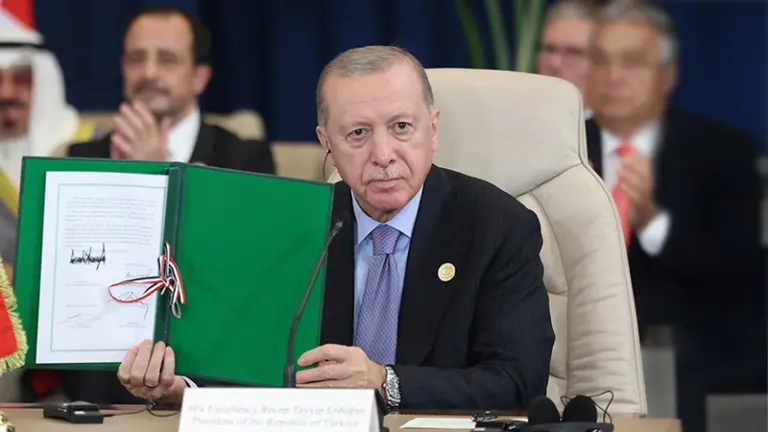
President Donald Trump envisions a central role for Turkey in Gaza. At the October 2025 Sharm el-Sheikh peace summit, Trump named Turkey as one of four guarantors of the ceasefire, along with Egypt, Qatar, and the United States. In addition, the Trump administration sees Turkey as an important player in Gaza’s reconstruction and stabilization, including by participating in the proposed International Stabilization Force (ISF) there. This envisioned role for Ankara is the result of a strategic convergence between Washington’s desire to delegate the burden of overseeing the Gaza ceasefire to capable regional actors and Turkish President Recep Tayyip Erdoğan’s willingness to assume that burden in exchange for US support for Turkey’s plans for Syria, other tangible gains in US-Turkey relations, and enhanced domestic support by presenting himself as a champion of Palestinian rights. Ankara’s success in persuading Hamas to accept Trump’s ceasefire deal paved the way for this development.
Two broader trends have contributed to this convergence. One is Ankara’s recent pivot from failed Gaza mediator to Hamas’s primary political patron, which elevated Turkey’s regional influence. The second is the improvement in US-Turkey relations during Trump’s second term. But the convergence rests on fragile foundations, including the strong personal rapport between the two leaders, untested assumptions that Trump can overcome Israel’s staunch opposition to a Turkish role in the ISF, and the risk that either failed reconstruction or entrenched Israeli control in Gaza could turn into domestic political liabilities for Erdoğan. As a result, Turkey’s durability as a partner in the stabilization effort is not certain. Even if Israeli resistance is somehow overcome, Turkey’s continued commitment to Gaza depends upon Erdoğan achieving his foreign policy and domestic goals; otherwise, Turkey may pull back.
Why Washington Needs Turkey
The sheer difficulty of identifying regional partners willing to shoulder the burden of stabilizing Gaza explains Turkey’s prominence in Trump’s plan. Few countries possess both the willingness and the capability to assume the risks associated with a stabilization role in the Strip. But Turkey has close ties and active communication channels with Hamas, experience in humanitarian operations, and considerable military and reconstruction capabilities. Perhaps most critically, Ankara is ready to become involved in one of the world’s most intractable conflicts, including by deploying Turkish troops to Gaza as part of the ISF. The November 2025 adoption of UN Security Council Resolution 2803, which authorized an International Stabilization Force (ISF) in Gaza, provided the legal framework Ankara sought for such a deployment.
President Erdoğan has volunteered Turkey for the job with enthusiasm because of the political benefits that he believes it will bring. Turkey’s loyalist media has highlighted Trump’s praise for Erdoğan’s willingness to participate in the ISF in triumphant tones, while largely overlooking the potential dangers.
From Failed Mediator to Political Patron of Hamas
In the immediate aftermath of the October 7, 2023, attacks, Erdoğan sought to mediate between Israel and Hamas, echoing his approach as a mediator between Russia and Ukraine. This role required Turkey to adopt a more cautious and neutral tone in the early days of the conflict. However, after Israel rejected Turkey’s mediation on the basis of its alleged support for Hamas, Ankara shifted away from this restrained posture. Rather than pulling back from Hamas, Ankara instead embraced its role as Hamas’s most vocal international defender—providing refuge to some of its leaders, championing the group’s legitimacy as a resistance movement, and maintaining open channels of communication. With no other regional actor so far willing to assume this position, Turkey has emerged as one important supporter of Hamas. This two-year trajectory enabled Turkey to later play a more prominent role in the October 2025 ceasefire negotiations.
Hamas now looks to Ankara for reconstruction financing, governance assistance, and political legitimacy.
Turkey’s relevance has grown as Iran’s regional influence has weakened. Previously, Turkey’s relationship with Hamas was more limited in scope and impact. Ankara maintained communication with Hamas’s political bureau, continued to host key political exiled leaders, and offered rhetorical support, but such support rarely translated into leverage over the movement’s strategic decisions. Iran, by contrast, dominated Hamas’s military wing through weapons supplies, funding, and strategic guidance, giving Tehran far greater practical influence. This dynamic limited Turkey’s utility as an interlocutor—it could talk to Hamas but could not reliably shape its actions.
Since Israel’s war on Gaza after October 7, the erosion of Iran’s Axis of Resistance by direct Israeli attacks, the fall of the Assad regime in Syria, and the decline of Hezbollah has shifted the regional balance. Two years of Israel’s brutal war combined with Iran’s weakening has left Hamas militarily weakened and isolated, forcing it to seek alternative sources of external support. Turkey has stepped in to become one of Hamas’s most dependable external political patrons. With few other governments willing to engage openly, Hamas now looks to Ankara not just for diplomatic support but also for potential reconstruction financing, governance assistance, and political legitimacy in post-war Gaza. This shift enhances Turkey’s value to the Trump administration, which seeks actors capable of influencing Hamas.
Trump and Erdoğan: The “Special Rapport”
The question of Turkey’s role in Gaza cannot be analyzed in isolation from the broader transformation in US–Turkey relations during Trump’s second term in office. The personal relationship between Trump and Erdoğan, in particular, is crucial. Trump has consistently praised Erdoğan in public, referring to him as a respected friend. The long-coveted White House visit that was denied to Erdoğan during Biden’s four years in office finally came in September 2025, thanks to the personal rapport between Trump and Erdoğan. This diplomatic breakthrough has allowed Erdoğan to project an image of restored international standing and Turkish influence. Notably absent from the renewed US–Turkish partnership has been any US criticism of Turkey’s authoritarian drift, a silence that Erdoğan values perhaps as much as any specific policy concession from Trump.
In return, Turkey has revised its foreign policies across multiple theatres to avoid antagonizing Washington. In Syria, despite its long-standing objections to US cooperation with Kurdish forces, Ankara has notably softened its tone and avoided escalating the dispute. A similar pattern is visible in Turkey’s policies toward Russia. Ankara has agreed to gradually reduce its dependence on Russian natural gas and pledged to purchase American liquefied natural gas at prices significantly higher than what Russia’s Gazprom charges.
Absent from the renewed US–Turkish partnership has been any US criticism of Turkey’s authoritarian drift.
In Gaza, Turkey has placed its full support behind the Trump peace plan, even though the plan contains several features that Ankara might be expected to criticize—especially the fact that the plan effectively extends Israel’s occupation by institutionalizing its long-term security presence in Gaza. Also of concern to Turkey, the plan sidesteps any meaningful pathway toward Palestinian statehood, offers no clarity on who will govern Gaza or how reconstruction will be organized, and raises the prospect of an international trusteeship that sidelines Palestinian political agency. Finally, the plan contains no accountability mechanisms regarding Israel’s conduct during the war—an omission that contrasts sharply with Ankara’s earlier rhetoric on Israel’s violations of international law and Palestinian rights.
Yet Turkey’s gestures to demonstrate alignment with Washington have not produced breakthroughs on key issues important to Erdoğan. Turkey remains excluded from the F-35 program due to US displeasure over its 2017 purchase of the Russian S-400 missile defense system, a reality that Erdoğan’s recent White House visit did not change. Turkey’s rejoining the F-35 supply chain currently appears unrealistic, leaving the Turkish Air Force without fifth-generation stealth capability. US sanctions under the Countering America’s Adversaries Through Sanctions Act remain in place and other restrictions on US defense procurement continue to constrain Turkey’s strategic ambitions.
The Syria–Gaza Nexus: A Package Deal
Turkey’s cooperation on Gaza cannot be viewed separately from its expectations of US support for its goals in Syria. After the collapse of the Assad regime and the emergence of a new government backed by Ankara, Turkey is seeking unambiguous US endorsement for its vision of Syria’s future: a stable, unified state under a strong centralized government. The Trump administration has moved quickly to engage with the new Syrian authorities, culminating in an unprecedented November 2025 White House visit by Syrian leader Ahmed al-Sharaa—steps that align closely with Turkish preferences. Trump has praised Erdoğan’s “great achievement” in ridding Syria of the Assad regime, a framing that Ankara interprets as validation of its influence and expectations there. Ankara likely views its close alignment with US policy on Gaza as leverage to secure fuller American support for its objectives in Syria. Above all, Turkey wants the United States to scale down and ultimately end its military assistance to the Syrian Democratic Forces and to focus on consolidating the new Syrian government’s authority. Although Washington has broadly endorsed Turkey’s preference for a unified and centralized Syria, it has not yet agreed to end its partnership with Kurdish forces, which remains a major source of Turkish frustration.
At the same time, Turkey’s bargaining logic may also operate in the opposite direction. By showing restraint on the Kurdish issue in Syria and by avoiding steps that would directly challenge Washington’s position, Ankara may expect stronger US backing for Turkey’s desired role in Gaza, including American support for the deployment of Turkish forces—despite Israeli objections. This two-level bargaining indicates Turkey’s assumption that cooperation in one theatre may facilitate reciprocal backing in another.
Israel’s Objections to a Turkish Role in Gaza
Israel remains firmly opposed to any Turkish military or administrative presence in the Strip. Israeli officials justify their objections by arguing that Turkey’s open political patronage of Hamas makes Ankara an unsuitable and untrustworthy actor. The more fundamental issue, however, is Israel’s longstanding preference for maximum operational freedom in Gaza. Even before its current onslaught, for two decades after the 2005 withdrawal Israel has waged a succession of devastating wars on the Strip, punctuated by recurrent airstrikes, targeted killings, and intelligence operations—all with minimal political cost. A Turkish military presence, even if integrated into an international mission, could complicate this unilateral freedom of action by inserting a capable state actor on the ground. A Turkish presence could create political and operational constraints for Israel, for example, by requiring coordination or notification before strikes, by limiting intelligence-gathering activities, or by necessitating justifications for operations that previously went unquestioned. The deployment of Turkish forces in Gaza would also raise the risks of escalation through accidental clashes with Israel, potentially triggering Turkey to lodge formal protests or demand investigations whenever Israel seeks to intervene.
The deployment of Turkish forces in Gaza would raise the risks of escalation through accidental clashes with Israel.
Israel’s objections also serve a broader political purpose: casting Turkey as a new external threat. This portrayal offers Israel a convenient replacement for the Iran-centered narrative that has lost credibility with the post-October 7 weakening of the axis of resistance. For Israeli leaders, maintaining a framework of existential insecurity has long served both domestic and international purposes. Since the state’s establishment in 1948, Israel has framed its security policy around successive existential threats: first, encirclement by Arab states, then Iran and its regional proxies. This framing has secured extraordinary military, diplomatic, and financial backing from the United States and from some European governments. Domestically, it has helped Israel maintain a degree of political cohesion. With Hamas and Iran’s regional network badly eroded, Turkey provides a new focal point for this narrative, allowing Israeli leaders to sustain claims of existential insecurity even as Israel enjoys overwhelming military superiority.
Ironically, this portrayal of Turkey as a strategic menace is not entirely unwelcome in Ankara. Erdoğan has long capitalized on confrontations with Israel to strengthen his domestic political standing, presenting himself as willing to challenge Israel when Arab governments have remained silent. Israel’s objections to Turkish involvement in Gaza feed directly into Erdoğan’s narrative. Both governments therefore find political benefit in exaggerating the perception of mutual hostility, even as Washington attempts to bring Ankara into the Gaza stabilization framework.
Conclusion
Turkey’s role in Trump’s Gaza plan is ultimately as much about Ankara’s strategic calculations as it is about Washington’s search for partners willing to take the political and security risks of military deployment in Gaza. The arrangement depends heavily on the personal rapport between Trump and Erdoğan, raising questions about its durability beyond the current US administration. It also assumes that US pressure can overcome Israel’s fierce opposition to a Turkish role in the ISF. While Trump has shown willingness to press Netanyahu on sensitive issues, from Gaza operations to Syria policy, his ability to extract meaningful concessions from Israel on the ISF is uncertain. The plan also presumes that Erdoğan can navigate a difficult balancing act: participating in the disarmament of Hamas, as envisioned by Trump’s plan, while maintaining his domestic narrative as a champion of Palestinian rights.
Maintaining this balancing act holds significant political risks. Should the ceasefire entrench Israeli control and fail to deliver tangible political or economic improvements for Palestinians, any domestic political dividends for Erdoğan would be erased. What is framed today as a diplomatic triumph could quickly become a source of criticism, undermining the very political legitimacy that Ankara hopes to strengthen through its Gaza role. Much depends, therefore, on factors largely beyond Ankara’s control, while Erdoğan’s calculus extends beyond Gaza itself. Turkey’s continued commitment to playing a significant role in Trump’s Gaza plan depends on Trump successfully pressuring Israel to accept Turkish forces in the Strip, the stabilization framework’s generating meaningful outcomes for Palestinians, and Erdoğan managing to extract sufficient gains in Syria and US–Turkey relations. This suggests that the sustainability of Turkey’s role and the durability of the ceasefire may ultimately hinge as much on developments in Syria and US–Turkish relations as on developments in Israel and Gaza.
The views expressed in this publication are the author’s own and do not necessarily reflect the position of Arab Center Washington DC, its staff, or its Board of Directors.
Featured image credit:FB/Recep Tayyip Erdoğan