
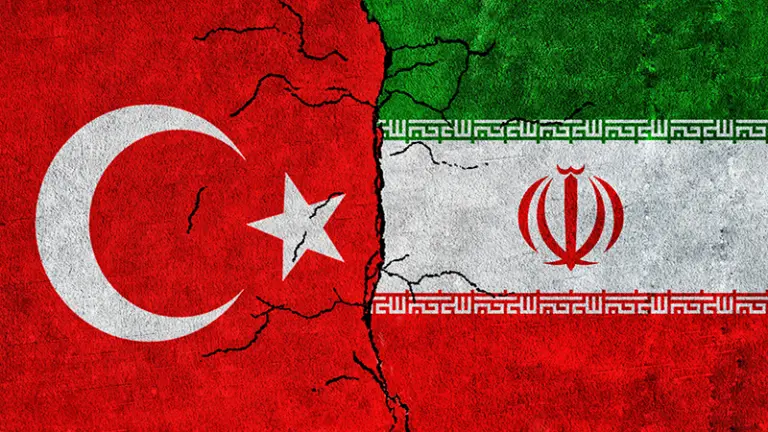
The launch of the US-Israel war on Iran did not surprise Ankara, but it did not please it either. Turkey, along with other regional powers including Saudi Arabia, had made intensive efforts to prevent it, but when these failed, Ankara chose the next best option: to stay out, keep the channels open to all concerned, and wait. This stance has a certain logic, but it also reflects a deeper reality that Turkish policymakers are reluctant to articulate openly. Turkey has limited control over the risks posed by this war and even less influence over its outcomes. The difficulty at the heart of the Turkish position is that the risks are immediate and concrete, while the potential gains depend entirely on the outcome of a conflict that Turkey cannot control.
Turkey’s apprehension about the war and determination to stay out of it were clear from Ankara’s initial reactions. President Recep Tayyip Erdoğan took a clear position, describing the US-Israeli attacks on Iran as a blatant violation of international law. Turkey closed its airspace to US forces, and Erdoğan personally conveyed his condolences following the assassination of Iran’s Supreme Leader Ali Khamenei. At the same time, Turkey was careful not to give the impression that it stood with Tehran. Ankara openly criticized Iran’s retaliatory attacks on Gulf countries, and Minister of Foreign Affairs Hakan Fidan blamed Iran for the failure of pre-war negotiations. The message was deliberate: Turkey was against the war but also was no one’s ally in it. Since his initial statement, Erdoğan has adopted a remarkably low-key stance, refraining from the bold statements characteristic of his interventions in previous regional crises.
Turkey’s Regional Vision Under Pressure
This response reflects the fundamental contradiction between the logic of war and Turkey’s broader regional vision. In recent years, Turkey has undergone a significant foreign policy shift and begun to reconcile with its former enemies following a period of regional isolation. This shift was consistent with broader trends in the region and led to a new shared vision between Turkey and the Gulf states that prioritized trade and diplomacy over military confrontation. Israel’s successive attacks in several countries over the past two years—including on Qatar, a key non-NATO ally and host to the largest US military base in the region—have increasingly undermined this vision. Over time, Israel began to be seen as the main threat to the regional order that Turkey and the Gulf countries were trying to build, replacing Iran as the main actor destabilizing the region. Against this backdrop, Turkey and the Gulf countries engaged in intense lobbying efforts to prevent the outbreak of war.
Israel began to be seen as the main threat to the regional order that Turkey and the Gulf countries were trying to build.
This regional vision was also consistent with Turkey’s longstanding view of Iran. Ankara has more often seen Iran as a rival that needed to be managed, rather than as an existential enemy. The two countries share a long border, compete for influence in the same regions, and support opposing sides in many conflicts. However, they have also cooperated when their interests have aligned, and neither has viewed the other as a threat that must be eliminated. Over time, this model has created a stable equilibrium in which competition coexists alongside pragmatic relations.
Recent regional developments have begun to undermine this balance. Israel’s gradual weakening of Iran’s network of regional allies and proxies has created geopolitical opportunities that Ankara can exploit. The clearest example is Syria, where the collapse of the Assad regime created space for Turkish-aligned actors in the emerging order. These gains, however, have been achieved in a regional environment that Ankara finds increasingly unstable. The potential normalization of Israel’s unlimited military hegemony is incompatible with the regional order that Turkey is trying to build. While Turkey can take advantage of Iran’s weakness, it is much less satisfied with the regional dynamics created by this weakness.
The Risks that Ankara Fears
Turkey faces real and immediate risks on several fronts. The most alarming is the prospect of Iranian state collapse or a protracted conflict that triggers a mass migration wave toward Turkish territory. Turkey shares a land border of approximately 500 kilometers with Iran, and it is almost certain that it would be the first destination for people fleeing the Islamic Republic. The Syrian precedent looms large: hosting millions of Syrians refugees during that country’s civil war placed considerable strain on Turkey’s infrastructure and social fabric (while also bringing some economic benefits). The scale of a potential migration crisis from Iran could be immeasurably worse. European capitals are also watching this scenario with growing concern. Immediately after the attacks on Iran, European Commission President Ursula von der Leyen spoke with Erdoğan to coordinate on migration, a sign that the concern extends far beyond Ankara.
The economic impact of the war is a further concern. Iran’s threat to traffic in the Strait of Hormuz remains one of its most effective levers. With its limited energy resources, Turkey is particularly exposed. Its economy is struggling with high inflation and a current account deficit; a continuous rise in the cost of oil imports likely would exacerbate these challenges. More than two weeks into this war, the risks have ceased to be merely hypothetical, as energy markets have already reacted adversely to the uncertainty. If this disruption persists, the damage to the Turkish economy could be serious.
Security Risks
The war also poses direct security risks to Turkish territory. Iran has struck targets in the region since the war began, and Turkey hosts several facilities that could plausibly attract Tehran’s attention, including Incirlik Air Base and Kürecik Radar Station—both NATO facilities—and the Baku-Tblisi Ceyhan pipeline terminal in Ceyhan through which Azerbaijani oil reaches the Mediterranean and then Israel.
So far, three Iranian missiles have entered Turkish airspace since the start of the war, all of them intercepted by NATO air defense systems. Whether these missiles were aimed at targets in Turkey or were directed at Cyprus or elsewhere and merely passing through Turkish airspace remains a matter of debate. While NATO’s official statement indicated that the missiles targeted Turkish territory, Iran denied the claim and stated that it had never targeted Turkey. In either case, Turkey did not escalate the situation. A US Patriot air defense system has been deployed on Turkish soil, a move that acknowledged the threat, but Ankara so far has chosen to contain the situation without retaliating.
This restraint is not surprising. Iran has strong reasons to avoid directly striking Turkey. Unlike the Gulf states or Cyprus, which host British military bases, Turkey has no operational US military facilities. Incirlik and several other bases on Turkish soil are NATO facilities under Turkish command, and Washington cannot use them unilaterally without Ankara’s approval. Beyond that, Turkey has a capable and battle-proven army, shares a land border with Iran, and could meaningfully retaliate if attacked. Attacking Turkey would be costly and risky for Iran. Turkey’s NATO membership further increases the deterrence: an attack could trigger Article 5 and draw the alliance into the conflict. Considering these obstacles to attacking Turkey, the incidents that have occurred to date can be explained more by the Iran Revolutionary Guard Corps’ highly decentralized command structure than by any deliberate policy. As a result of Israel’s systematic targeting of Iran’s military and political leadership, decisions in the Iranian military are being made at a much more local level, which can lead to outcomes outside the central government’s approval. For now, both sides seem to be opting for restraint, and the situation, while not risk-free, appears to be manageable.
Attacking Turkey would be costly and risky for Iran and could trigger Article 5.
Turkey’s second major security concern is the possibility of armed mobilization against the Islamic Republic by Kurds in Iran’s northern and northwestern regions. This concern involves a deeply ingrained reflex in Turkish strategic thinking. For decades, Ankara has viewed the emergence of Kurdish political or military autonomy along its borders as a direct security threat. This concern is particularly evident due to the presence of the Kurdistan Free Life Party (PJAK) in Iran, the most significant Kurdish armed group in the country, which has organizational ties to the Turkish terrorist-designated Kurdistan Workers Party (PKK). In the event of a wider war or the collapse of state authority, PJAK or similar groups could expand their activities and bring the Kurdish issue back to the forefront on Turkey’s eastern border.
To be sure, reports about President Donald Trump’s interest, early in the Iran war, in the US arming of Kurdish groups to rebel against the Tehran government have raised alarm in Ankara. Trump subsequently publicly distanced himself from such proposals, but such disavowals carry limited credibility given his erratic decision-making style and many contradictory statements. From Ankara’s perspective, aiding Iran’s Kurds would be highly destabilizing. Turkey would be unlikely to remain neutral in this scenario. In this respect, a policy of arming Iranian Kurds to weaken Iran could push Turkey and the Islamic Republic into a de facto alignment and drag Ankara into a conflict it had been carefully trying to avoid.
Potential Opportunities
Despite the risks, the war also creates opportunities that Ankara can exploit both domestically and internationally. At home, the ruling Justice and Development Party (AKP) government has spent more than a decade taking advantage of instability in Syria to support the argument that Turkey needs a strong centralized government. Today’s crisis fits that narrative neatly. In addition, the US-Israel war is bringing Turkey’s defense industry back to the center of the national agenda. The AKP government can point to a genuine and broadly recognized success story in the rise of its defense industry over the past decade, which is now a leader in drone production. Moments of regional crisis tend to increase the industry’s visibility and importance. Finally, there is a specific political gain at stake. The increasingly bellicose rhetoric coming from Tel Aviv suggesting that Turkey could be the next target after Iran directly serves Ankara’s preference to portray Turkey as a besieged but defiant power. Such external threats, however far-fetched they may be, are politically useful for a government that uses a narrative of national resistance to buttress its own legitimacy.
the US-Israel war is bringing Turkey’s defense industry back to the center of the national agenda. The AKP government can point to a genuine and broadly recognized success story in the rise of its defense industry over the past decade, which is now a leader in drone production.
Externally, a weakened but not collapsed Iran is not a bad outcome for Turkey. Iran has been a significant rival for regional influence, and the erosion of its regional military network has created a vacuum that Turkey could fill. The most striking example is Syria. Israel’s systematic dismantling of Iran’s Axis of Resistance played a major role in the eventual collapse of the Assad regime and Turkey’s allies in Syria subsequently positioned themselves to fill the resulting vacuum. This dynamic has made Ankara one of the most important external actors in post-Assad Syria. A similar dynamic could be repeated in Iraq and the South Caucasus, where Iran’s influence has historically complicated Turkey’s ambitions. If the current war results in a weakened but functional Iran rather than a failed state, it could significantly accelerate the expansion of Turkey’s influence in the region.
Conclusion
Turkey’s fundamental difficulty regarding the Iran war cannot be resolved through diplomacy or careful positioning alone: it does not know where this conflict is heading, and it cannot reliably predict US decision-making. Washington’s stated objectives in the war have shifted repeatedly since it launched airstrikes against Iran, which makes any stable diplomatic endgame difficult to envision and even harder to work toward. What is clear is that the collapse of the Iranian state would be a serious catastrophe for Turkey, creating migration, instability, and security threats on a scale that Ankara is ill-equipped to manage.
Yet, Turkey has no real instrument to prevent that outcome. Ankara wants the war to end as quickly as possible, but it lacks the leverage to bring that moment closer. Pressure on Washington appears to have yielded limited results. Regional lobbying efforts did not stop the war from starting. The only option left is a policy of cautious waiting. Throughout the conflict, Turkey kept communication channels open with Tehran and avoided being drawn into the war on either side. As a NATO member that has managed to stay out of the war while maintaining its credibility with various parties, Ankara can plausibly claim a seat at the table if diplomacy eventually returns, even though this seat may not deliver much influence on the outcome. The more fundamental question is whether the war will end without a wave of instability that will spill across Turkey’s borders and inflict shocks that Ankara lacks the capacity to absorb.
The views expressed in this publication are the author’s own and do not necessarily reflect the position of Arab Center Washington DC, its staff, or its Board of Directors.
Featured image credit: Shutterstock/OnePixelStudio