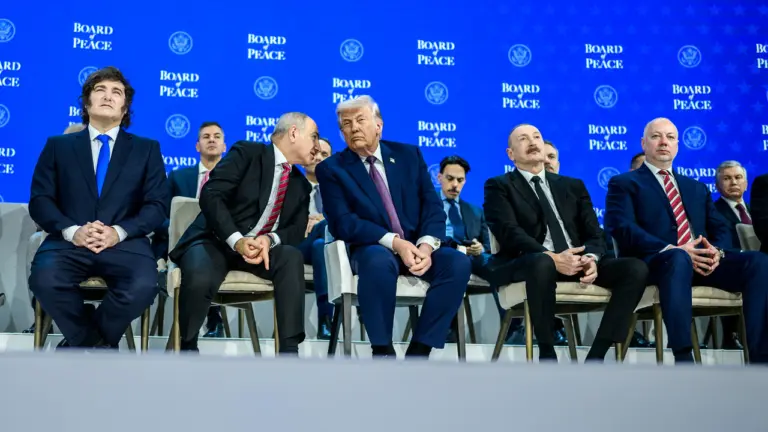
The Trump administration’s new “Board of Peace” is slated to hold its inaugural meeting in Washington on February 19, 2026. After the United Nations (UN) Security Council authorized the Board in November 2025 with a mandate that lasts until December 31, 2027, pending renewal, the first board meeting will be held at the newly renamed “Donald J. Trump United States Institute of Peace” and is expected to begin securing reconstruction funds and troop commitments to staff an International Stabilization Force (ISF) in Gaza.
The Board has an immense task before it. More than 72,000 Gaza Palestinians have been killed since the most recent wave of conflict began on October 7, 2023. Up to 90 percent of Gaza’s 2.1 million inhabitants have been displaced. Homes, schools, universities, medical facilities and agricultural lands have been destroyed, with reconstruction estimates reaching tens of billions of dollars and likely to go much higher. Gaza is in shambles and violence continues despite last October’s ceasefire negotiated by the Trump administration. Seldom has there been greater need for the ministrations of a serious, focused international body.
Curiously, the Board’s charter does not mention Gaza. There also seems to be a substantial gap between the body that the Security Council authorized last year and Trump’s personal ambitions for the Board of Peace, which extend well beyond Gaza to encompass worldwide diplomatic functions previously undertaken by the UN. Fully under President Trump’s personal control, the Board represents a challenge to the existing global order, as well as—surely not incidentally—yet another moneymaking opportunity for Trump, his family, and his associates.
The Board of Peace at the Starting Gate
The Board of Peace is an integral part of the Gaza ceasefire plan. It is mentioned in point nine of the Trump administration’s 20-point “Comprehensive Plan to End the Gaza Conflict,” to which the United States, Hamas, and Israel agreed in September and October 2025. The plan was formally approved by UN Security Council Resolution (UNSCR) 2803 on November 17, 2025, by a vote of 13-0, with Russia and China abstaining. In an unsurprising development, Trump was declared the inaugural chair of the Board. Its charter was ratified at a meeting of the founding members at the World Economic Forum in Davos, Switzerland, in January 2026.
The “comprehensive plan” specifies that the Board will:
set the framework and handle the funding for the redevelopment of Gaza until such time as the Palestinian Authority has completed its reform program…and can securely and effectively take back control of Gaza. This body will call on best international standards to create modern and efficient governance that serves the people of Gaza and is conducive to attracting investment.
This task is monumental. The World Bank estimates that the cost of reconstructing Gaza will amount to some $53 billion, a figure that will likely skyrocket once actual work begins. (The UN’s reconstruction estimate starts at $70 billion.)
To date, there have been no hard pledges of funding for reconstruction. And only Indonesia has firmly committed troops to the planned ISF, the work of which will be critical in curbing the ongoing violence and establishing the security necessary for both reconstruction and effective governance. The Board has its work cut out for it.
Dearth of Democratic Members, and a Striking Authoritarian Slant
Whether or not the Board will focus on the reconstruction of Gaza is an open question. Whether it is even built to do so is likewise unclear.
The Board’s current membership hardly instills confidence in its ability or willingness to help Gaza develop “modern and efficient governance that serves the people of Gaza,” as the comprehensive plan states, let alone bring about elections and even a modicum of democratic self-rule (though to be sure, the plan never mentions democracy or elections.) Of the 20 initial advisory members of the Board, 16 are classified as authoritarian or partly free regimes according to Freedom House and the Economist Intelligence Unit’s 2024 Democracy Index. Only four members—Argentina, Bulgaria, Israel, and Mongolia—are rated as fully “free.” Russia has been invited to join and is “studying” the proposal. If Moscow accepts, the balance will be further tipped toward authoritarianism.
Israel’s presence on a Board ostensibly intended to reconstruct and help govern Gaza—which Israel itself largely destroyed during a military campaign that the United Nations has termed “genocide”—only deepens the widespread skepticism. It seems unlikely that the Board as it is presently constituted will be inclined to deliver anything approaching the legitimate and accountable governance that most Palestinians seek. Notably, there are no Palestinians on the Board.
It seems unlikely that the Board will be inclined to deliver the legitimate and accountable governance that most Palestinians seek.
Western democracies are not represented, either. France, Germany, Greece, the United Kingdom, Norway, Sweden, Spain, Slovenia, and Ukraine have declined invitations to join the Board of Peace as of early 2026. Canada’s invitation was rescinded after Canadian Prime Minister Mark Carney offered some mild criticism of the Board and the Trump administration in his Davos speech. The reasons given for declining varied, from the charter’s alleged conflicts with domestic law, to concerns over the (seemingly deliberate) vagueness of the Board’s mandate and anxiety over the membership invitation extended to Russia in the midst of its war of aggression against Ukraine. But the objections all shared a common theme, perhaps put best by Slovenian Foreign Minister Robert Golob. “The main concern,” he said, “is that the committee’s mandate is too broad and that it could dangerously undermine the international order based on the United Nations Charter.”
Who Pays?
Can the Board pull together the resources required to rebuild Gaza? Again, there is plenty of room for doubt. The Board’s charter offers permanent seats to every member country that contributes $1 billion to fund the Board’s activities. But only four of the current members—the wealthy Gulf Arab states of Bahrain, Qatar, Saudi Arabia, and the United Arab Emirates—are likely to have the wherewithal to do so, let alone to contribute the many billions that will be required. (Board member Argentina, to cite just one example, was the beneficiary of a $20 billion Trump administration bailout in October 2025; other members are net foreign aid recipients themselves.) At this point there are no indications that non-member states or international organizations are willing to contribute to, or to channel contributions through, the Board.
Most members’ lack of substantive engagement in critical Middle East conflicts is also an issue likely to undermine the Board’s efforts. Only eight members—including Arab states, Turkey, and Israel—can point to any immediate connection or historic involvement with Palestine-Israel peace politics, suggesting their added value lies not in meaningful potential contributions but rather in padding the membership to build a veneer of legitimacy.
The picture that emerges is of a controlling international authority in Gaza that lacks the experience, the funding, or the political temperament to contribute significantly to the establishment of effective, representative, and legitimate Palestinian governance in Gaza.
Broader Ambitions
Trump himself has made no secret of his broader ambitions for the Board. Prior to his departure for Davos, Trump told reporters that his new Board of Peace, which a White House press statement called an “official international organization,” “might” replace the United Nations. Never a fan of that body, Trump said that the UN “just hasn’t been very helpful. I’m a big fan of the UN’s potential, but it has never lived up to its potential.” Speaking later in Davos, Trump was even more expansive. “Once this board is completely formed,” he said, “we can do pretty much whatever we want to do.” And almost as an afterthought, he pledged that “we’ll do it in conjunction with the United Nations.”
Many Europeans harbor no such illusions. Grouping Trump with other men—like Elon Musk—who seek to demolish institutions and norms, the 2026 Munich Security Report asserts that “Trump now believes he holds a mandate not only to remake the United States at home but also to redefine its role in the world according to a narrow, and often quite personal, interpretation of the national interest.”
The personal dimension of Trump’s involvement is striking. The Board of Peace charter puts Trump in the chair for as long as he likes, even after he leaves the White House, noting that “Donald J. Trump shall serve as inaugural Chairman…Replacement of the Chairman may occur only following voluntary resignation or as a result of incapacity,” after which the successor designated by Trump would take over. The chairman’s powers include approving Board meeting agendas, determining the composition of the executive board, calling votes, and setting up and dissolving “subsidiary entities” and subcommittees. Also, “Decisions shall be made by a majority of the Member States present and voting, subject to the approval of the Chairman” [emphasis added], and, for good measure, “the Chairman is the final authority regarding the meaning, interpretation, and application of this Charter.” In other words, the powers and operations of the Board are heavily concentrated in the hands of the chairman—that is, Trump.
A review of the executive board leaves no doubt over who is in the driver’s seat. As currently constituted, this consists of Trump himself, Trump administration senior officials (Secretary of State Marco Rubio and deputy national security adviser Robert Gabriel), business associates and campaign donors (Middle East envoy Steve Witkoff and billionaire Marc Rowan), and family members (son-in-law Jared Kushner). World Bank Group president Ajay Banga and former British prime minister Tony Blair round out the group.
As Trump has stated, his ambitions for the Board go far beyond Gaza. The Board’s self-approved mandate is breathtakingly broad. The “purposes and functions” section of the Charter’s preamble proclaims that the Board is nothing less than “an international organization that seeks to promote stability, restore dependable and lawful governance, and secure enduring peace in areas affected or threatened by conflict.” In a not-so-subtle dig at the United Nations and its bodies, the Charter laments that “too many approaches to peace-building foster perpetual dependency, and institutionalize crisis,” and insists that “a more nimble and effective international peace-building body” is the necessary antidote.
The Trump administration’s project to undermine the UN is well underway and is not confined to the Board of Peace.
Many observers do not agree, among them Western leaders who have declined—or been denied—invitations to join the Board. As France’s Foreign Minister Jean-Noël Barrot explained, “Yes to implementing the peace plan presented by the president of the United States, which we wholeheartedly support, but no to creating an organization as it has been presented, which would replace the United Nations.” The EU Institute for Security Studies (EUISS) put it this way: “Branded as a more agile instrument for conflict resolution, the Board risks normalizing parallel structures that centralize power while weakening multilateral legitimacy.”
This is not mere handwringing. The Trump administration’s apparent project to undermine the UN is well underway and is not confined to the Board of Peace. In January 2026, the White House announced that the United States was withdrawing from 66 international organizations, including 31 UN bodies. For many if not all the Board’s members, the future of the UN and the international system may be of less concern than “maintaining good relations with President Trump,” as the EUISS observed. From this perspective, taking a seat on the Board makes “participation the safer course despite the risks.”
Show Me the Money
Beyond ambitious plans for world peace—and for undermining the UN—there may be more self-interested motives at play, namely the profit motive. Trump no longer talks about depopulating and redeveloping Gaza as the “Riviera of the Middle East” (the 20-point plan specifically rules population transfer out). But he clearly hopes to rebuild Gaza along the lines of the “thriving modern miracle cities in the Middle East,” as point 10 of the peace plan suggests, which may amount to much the same thing. A “master plan” for Gaza redevelopment presented at Davos by Jared Kushner—a $30 billion vision including a coastal tourism zone with 180 skyscrapers, 100,000 housing units in Rafah, and a new industrial center—certainly harmonizes with Trump’s earlier concept.
The apparent idea is to open Gaza to inflows of public and private money, principally from the Gulf states. Board member Kushner is an obvious conduit, with many billions of dollars, most from the Gulf, already under management at his private equity firm, Affinity Partners. Other Board member states without as much liquidity may see opportunities in construction and other contracts. Egypt, for example, is in charge of the Arab League’s Gaza reconstruction plan, approved in early 2025, and is likely to seek a piece of the financial action, including through roles for its military-run construction firms, as the price of doing business.
The extent to which the Trump family and its associates may profit from reconstructing Gaza is not known. But an exposé published in The New Yorker makes clear that profit is always in the picture, as the president and his family seek to monetize the presidency. According to the report’s author, David D. Kirkpatrick, they have done so spectacularly, to the tune of $4 billion so far. Opportunities for mixing profit with reconstruction projects in Gaza are abundant.
But Can It Last?
With a relatively small membership heavily tilted toward authoritarian states—very much Trump’s comfort zone—and with a time-limited mandate, the Board of Peace appears to lack the broad legitimacy, finances, and scope to successfully challenge the UN in global peacebuilding. Even if it does last beyond the UN Security Council expiration date of December 2027, the fact that the Board is so closely tied to Trump personally will limit the extent to which other governments are willing to contribute or cooperate. And if the Board survives, its shelf life probably will expire at the end of Trump’s presidency in January 2029, whether or not he remains its chairman.
Regardless of the Board’s success or failure, the new body can still do significant damage to the architecture of international cooperation in whatever time it has. That is bad news for global order—and it may be worse news for the people of Gaza.
The views expressed in this publication are the author’s own and do not necessarily reflect the position of Arab Center Washington DC, its staff, or its Board of Directors.
Featured image credit: flickr/The White House