
Four years and four days after President Vladimir Putin committed an act of aggression by launching the full-scale Russian invasion of Ukraine, the United States and Israel initiated a war of choice against Iran that leaders across the six Gulf Cooperation Council (GCC) states had long sought to avert. On February 28, 2026, one day after a last-ditch dash to Washington by Oman’s foreign minister and chief mediator, Sayyid Badr Albusaidi, to publicly lay out the progress in negotiations, the United States and Israel launched airstrikes that in their opening hours killed Iran’s Supreme Leader, Ayatollah Ali Khamenei, in Tehran, as well as more than 160 girls and their teachers at an elementary school in southern Iran. Unlike the June 2025 12-Day War, which largely bypassed the Gulf states, an Iranian regime now fighting for its survival has lashed out forcefully and immediately at GCC nations, as many in that region had feared.
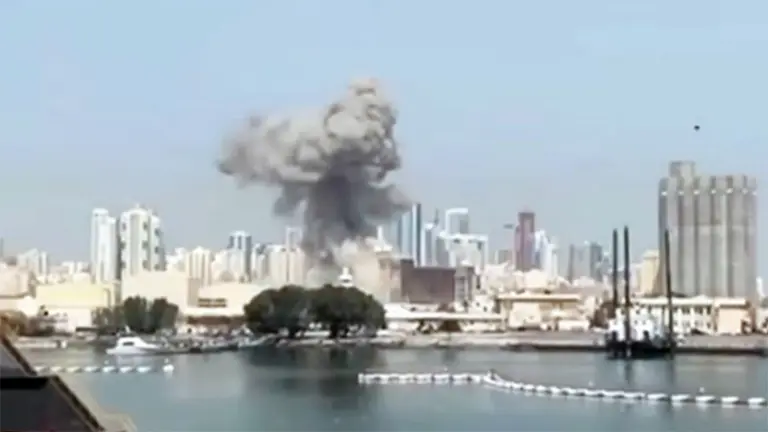
On the first day of the war, Iranian missiles and drones began to hit not only military facilities in Gulf states hosting US forces but also civilian targets such as hotels as well as energy infrastructure and international airports in Abu Dhabi, Bahrain, Dubai, and Kuwait. The attacks were the most serious and sustained threats to the physical security of the GCC states since the Iraqi occupation of Kuwait in 1990–91, and have adversely impacted aviation, tourism, and sport—all sectors that have been the focus of economic diversification strategies. The effective closure of the Strait of Hormuz because of attacks on shipping, and the widespread cancellation of existing war risk insurance coverage, has created the biggest shock to energy and global supply chains in 50 years. On March 2, 2026, QatarEnergy halted production of Liquefied Natural Gas (LNG) and two days later declared force majeure, while Kuwait and Bahrain cut back oil production for lack of storage capacity and alternative export routes.
Associated Damages of the War
More than two weeks into the war, it has become clear that starting assumptions made by US and Israeli policymakers have not played out as anticipated. Any notion that the White House may have had that a Venezuela-style ‘decapitation’ could be replicated in Iran has proved to be a miscalculation—one that could be as consequential for US credibility as the mishandling of the 1956 Suez Crisis was for Britain and France. The Iranian regime has shown itself more durable and resilient than expected and the country has not (yet) collapsed into internal strife, while the Gulf states have not participated in offensive military operations. Iranian officials have responded with asymmetric operations that counter the mismatch in conventional military strength, demonstrating an ability to significantly disrupt the global economy as well as affecting neighboring states.
Iranian officials have demonstrated an ability to significantly disrupt the global economy.
Prior to the war, more than 20 percent of the world’s oil and natural gas passed through the Strait of Hormuz. Its de facto closure only underlines the importance of this strategic and geoeconomic chokepoint. It is not necessary (nor even feasible) to physically block traffic through the Strait’s twin shipping lanes, which are located mostly in Oman’s territorial waters. Merely increasing the risk of attack on maritime vessels has been sufficient to deter shippers and insurers, effectively giving Iran a stranglehold over a vital artery for world trade that extends far beyond the energy flows with which the Gulf states are so closely associated.
While attention has focused on interruptions to oil and gas exports, the effective closure of Hormuz has also had an immediate impact on a wide range of industrial products critical to global supply chains. Regional producers export around 49 percent of global urea and 30 percent of the world’s ammonia, products that are critical to nitrogen fertilizer supply chains and crop production. Exports of phosphates and sulfur have been heavily affected as 50 percent of world sulfur exports rely on passage through the Strait of Hormuz. Gulf states also accounted for 8 percent of aluminum production, and prices jumped after deliveries from major smelters in Bahrain and Qatar were halted. Qatar produces around a third of the world’s supply of helium, a gas that is vital for semiconductor manufacturing and for cooling systems in data centers, medical imaging, and defense technologies—and is similarly off the market for the time being.
From November 2023 to November 2025, Houthi attacks on maritime vessels in the Red Sea prompted ships to avoid the Bab al-Mandab chokepoint by taking the (much longer) route around the Cape of Good Hope. But there are fewer viable workarounds to the Strait of Hormuz. Saudi Arabia and the United Arab Emirates have the East-West and the Abu Dhabi Crude Oil Pipeline that can, respectively, send 7 million and 1.5 million barrels of oil daily to terminals on the Red Sea and Indian Ocean, although neither pipeline could fully replace the seaborne transit of oil from terminals inside the Gulf without reducing natural gas export capacity. Their utility is also limited by smaller export capacities at Saudi oil terminals on the Red Sea at Yanbu and by the possibility of Iranian drone strikes on Emirati oil storage facilities at Fujairah.
Shipments of LNG from Qatar and Abu Dhabi currently have no viable alternative to the Strait of Hormuz. The interruption of cargo from Qatar’s Ras Laffan LNG export facility has removed some 20 percent of LNG from the market, with immediate ramifications for buyers worldwide, as well as for Kuwait, where Qatari LNG plugs a growing gap in domestic energy requirements. As seasonal demand for electricity approaches its summer surge, officials in Kuwait (as well as in Egypt, which has similarly been affected by the pausing of gas supplies from Israel) will likely hope that supply disruptions will be measured in weeks rather than months. Kuwait is also reliant on passage through Hormuz for nearly all of its oil exports, just like Qatar and Bahrain, illustrating how the effects of the shipping shutdown are felt unevenly across the Gulf.
The closure of the Strait will likely reshape planning calculations about energy and trade infrastructure. In 2023, for example, the Abu Dhabi National Oil Company (ADNOC) decided to double its LNG export capacity by constructing a major new facility at the industrial port of Ruwais, inside the Strait, rather than at Fujairah, which has direct access to the open sea. While there was an operational rationale for locating the plant close to existing facilities, different considerations may well prevail moving forward. Sovereign wealth funds may choose to redeploy capital domestically to finance projects such as the delayed Gulf railway project that will boost land-based connectivity within and beyond the GCC. Oman is likely to be a beneficiary of any such moves to diversify infrastructural links as the sultanate is less vulnerable to disruption than the Saudi Red Sea coastline, which remains heavily reliant on vessels’ ability to safely navigate the Bab al-Mandab for Asia-bound trade. Nevertheless, strengthening the resilience of Gulf infrastructure will take years.
The Need for More GCC Cooperation
While there are few short-term fixes, the current shock to the region’s wellbeing is unprecedented in the modern history of the Gulf states. Whereas previous crises tended to directly affect one or two GCC states at a time, the war on Iran has initiated a regional conflagration that hits all six simultaneously, albeit to varying degrees. It remains to be seen whether the current crisis is sufficient to trigger a genuinely collective response from the Gulf states.
There are indications that at least some in the Gulf are already thinking along these lines. On March 13, 2026, for example, former Qatari prime (and foreign) minister Hamad bin Jassim Al Thani called for the creation of a NATO-style military and security alliance. But previous attempts to craft region-wide security and defense arrangements have made little headway. From efforts following Iraq’s 1990 invasion of Kuwait to the Middle East Strategic Alliance mooted during Trump’s first term, collective security initiatives have floundered due to a reluctance to pool resources, a preference for bilateral ties with external security and defense partners such as the United States, and, not infrequently, a lack of shared threat perceptions.
The magnitude of the current crisis may be the catalyst for the GCC to revisit its strategic approach.
The magnitude of the current crisis may be the catalyst for the GCC to revisit its strategic approach, perhaps building on the first Vision for Regional Security that the Council proposed in March 2024. The GCC has functioned most effectively in times of external pressure; indeed, the organization came together quickly between February and May 1981 in response to the twin regional shocks of the 1979 Iranian Revolution and the 1980 Iraqi invasion of Iran. Already, the war with Iran has eased, if not ended, the deepening rift between Saudi Arabia and the UAE, which now share anger at Tehran for attacking Gulf states despite their refusal to facilitate or support the US campaign, not to mention their anger at Washington for plunging the region into such unnecessary turmoil.
Policymakers in Gulf capitals as well as at the GCC Secretariat in Riyadh will need to rethink how to engage with a weakened, hostile Iran whose colors have been sharply revealed during the March 2026 conflict. Until then, Gulf concerns that Iran would target them in response to a US or Israeli strike were mostly hypothetical (with the notable exception of the June 2025 missile salvo against Qatar’s Al-Udeid airbase). Now, in a situation where Gulf leaders sought to prevent the war and remained neutral from the start, there can be no ambiguity about Iran’s position.
Even if the war ends soon and does not descend into a grinding conflict that lasts for months, repairing trust and diplomatic relations with Tehran will not be swift. Years of doubts about the reliability of US security guarantees also are likely to grow, as Washington’s actions have exposed the Gulf states to harm rather than providing deterrence or protection. If anything, US (and Israeli) decision-making before and during the war on Iran has revealed the misalignment in their visions for regional security and stability—as well as the limited ability of Gulf leaders to influence the White House despite reported pledges to invest over $3 trillion in the US economy since Trump re-entered the Oval Office in January 2025.
These are big-picture issues that will become more urgent the longer the war continues and the deeper the direct and indirect impact on economy and society becomes. For now, GCC leaders know that the war on Iran has presented them with unwanted risks and that they must do what is necessary to avoid their unintended consequences, especially those caused by the Islamic Republic’s response to war. The costs of the war and the dangers of uncontrolled escalation were brought home by the missile strike on Ras Laffan Industrial City that caused ‘extensive damage’ to the heart of Qatar’s energy sector on March 18. Launched in retaliation after an Israeli drone attack which damaged gas treatment facilities at Iran’s Assaluyeh gas complex, the assaults on critical energy infrastructure risk moving into a mutually assured destructive phase in the war.
The views expressed in this publication are the author’s own and do not necessarily reflect the position of Arab Center Washington DC, its staff, or its Board of Directors.
Featured image credit: screencap/X