
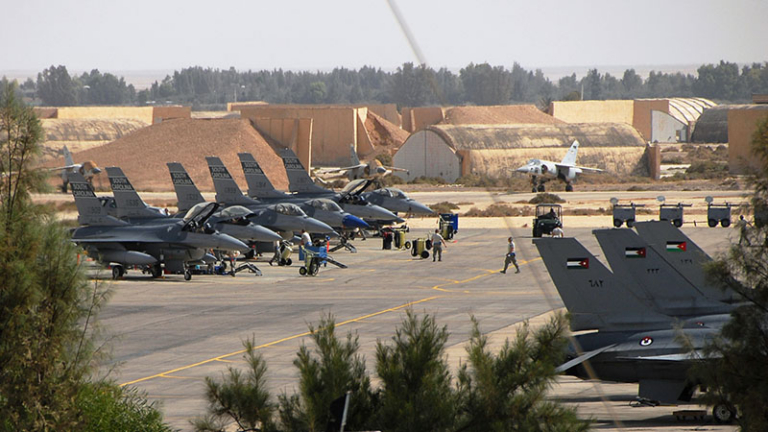
Since the start of the US-Israel war on Iran in February 2026, dozens of citizens of the Hashemite Kingdom of Jordan have been injured by debris falling from intercepted Iranian missiles that were headed to Israel or were targeting sites in Jordan. When the war began, the United States correctly assumed that its troops in the Gulf would become targets and moved some of them to Jordan from Bahrain, Kuwait, Qatar, and the United Arab Emirates. In recent weeks, however, Iran has begun targeting those troops, with multiple missiles killing at least three US soldiers and wounding dozens of others. Damages included multiple Black Hawk helicopters, a residential facility at King Faisal Air Base, and multiple sites at Muwaffaq Salti Air Base, a major location for permanently stationed US troops.
The fact that Jordan had come to the aid of Israel outraged many citizens at a time when political criticism of King Abdullah’s foreign and domestic policies was already high.
In late July 2026, hundreds of prominent Jordanians signed an open letter demanding the immediate withdrawal of US troops from Jordan. The signatories came from across the political spectrum and included lawyers, activists, former government officials, and tribal figures, who said that the presence of US troops “exposes Jordan to security, political, and economic risks that serve no national interest and increases the likelihood of our country being dragged into a regional conflict to which it is not a party.” The public outcry followed a June 2025 incident in which Jordanian air defenses shot down Iranian missiles as they crossed the kingdom’s airspace en route to Israel. The fact that Jordan had come to the aid of Israel outraged many citizens at a time when political criticism of King Abdullah’s foreign and domestic policies was already high.
The presence of an estimated 4,000 US troops in Jordan could further act as a lightning rod for public discontent. In mid-July 2026, the US embassy in Amman learned of a threat to Jordan’s only port city, Aqaba, which reportedly led to the evacuation of both the seaport and the airport—though Jordanian officials denied these reports. With tens of thousands of commercial flights to Jordan canceled since the start of the war, the country’s tourism industry is now tanking. While US support is supposed to provide the kingdom with vital protection, its military presence also risks drawing the country further into regional conflicts over which Jordanian citizens have little influence.
Jordan’s Political Bargain with the United States
Jordan has built its security around external alliances and is much weaker militarily and economically than its neighbors. The United States has been supporting the kingdom since the late 1950s. Jordanian support for that alliance has vacillated over the years, but animosity toward the United States worsened following the signing of a peace treaty with Israel in 1994 at the urging of the United States. Tens of thousands of protesters have since condemned US support for Israel, the US-led 2003 Iraq War, and US support for authoritarian regimes during and after the Arab uprisings of 2011. But Jordan has gained essential military and economic aid as a result: combined US annual aid has nearly tripled since the Arab uprisings from around $700.5 million in 2010 to around $1.8 billion in 2024 (the most recent year for which US government figures have been fully reported).
Combined US annual aid [to Jordan] has nearly tripled since the Arab uprisings from around $700.5 million in 2010 to around $1.8 billion in 2024.
With all of the military aid it receives, the Jordanian Armed Forces has close ties to the United States, with which it routinely engages in bilateral military exercises. The United States funded the establishment of the King Abdullah II Special Operations Training Center (KASOTC), a military training facility with a vast desert campus “where advanced training meets advanced technologies.” The United States has routinely used Jordan as a base of operations against ISIS in Iraq and Syria and to train rebel fighters during the Syrian civil war. Unlike in the Gulf, it does not operate its own permanent military bases in Jordan, although US troops maintain a permanent presence in the northern Jordan at the Muwaffaq Salti Air Base, where Patriot missile batteries and Terminal High Altitude Area Defense (THAAD) anti-missile systems are stationed. In addition, the US-Jordanian Defense Cooperation Agreement allows US military personnel to carry weapons in public that are illegal for local citizens—a particular point of anger among many Jordanians.
Jordanian Public Opinion on Israel and the Occupied Territories
Jordanians have consistently supported an independent Palestine and have taken to the streets for that cause since the 1930s. In recent decades, large pro-Palestinian protests broke out in support of the first Intifada in 1987 and again as Jordan moved toward signing the 1994 peace treaty with Israel. During the Second Intifada, which began in late 2000, large protests continued for more than a year.
Since the 2005 Israeli disengagement and military withdrawal from the Gaza Strip, Israel has launched multiple strikes in the Occupied Palestinian Territories: dozens of strikes in the West Bank, and, in Gaza, dozens of strikes and nine large military operations causing thousands of deaths. In response, Jordanians across the political spectrum have taken to the streets nationwide. Despite speaking in support of Palestinians and in condemnation of the Israeli strikes and campaigns, King Abdullah has never ceded to popular demands that Jordan cancel the peace treaty or sever its relations with Israel.
In the aftermath of October 7, 2023, the regime again found itself struggling to balance its reliance on US aid with popular outrage at the scale of Israel’s war on Gaza. Jordanians renewed their calls for their country to end its peace treaty with Israel. Since the beginning of the war, there have reportedly been more than 500 protests focusing on Gaza and Jordan’s relations with Israel. While US aid provides Jordan with some stability, Israel also continues to be a major source of insecurity. Israeli officials’ talk of potential Palestinian expulsions, combined with what appears to be a move toward the annexation of the West Bank, raises the prospect of another large wave of Palestinian refugees into Jordan. According to a 2024 survey by NAMA Strategic Intelligence Solutions, 73 percent of Jordanians polled were in favor of limiting Jordan-Israel relations.
More than 90 percent of Jordanians polled… indicated they believed that the United States was responsible for the current conflict in Gaza.
For their part, Jordanians direct their anger not only toward Israel but also toward the United States, seen by many as responsible for Jordan’s defense of Israel. Indeed, more than 90 percent of Jordanians polled in the same survey indicated they believed that the United States was responsible for the current conflict in Gaza, and 80 percent of respondents stated they were currently boycotting products from Israel and the United States because of the current conflict.
Whatever happens, the US military presence in Jordan will remain unpopular as long as Washington is seen as advancing Israel’s position over Jordanian interests. If yet more US troops are sent to the kingdom, it will make the Jordan more vulnerable to domestic unrest and potentially external attack, pulling the country deeper into a regional order reliant on US support and acutely exposed to the political whims of Presidents Trump and Netanyahu.
The views expressed in this publication are the author’s own and do not necessarily reflect the position of Arab Center Washington DC, its staff, or its Board of Directors.
Featured image credit: Caycee Cook/USAF via WikiMedia