
In early December 2024, the Assad regime crumbled as Hay’at Tahrir al-Sham and allied groups swept major Syrian cities in a major military offensive, culminating in their takeover of Damascus. In the early hours of December 8, Bashar al-Assad fled to Russia, bringing 54 years of Assad family rule to an end. With Syria emerging from civil war into a new era, it is an opportune time to revisit the political, economic, and social forces that have shaped the country in the modern era.
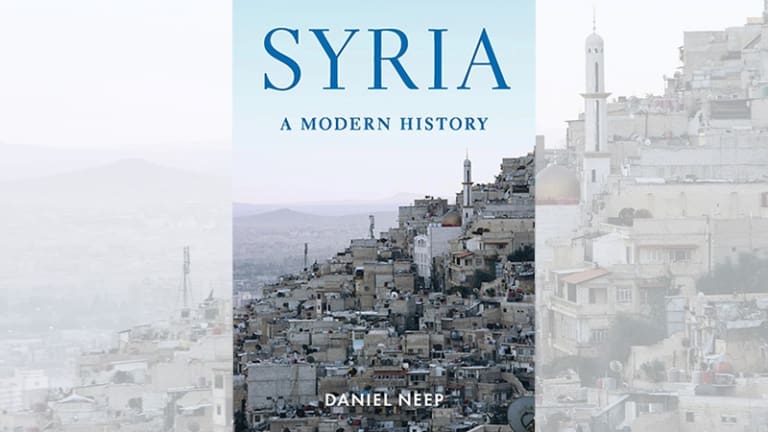
This is precisely what Daniel Neep’s latest book, Syria: A Modern History, delivers. Across 12 chapters, Neep narrates a sweeping account of Syrian history from the late Ottoman era to the end of the civil war. Neep’s eminently sociological approach pays particularly close attention to political contestation, state formation, socioeconomic change, popular movements, and geopolitical pressures. Nevertheless, along the way he also tells us of petty personal rivalries, idiosyncratic colonial officials, eccentric generals, esoteric religious movements, and regional cultural identities. The result is a holistic and detailed account of the twists and turns of modern Syrian political history.
Neep’s first two chapters focus on late Ottoman Syria from the 1800s to the end of World War I. These chapters explore in detail how political reform and economic change in the late Ottoman Empire affected the territories of what is modern-day Syria. He does so by drawing on contemporaneous accounts, historical scholarship on Syria (in English and Arabic), and the latest developments in late Ottoman historiography. Such a synthesis has impressive returns for Neep’s narrative. For example, in line with a more recent historiographical consensus, Neep pushes back against the portrayal of the Ottoman Tanzimat reforms of the mid–19th century as a crude attempt to “Westernize” Ottoman institutions. Instead, he asserts that the Tanzimat are “best conceived not as the Middle East attempting to catch up with the West, but as part of a generalized reconfiguration of relations between state, society and economy that swept the world in the nineteenth century” (p. 19). This insight allows him to explore how one of these reforms—the 1858 Ottoman Land Code that sought to codify and expand a form of private property in the Ottoman Empire—was implemented with mixed results across Syria. While Syrian history is often narrated from the perspective of the cities of the interior—Damascus, Aleppo, perhaps Homs and Hama—Neep goes further by examining the effects of Ottoman reforms in the rest of modern-day Syria’s regions, including the southern regions of the Hawran plain and Jabal al-Druze (the Druze Mountain), the Syrian coastal region, and the oft-neglected eastern regions of the Euphrates Valley, the Jazira, and the desert. This is also how Neep introduces the reader to the geography of Syria, thereby adeptly combining an analysis of Syrian social property relations with an overview of its regional diversity and demographics.
Chapters 3 and 4 focus on the French Mandate era. This era is Neep’s specialty, and the chapters contain many rich insights into French colonial policy and the Syrian nationalist politics that developed to oppose it. Despite the pretensions that the League of Nations mandatory regimes would help to develop modern state institutions, Neep explores how and why the French Mandate utterly failed to do anything of the sort. France’s predilection for divide-and-rule schemes and insistence on keeping Syria fragmented meant that the only institutions that had any power or resources during the Mandate were France’s own colonial security apparatus and intelligence units. In Neep’s narrative, while this was the product of French hubris and disregard for the realities of Syrian society, it was only the first of many failures to develop effective state institutions in Syria over the course of the 20th century.
In his treatment of the nationalist movement against the French, Neep steers away from discussing nationalist politics solely as a politics of elites. Instead, he pays particular attention to the socioeconomic changes and political pressures from below that developed during this time. He explores the development of peasant political consciousness, the rise of new “pioneering industrialists,” and the emergence of nationalist youth movements. In a line that succinctly captures the dynamic and multifaceted nature of politics toward the end of this era, Neep writes that in 1939, “The new youth movements repeatedly took to the streets in the cities, autonomist movements stirred in the provinces, and radical nationalists demonstrated in opposition to the French Mandate and the National Bloc government” (p. 139).
This sets the stage for Chapters 5 to 8, which narrate the tumultuous time between Syria’s independence in 1946 and Hafez al-Assad’s rise to power in 1970. This was an important period that saw the rise of the military as a major political actor, as well as the emergence of ideological and social forces that defined Syrian politics in the era—students, workers, peasants, Nasserists, and Baathists. In these chapters, Neep narrates the minutiae of shifting domestic and international alliances. But to these stories, which usually predominate the historical writing on the era, he also contributes novel analysis on developments in the Syrian state and economy. In Chapter 6, he rereads the legacy of Adib al-Shishakli, the general who dominated Syrian politics in the early 1950s, as more than just another power-hungry military ruler. Al-Shishakli was also “the first Syrian ruler to grasp the importance of institution building” and thus broke new ground by attempting to develop the state’s institutional capacity beyond the military (p. 184). In Chapter 7, Neep describes major new developments in the economy, including fascinating details on the explosion of private sector investment that led to an agricultural revolution in the northeastern Jazira region in the 1950s.
Chapters 9 and 10 cover the era of Hafez al-Assad’s rule and the beginning of Bashar’s. Here, Neep is assisted by the relatively more robust scholarly literature on this era compared to earlier periods. He details Hafez’s ideological dilution of the Baath Party, his international and domestic conflicts, and his various strategies for state-building and cultivating loyal constituencies. In addition, he traces the political repression that Hafez’s regime unleashed, as Syria was rendered a “society of prisons” (p. 345). Neep also gives space in his narrative for political opposition during this era, from the Islamist insurgencies of the 1970s to left-liberal dissidence in the 1980s and 1990s. The latter culminated in the public debate over the need for political reform in Syria known as the “Damascus Spring,” which unfolded shortly after Bashar’s ascension to power in 2000.
Bashar eventually cracked down on these calls for political reform. With challenges to his rule out of the way, he then took steps to advance a series of economic reforms that would move Syria away from a state-controlled economy toward what was proclaimed a “Social Market Economy,” the subject of much of Chapter 11. Here Neep examines how economic liberalization primarily paved the way for investment in unproductive sectors like real estate and luxury consumption, which led to the rise of a new class of economic elites. Combined with the lifting of social protections and subsidies, these policies exacerbated economic inequality and contributed to the growing list of popular grievances that would eventually spark the 2011 uprising against the regime. While this story may be familiar to Syria specialists, Neep contributes new details and his own critical analysis of many of these dynamics. After analyzing the early years of the uprising at the end of Chapter 11, the book’s final chapter shifts focus and provides an overview of the military conflict from 2015 to 2024, with attention to the emerging military factions and geopolitics of the conflict. The book ends with a postscript on the overthrow of the Assad regime in December 2024 and the dawn of a new era for Syria.
Syria: A Modern History avoids many of the pitfalls that have plagued certain corners of Syrian history-writing. For one, it does not overly rely on sect and sectarianism to explain Syria’s history. While sectarianism certainly does factor into the narrative at many points, it is treated as one of many historical variables and does not retain the privileged explanatory power that it has had in much analysis of Syrian history. At times Neep goes to lengths to show how certain phenomena that on the surface may seem to be purely motivated by sectarianism—the appointment of an increasing number of Alawites to privileged state and military positions in the 1960s, for example—can instead be explained by other, more mundane political considerations.
Neep also steers clear of narrating Syria’s history as a history of plots and intrigue centered around big personalities vying for power. This is particularly important for his treatment of the 1950s and 1960s, when political conspiracies abounded. Despite tracking the minute details of political schemes, with all their alliances and betrayals, Neep does not lose sight of the broader historical conditions in which these power struggles took place. We are thus continually reminded of the ideological stakes, economic conditions, and social pressures that shaped how these secretive politics played out. As a result, Neep paints a more balanced, panoramic portrait of Syrian state and society.
Although Syria: A Modern History is suitable for a general audience looking for a deep dive into Syrian history, it should also be of interest to Syria scholars and specialists. Throughout the book, Neep has a subtle way of intervening in certain scholarly debates and presenting new findings in a seamless manner. For those interested in the history of state formation, this aspect should be of obvious interest. But the book is also indispensable for those with an interest in social and economic history. Practically every chapter has a digression detailing the economic conditions and developments of the era, and much of this work fills major gaps in the literature on Syria’s economic history. What also makes this book unique is its attention to Syria’s different regions. Neep’s narrative frequently ventures beyond Syria’s major cities to include details about important developments in the peripheral regions that are so often overlooked in histories of Syria.
Finally, Neep’s reconstruction of many of the issues Syria has faced historically is relevant for thinking about its current political conjuncture. In the aftermath of decades of repression that foreclosed political debate, Syrians once again are asking questions such as: What is the correct balance between state centralization and regional autonomy? What should the place of Syria be amid emerging regional blocs and broader geopolitical developments? What should the shape of economic development be, and how much of this effort should be left to the private sector? What constitutes a Syrian national identity amid all of Syria’s ethnic and religious diversity? As Neep demonstrates, these are questions that Syrians have sought to answer for more than a century, which makes Syria: A Modern History a crucial resource for those interested in Syria’s past, present, and potential futures.
The views expressed in this publication are the author’s own and do not necessarily reflect the position of Arab Center Washington DC, its staff, or its Board of Directors.
Featured image credit: US DoD Archive