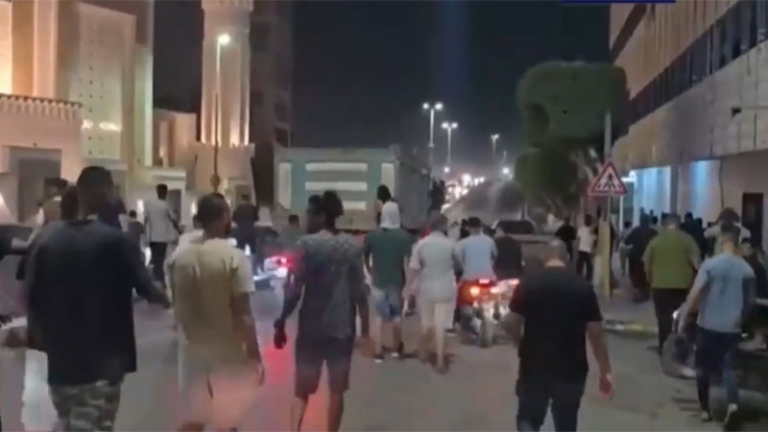
In July 2026, a major heatwave swept the western Mediterranean, causing extreme temperatures and fueling wildfires in France, Italy, Spain, and North Africa. Libya was not spared. As is often the case during summer, surging demand for air conditioning placed the aging electricity grid under immense strain. This year, however, exceptional heat, chronic maintenance issues, and fuel supply problems combined to push the system beyond its limits. Daily power cuts that exceeded 14 hours in some areas led to severe water shortages and communication blackouts. Mass protests soon erupted in towns and cities across western Libya.
Exasperated demonstrators blocked roads, government buildings, and publicly owned companies, expressing their anger and frustration over collapsing public services, soaring prices, and the general deterioration of living conditions. For several hours on July 28, 2026, protesters even shut down the Mellitah Industrial Complex, one of Libya’s most important gas production and electricity hubs, bringing gas exports to Italy to a halt and cutting supplies to local power plants. The escalation prompted government security forces to intervene to regain control of the facility, but this did not end the crisis.
Abnormal heat is one thing. Being wholly unprepared to cope with it is another.
The government could have done more to prevent the conflagration. Several major incidents—including the September 2023 Storm Daniel, which caused catastrophic flooding that killed thousands and destroyed much of the city of Derna—had already highlighted Libya’s unpreparedness for the potentially devastating impact of climate-related disasters. Yet Libya only launched its first comprehensive national climate strategy in July 2026. Before then, the country had no framework to tackle environmental challenges, despite its inadequate infrastructure and its acute vulnerability to aridity and water scarcity. Given Libya’s enormous oil wealth, this lack of preparation is not due to lack of resources. Libya’s crude production in 2026 surged to a 13-year high, averaging between 1.4 million and 1.49 million barrels per day (bpd). High global oil prices resulting from the Iran war and conflict across the Middle East have further boosted state revenues. Abnormal heat is one thing. Being wholly unprepared to cope with it is another.
Popular discontent in Libya is not only the product of inadequate disaster planning, however. The recent crisis also exposed the deeply entrenched corruption of the ruling elites and the resulting governance failures that have had devastating consequences for most Libyans. It should come as no surprise that protesters called for civil disobedience. Fifteen years after the collapse of the Gaddafi regime, ordinary citizens continue to bear the cost of a fragmented political order in which rival factions compete for power and access to state resources, while effective governance and service delivery have remained secondary concerns. The current crisis cuts across more than a decade of division between the internationally recognized Government of National Unity (GNU) in the west and its rival, the House of Representatives (HoR), in the east. Although large demonstrations primarily took place in the west, the populations of eastern and southern Libya were affected by the crisis in electricity and living standards as much as their compatriots. But the security control imposed by the HoR-affiliated Libyan National Army, led by Khalifa Haftar, and local social structures proved more effective at containing dissent.
The crisis comes despite the first signs of a thaw between Libya’s two governments, which in April 2026 together approved Libya’s first unified national budget since 2013. This initiative was brokered by US Special Envoy Massad Boulos after more than a decade of failed international efforts to reunify Libya’s rival institutions and is widely portrayed as evidence of political progress. Yet elite political agreements such as this do little to restore the Libyan state’s capacity to provide its citizens with basic services.
For the Libyan people, steadily deteriorating living conditions reflect the country’s poor governance and the widespread mismanagement of public wealth by political institutions.
For the Libyan people, steadily deteriorating living conditions reflect the country’s poor governance and the widespread mismanagement of public wealth by political institutions. Protesters, behind whom stands much of the country’s “silent majority,” have taken to the streets because of both the physical discomfort caused by the heat and the sense of helplessness born of more than a decade of so-called political transition. They sometimes directly blame the crisis on GNU Prime Minister Abdul Hamid Dbeibah and his interim administration, which was established in 2021 to lead the country to national elections. They have watched successive UN special representatives experiment with different negotiation formats between Libya’s rival political institutions, their leaders, and sometimes a broader range of civil society representatives, without managing to bring the conflict to an end. Now, they demand an end to prolonged transitional arrangements and the removal of provisional political institutions. But, disillusioned by the lack of clear outcomes produced by the UN Structured Dialogue consultations launched in December 2025, many Libyans now realize that the US administration appears to have other plans for them.
Today, public frustration is at its highest level in years. There is significant opposition to the top-down approach adopted by US Special Envoy Boulos, and several important Libyan constituencies have rejected the idea of a deal between the Dbeibah and Haftar families. They see this proposed solution as a way to protect the incumbent political elite—and their foreign business partners—in the name of a stability that offers little more than another reshuffle among the same forces that have already plundered the country’s resources and caused the current crisis.
Since the indefinite postponement of the general elections originally scheduled for December 2021, the grassroots demand for electoral sovereignty to restore the legitimacy of political institutions has gone unanswered. In 2025, 20 local political, legal, and constitutional experts repeated this demand in their report to the United Nations Support Mission in Libya; more recently, participants in the UN Structured Dialogue reiterated it in their June 2026 final report. It may be true that Libya’s various grassroots movements do not have a fully developed vision of what a new system of effective and just governance would look like. But they have consistently argued that the current political formula is leading the country into renewed conflict and eroding the last remnants of its state institutions. The ongoing heatwave in North Africa confirms that Libya’s grassroots voices should be heard sooner rather than later.
The views expressed in this publication are the author’s own and do not necessarily reflect the position of Arab Center Washington DC, its staff, or its Board of Directors.
Featured image credit: Screencap via X