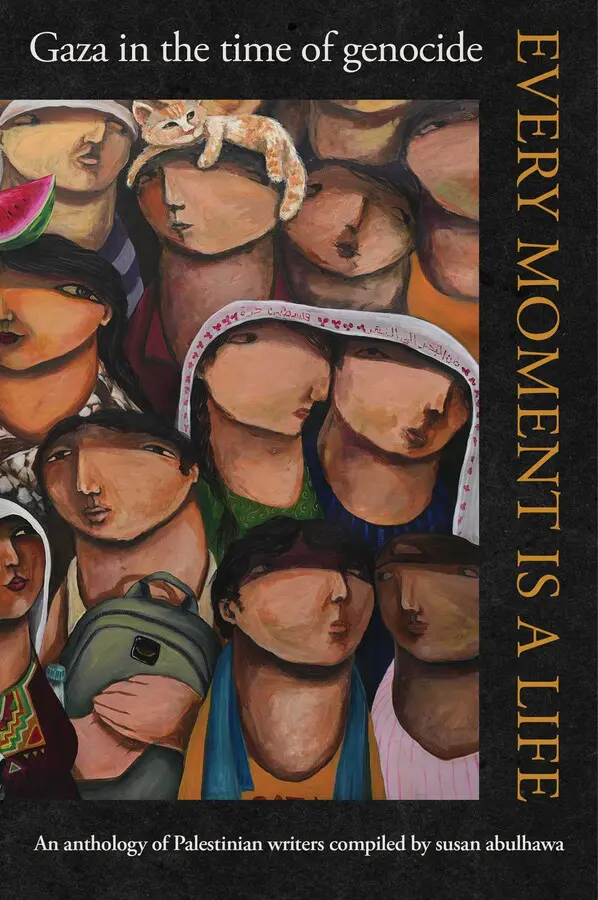
 A sobering reminder for the American reader of the Gaza genocide will soon land in bookstores and libraries throughout the United States, offering firsthand accounts of what Israel has done in the Strip. The forthcoming book is a collection of short essays written by young Palestinian writers enduring unfathomable hardships, dislocation, homelessness, and utterly broken lives under Israeli bombardment. Their personal accounts of the ongoing genocide, expulsions, family separation, and destruction provide grim reminders of what has transpired in Gaza since October 2023—and of what continues to unfold as the world goes about its business seemingly oblivious to the suffering of Palestinians.
During 2024 and 2025, activist, writer, and editor susan abulhawa collaborated with 18 Palestinian writers from Gaza to produce this volume of daily reports about living during the genocide and the ethnic cleansing of Palestinians. The essays are short, 4-5 pages each, originally written in Arabic and expertly translated into English. They convey to the reader the minutiae of living through a devastating war: Israeli warplanes roaring overhead, inadequate food and water supplies, devastated healthcare facilities, endless lines of refugees, parentless children and separated families, and a destroyed landscape, among other details. The published volume is bilingual and contains both the Arabic and English versions, as well as short biographies of the authors, whose number includes former teachers, artisans, farmers, interrupted medical students, penniless fathers, fashion designers, and others seeking to be heard. The essays are haunting reports of a people hanging onto its humanity by a thread, mostly waiting for when their time would come to depart this world with the next Israeli bomb, missile, or bullet.
In one account, Mohammad Mu’ammar asks whether Gaza has gone back to the stone age as he prepares his beloved coffee over twigs that he collected outside his tent, which consists of three poles and a flimsy, tattered tarp. As he steels himself to drink it on the Mediterranean beach, he laments the loss of family members who he says were killed quickly but cruelly when a missile tore them to shreds.
In another, Khuloud Abu Zaher tells the tale of a woman awaiting the imminent birth of her first child in her small tent but without her own mother to help. Her husband tries to talk her through her birth pangs as he thinks of a way to transport her to a functioning hospital: donkey, horse-drawn cart, or tiny three-wheeled tuktuk? Ghassan Salam recounts how he found an infant whose parents and sibling had died in an air raid as they sought refuge. It was all but impossible for him to find the baby’s next of kin. When he finally succeeded, he had become so attached to the child that he already had named him, as if he were his own son.
Rizq Ahmed tells the story of his family sitting down for dinner around a broken table as his father reminded everyone to save some of the bread as they might not find any the next day. Khadija Abu Lebdeh laments having to give up her martyred brother’s bed for firewood. Her younger brother—killed during the family’s trek to the tent encampment that they now call home—had carved his name into the frame when they were back in their now-destroyed house. Fashion designer Fatima Asfour relates her agony trying to find her old wardrobe closet in her parents’ apartment, now flattened like hundreds of others in her old neighborhood.
The contributors chronicle how Israel’s genocide has made everyday activities impossible. To be sure, these writers from Gaza offer nothing less than eyewitness reports of an ongoing Zionist project to secure full control over the land between the river and the sea, humanity, justice, and international law be damned. A reader can easily imagine similar tracts by others living under the precarious conditions of Israeli occupation in the West Bank, where Israeli settlers, protected by Israeli soldiers, are making life impossible for the Palestinians there.
And yet, despite the harsh reality that the writers expose both of their individual lives and of life more generally in the age of genocide, the essays bear their share of optimism and hope, albeit indirectly. The book gives them a platform as writers who yearn for a public voice, like innumerable others around the world. Although exposing traumatic experiences, their contributions speak of a longing for peace and for a hopeful future where they realize their dreams and ambitions. Indeed, they form the vanguard in a literary struggle to secure their people’s human dignity, rights, and liberation. Proceeds from the book will support the Palestine Writes Literary Festival as well as the contributors—whom the reader hopes are still alive.
abulhawa’s collection is what the American reader needs to read today to understand what the US government has enabled, and continues to enable, Israel to do in Gaza under both the Biden and Trump administrations. There is no doubt that this publication will receive the usual criticism and opprobrium from Israel’s supporters in the United States who have taken it upon themselves to hide the truth about genocide and ethnic cleansing in Gaza. But by chronicling the details of the atrocious truth, abulhawa and her collaborators took the moral stand that the world needs at this precarious moment.
susan abulhawa, ed., Every Moment Is a Life: Gaza in the time of genocide (New York: Atria/One Signal Publishers, forthcoming February 10, 2026, 224 pages).
The views expressed in this publication are the author’s own and do not necessarily reflect the position of Arab Center Washington DC, its staff, or its Board of Directors.