
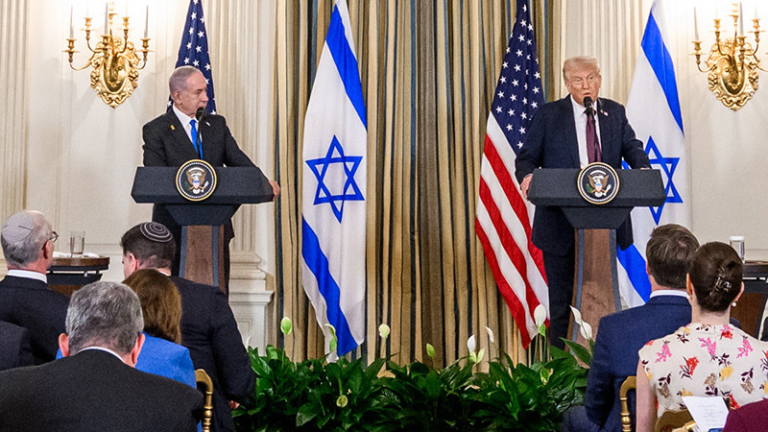
On September 29, the White House announced a new 20-point plan for ending the Israeli war on Gaza that includes, among other things, provisions for an immediate ceasefire, the release of Israeli and Palestinian prisoners and hostages, and the disarmament of Hamas and amnesty to its members who lay down their weapons. The plan also calls for the setting up of an international stabilization force to handle security in Gaza and the establishment of an international transitional authority to govern the Strip. Trump’s plan promised that Palestinians would not be forcibly removed from Gaza. In a press conference with the president, Israeli Prime Minister Benjamin Netanyahu provided a tepid acceptance of the plan but insisted on his government’s agenda of destroying Hamas and ending its presence in Gaza. From its side, Hamas announced that the plan ignores the Palestinians’ right to represent themselves and is said to still be considering whether it will accept it outright or ask for changes.
Arab Center Washington DC (ACW) asked its fellows and analysts to provide their brief perspectives on different aspects of the plan. Their responses are below.
Buy-in from the Arab and Muslim World
Heba Gowayed, Non-resident Fellow; Professor of Sociology, CUNY Hunter College
In a joint statement, Egypt, Jordan, Qatar, Saudi Arabia, the United Arab Emirates, and other Muslim countries including Indonesia, Pakistan, and Turkey, said that they welcomed Trump’s leadership and his “sincere efforts to end the war in Gaza.” They expressed their collective willingness to finalize the agreement, which they saw as working toward a two-state solution. They expressed their belief that the United States will ensure unrestricted humanitarian aid to Gaza, that Palestinians will not be displaced, that Israel will withdraw fully from the Strip, and that Gaza will be rebuilt and join the West Bank in a Palestinian state. Reports indicate that Egypt, Qatar, and Turkey have met with Hamas and are pressuring the movement to accept the proposed plan.
The support of these countries is critical as the implementation of Trump’s twenty-point plan hinges on the buy-in of Arab states to support both the process of “demilitarization” which is at the core of plan and also the import of aid and goods into Gaza, constrained for decades and even more restricted during the past two years of genocide. Egypt and Jordan are specifically named as consultants and key actors in the creation of the International Stabilization Force which would be deployed to Gaza as part of a “long-term internal security solution.” In an extension of Egypt’s current role in the management of the Rafah border, Cairo would work alongside “newly trained” Palestinian police forces to prevent munitions from entering Gaza and to secure the entry of goods into the Strip.
The Israeli Impediments to Trump’s Gaza Plan
Khalil E. Jahshan, Executive Director
President Trump’s plan to end the genocidal war in Gaza is neither a cohesive plan nor a framework agreement; it is instead a half-baked hybrid document lacking sound details and is embedded with contradictions and loopholes apt to derail the process once its implementation gets underway. The 20-point list touted by the White House as a plan for a historic and comprehensive peace throughout the Middle East, not just Gaza, as emphasized by the president on September 29, 2025, stands little chance of winning complete or unqualified endorsement by the current Israeli government, or the Israeli public at large.
In their joint press conference at the White House, Trump and Netanyahu seem to be commenting on two significantly divergent proposals. As soon as President Trump finished his summation of the plan’s provisions, Netanyahu redefined it as a parallel document in complete harmony with his government’s original five fundamental points about the objectives of the Gaza war. He actively ignored apparent and substantive differences between Washington and Tel Aviv about serious issues like the call for an immediate ceasefire, avoiding the ethnic cleansing of Gaza, the fate of decommissioned or demilitarized Hamas fighters, the extent and schedule of the Israeli withdrawal, and the future governance of the Strip. It became abundantly clear to all observers that the two “allies” were not reading from the same sheet of music.
The reaction back in Israel was equally ambivalent and confused. While 71 percent of the public backed the American plan, only 12 percent expressed confidence that it would be implemented. In a typical knee-jerk reaction, traditional opposition leaders in Israel, like Benny Gantz, Naftali Bennett, and Yair Lapid, quickly endorsed the plan while acknowledging its difficult but necessary nature. Within Netanyahu’s fragile coalition, however, Finance Minister Bezalel Smotrich and Minister of National Security Itamar Ben-Gvir raised objections, warning against violating the longstanding red line preventing Palestinian statehood, which, in their judgment, “would endanger Israel’s existence.” Ben-Gvir reminded Netanyahu that he does not “have a mandate to end the war without Hamas’ complete defeat,” and that he “should never have gone along with an agreement that’s full of holes like this.”
Setting aside President Trump’s upbeat demeanor over the proposed ideas for Middle East peace, a lot could go contrary to Washington’s wishes and desires regarding Gaza. In spite of his declared compliance with the plan as presented at the White House, nothing would prevent Netanyahu from reneging on his public commitment by blaming either Hamas’s wavering or Israeli internal differences. Should the opposition to the Trump plan pick up momentum in Israel, it is quite likely that Netanyahu would seek refuge in Israeli chaotic electoral politics to kill the proposal by resorting to extensive delay tactics allegedly necessitated by parliamentary elections.
Permanent Palestinian Subjugation and Neocolonial Rule Dressed Up as Peace
Tamara Kharroub, Deputy Executive Director and Senior Fellow
President Donald Trump’s recent 20-point proposal for Gaza is not a plan for peace, but a scheme to subjugate Palestinians and give Hamas an ultimatum. Absent from the entire process and text is any Palestinian participation or agency, let alone guarantees for Palestinian statehood. While the plan offers a welcome end to the suffering and genocide in Gaza, its long-term dangers lie in sidelining Palestinian self-determination, a right under the UN Charter, and any measures for Israeli accountability or international legal mechanisms.
The plan, which the White House unveiled before it was viewed by Hamas, the Palestinian Authority, or any Palestinian entity, eliminates Palestinian agency and self-governance. It gives Israel full US backing to continue its genocidal war in Gaza if Hamas rejects it or if Israel perceives the organization to violate the terms of the agreement. The text is rife with vague and conditional language, where Israeli withdrawal is “based on standards, milestones, and timeframes linked to demilitarization” and a “credible pathway to Palestinian self-determination” will only be discussed “when the PA reform program is faithfully carried out.” There are no guarantees or binding mechanisms or clarity around what constitutes reform or demilitarization and around who determines what they are. The plan ultimately gives Israel a blank check to prolong its presence in Gaza, fully reoccupy it, or resume its genocidal war.
The plan envisions Gaza being governed by a technocratic, apolitical Palestinian committee, overseen by a “Board of Peace” chaired by Trump along with other international members like Tony Blair (the architect of the Iraq war and its associated war crimes). This structure ensures that decision‐making and control remain largely in foreign hands that bend to Israel’s wishes. Needless to say, a western government body imposed on the Palestinians with promises of economic prosperity without rights has never worked in Palestine, or anywhere else for that matter. It should only be up to the Palestinians to decide their own governance and future. The International Stabilization Force (ISF) and transitional authority overseeing Gaza without offering any guarantees for Palestinian agency, rights, security, and self-determination, are nothing less than a scheme for neocolonial rule and the permanent subjugation and acquiescence of the Palestinian people to Israeli control.
Plan Comes as Isreal’s Isolation Increases
Yousef Munayyer, Head of the Palestine/Israel Program and Senior Fellow
The Israeli-American plan announced by the White House this week can be understood in the broader context of Israel’s global isolation. American allies in Europe, many of whom had held off on doing so for years, broke with Washington and announced their recognition of a Palestinian state. Many states are sanctioning Israeli ministers and multiple corporate entities are reviewing or ending economic ties with Israel. So significant is this growing criticism and boycott that Benjamin Netanyahu, an indicted war criminal, announced in a recent speech in Israel that the country must gird its economy for isolation. At the United Nations during the organization’s 80th meeting, leader after leader denounced Israel’s horrors in Gaza.
Releasing the plan as Netanyahu was preparing to visit the White House and hold a press briefing with President Trump is an effort to reset the current global conversation by gathering Israel, the United States, and their allies in a chorus of pressure on Palestinians. This should be seen as a Netanyahu response to global advocates for justice who had their moment at the United Nations. To be sure, Netanyahu is saying, “you may have Turtle Bay, but I still have the White House.”
This, more than the contents of the plan that leave little room for optimism, is crucial to understanding what all the pomp and circumstance was about: an effort to buy more time and space for Israeli genocide with the American, Israeli, and global publics until Israel finishes its war on Gaza. For many reasons, it is unlikely to work. The reality of the horrors in Gaza is indelible, and no number of points on a White House press release will obviate that.
Tony Blair: from Iraq to Gaza
Daniel Neep, Senior Editor
It comes as little surprise that Donald Trump has named former UK prime minister, Sir Tony Blair, as a likely member of the so-called Board of Peace that will oversee Gaza if the new ceasefire plan is implemented. Trump’s plan incorporates elements of Blair’s own proposal to establish a Gaza International Transitional Authority (GITA) that would assume day-to-day responsibility for governing the Strip. The GITA International Board—comprising seven to ten billionaires, UN officials, business executives, and “at least one qualified Palestinian representative”—would provide strategic direction for the Authority’s coordination of humanitarian aid, reconstruction, and public services that would be implemented by vetted Palestinian employees on the ground. Trump’s plan for Gaza clearly bears the imprint of Blair’s ambition to return to his own unfinished business in the Middle East.
Blair’s extensive diplomatic experience supposedly qualifies him for the job. But as official envoy for the Middle East Peace Quartet (United Nations, European Union, United States, and Russia) from 2007-2015, Blair was so sympathetic to Israel that the US and EU sidelined his office. As top cheerleader for and participant in the 2003 US-led invasion of Iraq, Blair was an enabler for the Bush administration’s woefully inadequate planning for post-war governance, which ushered in years of chaos and violence across the region. If Blair made his international reputation after negotiating the 1998 Good Friday Agreement that successfully ended fighting in Northern Ireland and rallying the international community in response to the 1999 Kosovo genocide, then it was surely in the Middle East that Blair lost his way.
Since then, Blair and associates have advised authoritarian governments from Egypt to Kazakhstan and Guinea and have reportedly exploited his connections to facilitate political introductions and business deals around the world. Staff from the Tony Blair Institute for Change (TBI) were involved in discussing the Boston Consulting Group’s ‘Gaza Riviera’ project, which envisaged the expulsion of Palestinians from Gaza, and aggressively pushed solutions from technology firm Oracle after its founder invested $130 billion in TBI between 2021 and 2023. Blair’s murky connections help explain why his suggestions for the GITA International Board include such luminaries as Egyptian telecoms billionaire Naguib Sawiris and Aryeh Lightstone, who reportedly helped establish the Gaza Humanitarian Foundation, the private aid organization set up to offset Israel’s role in starving Gaza.
Echoes of business run through Blair’s blueprint for the GITA. We read much of public-private partnerships, boards, chairmen, and even chief executives. There is little mention of Palestinian participation, self-governance, or state-building. The language of democratic politics has been erased from plans for Gaza. For Blair, no doubt, this is business as usual.
The United States Is Not Serious About Peace in Gaza
Assal Rad, Non-resident Fellow
On Monday, President Trump joined Israeli Prime Minister Netanyahu to announce a new proposal to not only end Israel’s assault on Gaza but also, according to the president, to bring lasting peace to the region as a whole. Yet, the plan’s rollout has raised more doubts than hopes. While any deal that might bring some relief from the daily slaughter in Gaza is desperately needed, a so-called agreement led by foreign powers that sidelines Palestinians evokes the history of Western interventionism. That a notorious war criminal, such as former UK Prime Minister Tony Blair, would be involved in Gaza’s governance only adds to anxieties about this vision for the future of Palestinian self-determination.
Neither President Trump nor premier Netanyahu took questions from the press. Key terms were left undefined in a proposal that supposedly hinges on approval from Hamas. Meanwhile, Netanyahu reiterated Israel’s “right” to do whatever is necessary for its security, a phrase that has been repeatedly used to justify Israel’s actions. This rhetoric mirrors the language used to excuse what the United Nations and the world’s leading human rights bodies recognize as a genocide against Palestinians. It also calls into question the sincerity of US engagement in real peace.
The United States has positioned itself as a broker for peace, yet its complicity in Israel’s military escalations undermines its credibility. When Israel launched attacks on Iran in June, the United States was engaged in talks with Tehran. During negotiations over a US-backed ceasefire, Israel carried out an airstrike on Qatar—an American ally—targeting the negotiators. These actions occurred under the umbrella of US-led diplomacy, casting doubt on whether Washington is genuinely committed to peace or simply providing cover for continued aggression and Israeli impunity.
Any peace plan that leaves open-ended “security” guarantees for Israel without enforcing international law or protecting Palestinian rights is a blank check for occupation and crimes against humanity.
The views expressed in this publication are the authors’ own and do not necessarily reflect the position of Arab Center Washington DC, its staff, or its Board of Directors.
Featured image credit: The White House