
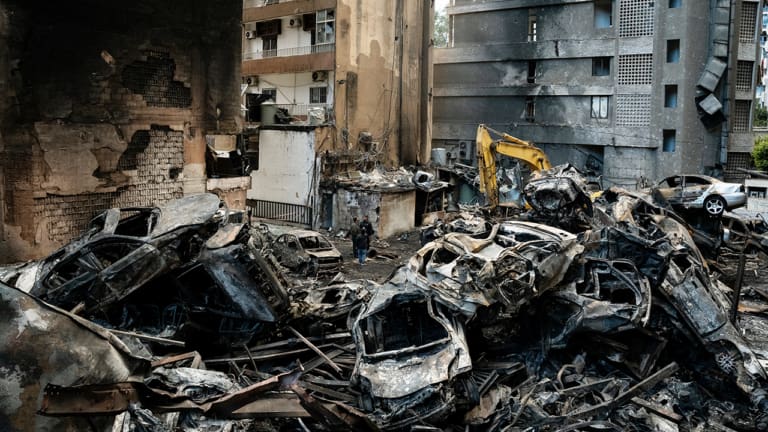
After an almost 14-month conflict that began in October 2023, during which Hezbollah exchanged missile fire with Israel in an effort to relieve pressure on Palestinians in Gaza, the two sides agreed to a ceasefire in November 2024. Under the deal’s terms, Hezbollah withdrew from its forward positions along the border, which were transferred to the Lebanese Armed Forces (LAF), and suspended military operations. The organization turned inward to focus on reconstituting itself after Israel’s September 2024 killing of its leader, Hassan Nasrallah, and several senior field commanders. Israel, meanwhile, continued near-daily strikes, targeting what it described as Hezbollah weapons depots and residual leadership networks.
On March 2, 2026, Hezbollah resumed missile fire into Israel, presenting the move as retaliation for the February 28, 2026, US-Israeli assassination of Iran’s supreme leader, Ayatollah Ali Khamenei, a figure of considerable religious and political significance in Shia communities in Lebanon and the wider region. This marked the effective end of the 2024 ceasefire.
Hostilities have since escalated into a renewed war. Israel has deployed ground troops into South Lebanon, triggering the mass displacement of more than a million Lebanese from the south and Beirut’s southern suburbs. The Lebanese government, not formally a party to the conflict, has repeatedly appealed for a ceasefire, signaling a willingness to pursue direct negotiations with Israel that could extend to a formal peace deal and full normalization of relations.
Ambassador-level talks took place in Washington, DC, on April 14, 2026, hosted by Secretary of State Marco Rubio. The direct Israel-Lebanon convening, the first in decades, is likely to echo the 1983 negotiations that led to the May 17 Agreement of that same year, which followed Israel’s 1982 invasion of Lebanon. That accord, signed by Lebanon under fire, preceded a prolonged Israeli occupation of South Lebanon that gave rise to Hezbollah as the leader of the armed resistance to Israel’s presence. The agreement collapsed within a year, as Israeli troops remained in place and both Iran and Syria deepened their support for Hezbollah.
The 1982 invasion followed two decades of Israeli attacks on Palestinian resistance groups, primarily targeting the Palestine Liberation Organization (PLO), which had recruited heavily from Palestinians who had sought refuge in Lebanon after earlier Arab-Israeli wars. Throughout the 1970s, Israel had pressured the Lebanese government to expel the PLO or face military intervention. Within Lebanon, right-wing Christian parties—then controlling the presidency and heavily influential in the LAF—opted to confront the PLO despite the absence of a national consensus on the group’s presence. Early confrontations, including LAF and Kataeb Party militia actions against Palestinians in 1973, escalated tensions. These culminated in the infamous Ain al-Remmaneh bus massacre in 1975, widely regarded as the immediate catalyst for Lebanon’s 15-year civil war. It was during that war that Israel launched its 1982 invasion, seeking to eliminate the PLO and to install a compliant government in Beirut.
The parallels between today’s dynamics and those of the 1970s and 1980s are uncanny.
The parallels between today’s dynamics and those of the 1970s and 1980s are uncanny. Lebanese society today remains politically divided, as it was then, although Israel now confronts Hezbollah, not the PLO, on Lebanese territory. The internal balance within Lebanon has also evolved. The Sunni community, historically supportive of Palestinians, is split: Many are highly critical of Hezbollah and unlikely to mobilize in support of armed confrontation with Israel. The postwar settlement enshrined in the 1989 Taif Accord changed the distribution of power within the state. The Christian Maronite community no longer dominates the executive authority or the armed forces; decisions are now taken by a council comprised of representatives from several religious sects. Because of these changes, measures such as disarming Hezbollah or making peace with Israel require a degree of national consensus that is currently lacking.
The Lebanese state, itself a colonial creation, is built on the fragile confessional compromise of the 1943 National Pact, which underlies an understanding that no major national realignment can occur without a widespread consensus among communities. Over time, this constraint has worked against a strong military posture. The LAF is modest in size, ill-equipped to defend the borders, and unauthorized to confront invading forces unless specifically ordered to do so by the government. This reality was apparent in mid-March 2026, when Israeli ground forces crossed the Blue Line separating the two countries. The LAF withdrew rather than engage, with commanders citing operational limitations and the absence of orders from Beirut. This episode fits a long-established pattern in which Israeli forces have operated on Lebanese territory with minimal resistance from the state, from the 1968 Israeli paratrooper raid on Beirut International Airport—which blew up 13 Middle East Airlines planes on the tarmac and left without resistance from the Lebanese army—to subsequent incursions in 1978 and 1982.
Diplomatically, Lebanon has struggled to mobilize France or the United States to constrain Israeli aggression. Against this backdrop, calls—mainly from the United States and Israel, but also from the Lebanese right wing— for the Lebanese state to exercise exclusive authority over decisions of war and peace are nonsensical. They assume the ability, will, and capacity to make such decisions of a state that, historically, has not possessed them.
The Lebanese government should not pursue peace abroad at the expense of domestic harmony.
For Lebanon, any approach to negotiations with Israel faces two main constraints. First, past experience imposes limits—as captured by George Santayana’s well known saying that “those who cannot remember the past are condemned to repeat it.” Second, the viability of any agreement with Israel depends on consensus. The Lebanese government should not pursue peace abroad at the expense of domestic harmony. A nation divided cannot make peace with an external enemy. It is defensible for Lebanese to want to avoid being drawn into a wider regional war; it is also defensible to view resistance as necessary in the face of new Israeli efforts to occupy Lebanon. A revised compact is needed to create consensus on a national strategy, including rules governing the use of force. A state that wants to have exclusive authority over weapons and decisions of war and peace must also possess—and demonstrate—the capacity and willingness to use both diplomacy and coercion as necessary to defend its sovereignty.
The lesson is that forcing Lebanon to accept an occupation will backfire, provoking even fiercer resistance, risking civil war, and sowing heightened anti-American sentiments across Lebanon and the region for years to come.
The views expressed in this publication are the author’s own and do not necessarily reflect the position of Arab Center Washington DC, its staff, or its Board of Directors.
Photo by ALFONS CABRERA / NURPHOTO / NURPHOTO VIA AFP