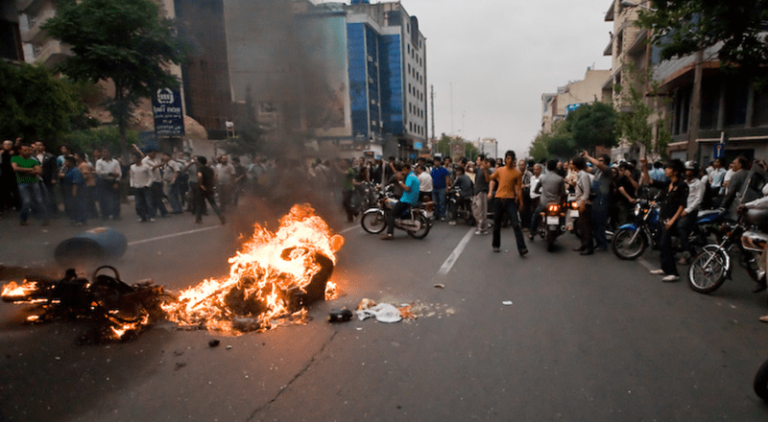
Iran has not lacked moments of mass defiance against the regime. Over the past two decades, repeated waves of protest have challenged the authority, legitimacy, and ideological foundations of the Islamic Republic. Episodes such as the Green Movement in 2009, the intermittent waves of nationwide protest between 2017 and 2019, the “Women, Life, Freedom” uprising of 2022, and the December 2025–January 2026 protest wave all underscore the persistence and expansion of dissent across Iranian society.
The central paradox of contemporary Iran is not the absence of opposition, but the absence of a cohesive opposition.
However, none of these movements has produced a unified political force capable of shifting the balance of power away from the entrenched regime of the Islamic Republic. The central paradox of contemporary Iran is not the absence of opposition, but the absence of a cohesive opposition force capable of consolidating and uniting a critical mass of Iranians into a broad, inclusive national movement. Protest has been recurrent and periodically widespread, but it has not translated into sustained political organization or a viable governing alternative. At its core, the problem is one of leadership: the lack of figures and structures able to aggregate constituencies, reconcile competing visions, and endure repression over time.
This failure reflects not a single constraint but the interaction between state strategies and a fragmented opposition landscape. Repression has systematically targeted dissidents through imprisonment, surveillance, and political exclusion, preempting the emergence of domestic leadership. The case of figures such as Mostafa Tajzadeh—a reformist insider who has called for fundamental political change and was imprisoned from 2009 to 2016 before being rearrested in 2022 and remaining in prison since—illustrates both the potential for leadership that could bridge divides within Iranian society and the state’s determination to neutralize it.
At the same time, broader social and political divisions have limited the opposition’s ability to build cross-class and cross-regional coalitions. Outside Iran, competing leadership projects have also failed to bridge this gap. Monarchist networks centered on Crown Prince Reza Pahlavi represent the most visible current but face deep legitimacy challenges inside and outside the country, while attempts at collective leadership such as the 2023 Alliance for Democracy and Freedom in Iran (also called “the Georgetown Coalition”) have collapsed under internal divisions.
Taken together, these dynamics have produced a cycle in which opposition fragmentation is exploited by the state to intensify repression, while repression in turn prevents the consolidation of durable leadership.
The Organizational Vacuum
The first and most fundamental constraint is the absence of durable organizational infrastructure and leadership within the opposition. The Green Movement of 2009 provides the clearest illustration. It emerged in response to contested presidential election results and quickly became the largest protest movement since the 1979 Revolution. At its height, millions mobilized around the demand “Where is my vote?”—including an estimated three million participants in a peaceful march in Tehran on June 15, 2009.
Yet despite its scale, the movement did not develop the organizational capacity needed to sustain momentum or to expand beyond its core base. It was led by Mir Hossein Mousavi, a former prime minister, and by Mehdi Karroubi, a former speaker of parliament, both establishment figures whose participation gave the movement legitimacy and signaled a meaningful rupture within the system. However, their leadership remained reformist in orientation and was not embedded in a broader organizational structure capable of coordinating action across sectors or over time. When the two leaders called for renewed demonstrations in February 2011, during the Arab uprisings, the government responded by placing them under house arrest, effectively removing the movement’s most visible leadership and halting its trajectory. Karroubi was released in 2025 after years of confinement, but Mousavi remains under house arrest.
Mass mobilization has not been matched by the development of leadership structures.
This episode reflects a broader pattern in which mass mobilization has not been matched by the development of leadership structures capable of sustaining coordination, maintaining cohesion, and translating protest into an enduring political project. Subsequent protest waves have exhibited similar dynamics. The demonstrations of winter 2017–2018 and November 2019 were more geographically dispersed and featured more explicit calls for systemic change, yet they remained largely leaderless and episodic. The 2022 “Women, Life, Freedom” uprising was even broader and more socially transformative, yet it too lacked a unified leadership structure or coordinated political program capable of sustaining pressure beyond the immediate wave of protest.
The result is a recurring cycle: mobilization expands, demands radicalize, and dissent widens, yet it fails to unite a critical mass of Iranians or produce leadership capable of turning these moments into a cohesive national movement. Repression reinforces this pattern by not only suppressing protest but by preempting leadership through arrest, surveillance, and disruption of coordination. Without figures and structures that can link constituencies and sustain continuity, even large-scale uprisings dissipate against a cohesive state.
A Cohesive and Embedded Coercive Apparatus
The second major constraint is the apparent cohesion and resilience of Iran’s coercive institutions. Political change in authoritarian systems typically requires not only pressure from below but also fractures within the ruling elite or security apparatus. In Iran, such fractures have been largely absent.
In recent decades there have been no significant high-level defections from Iran’s security establishment.
The Islamic Revolutionary Guard Corps, the Basij, and associated intelligence institutions have remained unified and capable of containing unrest. Unlike during the 1979 Revolution, when strikes, defections, and elite fragmentation contributed to government collapse, in recent decades there have been no significant high-level defections from Iran’s security establishment. This cohesion is not only ideological but institutional and material. The Basij operates as both a paramilitary force and as a social network embedded in employment, patronage, and local governance, linking loyalty to livelihood. This embeddedness makes the coercive apparatus more resilient and complicates efforts to generate defections or undermine the state’s capacity to enforce order.
At the same time, the state has adapted its methods of control: it combines selective violence with surveillance and digital repression, including internet shutdowns, restrictions on social media platforms, and post-protest identification of activists. Through the expansion of the National Information Network, a domestically developed intranet marked by state-approved platforms and by restrictions on global services, authorities can filter and manage connectivity in ways similar to China’s “Great Firewall” model. These tools serve to disrupt coordination, fragment opposition networks, and expose emerging leaders before they consolidate.
The Diaspora Credibility Gap
A third constraint concerns the absence of a credible opposition leadership capable of bridging domestic and external arenas. If repression has prevented the emergence of sustained leadership inside Iran, a key question is whether such leadership can emerge in exile. In practice, diaspora opposition has struggled to fill this role. While Iranian communities abroad have played a visible role in amplifying protest movements and shaping international narratives, this visibility has not translated into broad legitimacy inside Iran. The diaspora remains fragmented, and its most prominent leadership projects are viewed with skepticism by many domestic actors.
While Iranian communities abroad have played a visible role in amplifying protest movements and shaping international narratives, this visibility has not translated into broad legitimacy inside Iran.
The most prominent attempt to establish unified opposition leadership in exile was the short-lived Georgetown Coalition. Formed after the Women, Life, Freedom uprising, it brought together at a February 2023 Georgetown University event high-profile figures including Reza Pahlavi, Masih Alinejad, Nazanin Boniadi, Shirin Ebadi, Hamed Esmailion, and Abdullah Mohtadi. Initially framed as a potential nucleus for coordinated leadership, it collapsed within weeks amid disputes over authority, decision-making, and political vision. Esmailion withdrew citing concerns about undemocratic behavior and resistance to collective leadership, while others pointed to a lack of transparency and inclusivity. Critics argued that Pahlavi’s camp sought to centralize authority and to position him as the de facto leader, rather than as just one figure within a pluralistic coalition.
This episode exposed deeper structural tensions within the most visible exile current: the monarchist bloc centered on Reza Pahlavi. He frames his position for a post-Islamic Republican Iran around holding a referendum in which Iranians would choose between a constitutional monarchy and a democracy for the new political system—an open outcome. But many within his circle remain committed to restoring the Pahlavi monarchy and to other explicitly authoritarian models of leadership.
Following the Georgetown Coalition’s collapse, the monarchist current moved toward positions that many Iranian activists view as politically and morally fraught, including openness to external pressure on the regime and an implicit “the ends justify the means” logic that prioritized the rapid collapse of the Iranian regime, even at the risk of instability or foreign intervention. This perception was reinforced by Reza Pahlavi’s April 2023 visit to Israel, where he met Prime Minister Benjamin Netanyahu and publicly aligned with the Israeli leadership, a move widely seen as signaling a reliance on external actors. Controversies have also been fueled by the rhetoric of figures such as Yasmine Pahlavi, the Crown Prince’s wife, who drew criticism for questioning human rights defenders like Nobel Peace Prize laureate Narges Mohammadi and for amplifying exclusionary slogans such as death to “clerics, leftists and the Mojahedin-e Khalq [MEK, an exiled opposition group],” raising concerns about intolerance of dissent and commitment to pluralism.
At the same time, other diaspora currents, including republican and civil society–oriented networks, remain fragmented and less organizationally cohesive. While they may command greater credibility among activists inside Iran, they have struggled to project unified leadership or coordinate at scale. This reflects not only resource constraints but structural limits: leadership that emerges outside the country lacks embedded networks, organizational infrastructure, and the ability to sustain ties across Iran’s diverse social base. In contrast, the most viable sources of opposition leadership historically have emerged from within the system itself, as in the case of Mir Hossein Mousavi and Mehdi Karroubi in 2009, or more recently, of figures such as imprisoned ex-deputy interior minister Mostafa Tajzadeh. Such actors, however, are systematically neutralized through repression before they can consolidate broader coalitions.
The result is a polarized opposition landscape in which competing leadership projects have failed to consolidate authority or build trust across constituencies. Diaspora activism continues to amplify visibility and shape international discourse, but in the absence of credible, inclusive leadership rooted in domestic realities, it has not produced a viable bridge to political organization inside Iran.
The Politics of “Foreign Sedition”
The state has consistently exploited opposition fragmentation by framing dissent as foreign-backed subversion. From the 2009 Green Movement through the Women, Life, Freedom uprising and beyond, authorities have portrayed protest as the product of US, Israeli, or other external interference rather than as domestic political expression. This narrative draws strength from visible features of the opposition itself. The prominence of diaspora actors—especially monarchist networks that advocate US sanctions on Iran, align with foreign governments, or call for external pressure—provides the government with concrete examples to reinforce its claims. Full persuasion is not required. It is enough to introduce doubt about the independence and intentions of any organized alternative.
Full persuasion is not required. It is enough to introduce doubt about the independence and intentions of any organized alternative.
This framing serves several strategic functions. It reinforces cohesion within the security apparatus by recasting dissent as a national security threat and raising the costs of elite defection. It also shapes public perception, particularly among a large and less visible segment of society that is dissatisfied with the system but wary of instability, foreign intervention, and fragmented opposition leadership. For this group, the risks associated with government collapse can outweigh the appeal of change. Over time, this dynamic produces a form of political containment. Protest waves expand the boundaries of dissent and expose state vulnerabilities, yet they are repeatedly absorbed into a state-promoted narrative that prioritizes order, sovereignty, and stability. The result is periodic mobilization without consolidation into a broad, credible national movement capable of compelling systemic change.
The Limits of Iran’s Opposition
The interaction of these constraints has produced a clear and persistent pattern. Iran’s opposition has repeatedly mobilized broad segments of society, undermined state narratives, and generated crises for the state. What has been missing is leadership capable of converting these episodes into a sustained political project. Building such a project requires more than protest. It depends on coordination, organizational depth, and the ability to assemble a broad, cross-class coalition around a credible alternative. It also requires some degree of fracture within the state itself and the possibility of regime defectors. In Iran, neither condition has been met. The security apparatus has remained cohesive, while opposition forces, both inside and outside the country, have struggled to develop leadership structures that can endure repression, manage internal divisions, and mobilize beyond episodic protests.
What has been missing is leadership capable of converting these episodes into a sustained political project.
This has important implications for how external observers interpret developments in Iran. Periodic protest waves and the visibility of diaspora actors are often taken as evidence of an emerging alternative to the Islamic Republic. In practice, they are a weak indicator of a potential political transition. The absence of credible, unifying leadership remains the central constraint. As long as opposition forces cannot bridge the gap between mobilization and organization, Iran is likely to remain in a pattern of recurring unrest that unsettles the system but does not fundamentally alter it.
The views expressed in this publication are the author’s own and do not necessarily reflect the position of Arab Center Washington DC, its staff, or its Board of Directors.
Featured image credit: Wikimedia Commons