
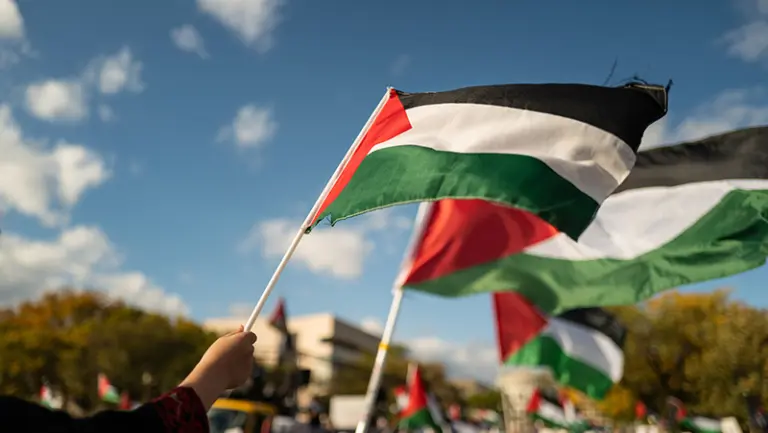
Let down by the international community, Arab states, and their own leadership, Palestinians have survived more than 75 years of war, persecution, and isolation. Despite numerous United Nations resolutions in their favor, they now find themselves subjected to a genocidal campaign that seeks to ethnically cleanse them from their homeland. Always resilient, Palestinians have not run out of options despite the fierce campaign against them by an aggressive right-wing Israeli government that is supported by the full economic and military power of the United States.
Numbering more than 14 million—divided roughly in half between occupied Palestine and the diaspora—Palestinians are not likely to disappear from the political map. To be sure, they are not heading down the road of Native Americans, a people whose numbers were gradually whittled down by war, disease, and extermination until they were ultimately dispossessed of their land. Considering their objective conditions, the Palestinians’ best option to achieve their national rights is prolonged passive resistance against Israeli policies and behavior. In this respect, they may benefit from the popular support of an international solidarity movement that has grown significantly over the past two years. But at this point, it is likely that some kind of armed conflict may reemerge, despite the balance of power being strongly in favor of Israel.
Failed Leadership
The 1964 founding of the Palestine Liberation Organization (PLO) (in 1974 becoming the sole legitimate representative of the Palestinian people) provided the symbol for a coordinated national struggle. Yet Palestinian political leadership has often been fragmented and ineffective. Initially perceived as an extension of the Arab nationalist order led by Egyptian President Gamal Abdel-Nasser, the PLO could not act independently of Cairo until the 1967 Arab defeat at the hands of Israel and the subsequent collapse of Nasserism. By 1968, the PLO had begun to express an autonomous Palestinian nationalism, but it was still stymied by the geography of occupation and displacement. PLO cadres were scattered across several Arab states, mainly Lebanon and Jordan, and could not operate freely.
The PLO presented itself as an umbrella organization for the Palestinian nationalist movement.
The PLO presented itself as an umbrella organization for the Palestinian nationalist movement, embracing a political and diplomatic path as well as a militant approach to liberation. It included such factions as Fatah, which represented liberal nationalism, as well as the Democratic Front for the Liberation of Palestine and the Popular Front for the Liberation of Palestine, both of which had a leftist Marxist-Leninist ideology.
The PLO’s stature reached its pinnacle in 1974, when its chairman, Yasser Arafat, was invited to speak before the UN General Assembly, where he delivered his famous ‘Gun and Olive Branch’ speech. The PLO’s luster faded fast, however, after Israel’s 1982 invasion of Lebanon, which led to the organization being expelled from its last territorial base from which it was able to launch military operations against Israel. In 1988, the PLO endorsed the goal of achieving a Palestinian state that would exist alongside Israel. That historic decision led the way to the 1993 Oslo Accords, which fell far short of establishing statehood, but heralded the organization’s transformation from resistance group to local government in the form of the Palestinian Authority (PA). The PA, though, became a weak civil authority subordinated to Israel.
Islamist organizations started appearing after the 1987 Intifada, a development that signaled Palestinian disaffection with the secular and left-leaning PLO. Hamas soon emerged as the most prominent force in the Palestinian Islamist movement. Having emerged as an offshoot of the local Muslim Brotherhood, Hamas espoused an Islamist ideology, clearly expressed in its 1988 founding charter, and immediately enjoyed backing from the growing Islamist support base across the region. Hamas won the 2006 Palestinian legislative elections, earning it the enmity of the Fatah-dominated PLO and the United States, even though international observers testified that the vote was open and fair. Although Hamas prioritized force in combatting Israeli occupation, it also demonstrated political acumen, creating and running government institutions in Gaza and engaging in conversations with the PA and Israel after its electoral victory.
Hamas under Siege
Hamas repeatedly confronted Israel’s occupation and confinement of Palestinians inside Gaza. Hamas’s alliance with Lebanon’s Hezbollah, and later with Yemen’s Ansar Allah (the Houthis), drew it closer to Iran despite their religious differences. The Israeli war on Gaza after October 7, 2023—which is ongoing despite the October 2025 ceasefire—signaled a shift in Tel Aviv’s intentions toward Hamas and the Gaza Strip. US President Donald Trump now seeks to transform Gaza into an international resort, with no mention of Palestinian national rights or the right of return. The destruction, or at least the pacification, of Hamas is a necessary precondition for the success of Trump’s plan. The ongoing expansion of Israeli settlements in the West Bank and the Netanyahu government’s recent declaration that it will recognize the legal registration of West Bank land according to Israeli law are further indications that little room remains for the compromise needed for lasting Palestinian-Israeli peace.
Currently encircled in the narrow coastal strip of Gaza, Hamas appears to have limited military options.
Currently encircled in the narrow coastal strip of Gaza, Hamas appears to have limited military options. Given the narrow geography in which its fighters can move and the extent of Israeli and US electronic surveillance, a major confrontation with Israeli forces is not in the cards now. Nevertheless, intact as an organization, with leaders outside Gaza and with supporters across the Strip and the West Bank, Hamas could conceivably harass Israeli forces for a long time to come—unless Israel pushes ahead with re-occupying the entirety of Gaza and destroying what is left of the tunnels that have provided Hamas with some degree of movement. Despite having emerged in opposition to the PLO’s readiness to make peace with Israel, Hamas has indicated more than once its willingness to recognize Israel in the context of a peace agreement that recognizes Palestinian statehood. A political deal may be its only path forward.
Passive Resistance
Campaigns of passive resistance have historically been associated with defeating colonialism, as in India under British rule. Palestinians have engaged in such resistance to oppose the Israeli occupation. Their efforts have landed thousands in prison, and many leaders exiled. The only path left at this point is mass protest, buttressed by the newfound international solidarity from popular movements in Europe and the United States, where pro-Palestinian sentiment is growing. Popular protests in Western countries could pressure those governments to halt arms sales to Israel, or at least to make those sales conditional on Israel’s recognition of Palestinian rights. The history of anti-colonialism provides numerous examples of mass demonstrations, boycotts, and civil disobedience that can disrupt the occupier’s everyday governance. In many instances, though, colonial powers refused to respond to peaceful demands, and violence ensued. France’s bloody, protracted, and ultimately doomed war to prevent Algeria’s independence shows the limits of imposing authority without popular consent.
The case of Israel’s occupation is more complex than British rule in India or the French occupation of Algeria. Israelis consider themselves to be historically rooted in Palestine and to have no other homeland to which they can return. A new international movement for Palestine, committed to nonviolence, could nevertheless prove effective in effecting change. For if Israel’s violence continues unabated, new forms of armed resistance are likely to emerge and the cycle of violence will persist indefinitely.
The views expressed in this publication are the author’s own and do not necessarily reflect the position of Arab Center Washington DC, its staff, or its Board of Directors.