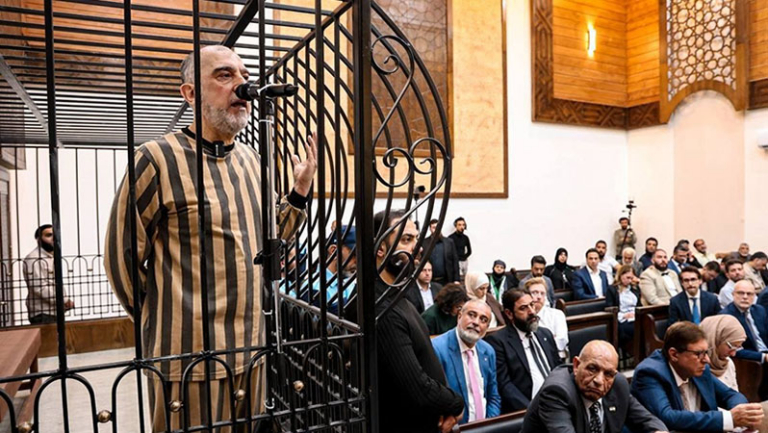
On August 11, 2026, the Fourth Syrian Criminal Court sentenced to death former President Bashar al-Assad and seven other regime insiders—including his brother Maher al-Assad, the former head of the Fourth Armored Division—after a trial in absentia. Atef Najib, one-time head of the Political Security Directorate branch in Daraa and a cousin of the Assads, was sentenced in person. After a hearing that began on April 26, 2026, the defendants were found guilty of charges including murder, torture, and crimes against humanity for their roles in repressing the uprising that began in 2011.
For many Syrians, these verdicts are symbolically important. They establish individual responsibility at the very highest levels of the former regime for atrocities committed against Syrians. No less a personage than Bashar al-Assad himself—although arguably the face of the old regime rather than its brain or even its heart—has been held accountable for decisions made during his presidency. It was on the watch of the now-sentenced Atef Najib, moreover, that in March 2011 15 children were detained and tortured in Daraa, which sparked the first widespread protests in the southern governorate. For many Syrians, this bitter reckoning has been long overdue.
In political terms, however, the new Syrian authorities are doing rather more than prosecuting individual crimes. With Daraa, cradle of the revolution, at the center of its first efforts at delivering accountability, the rulings also deliver official judgment on the origins of Syria’s long and brutal civil war. The protestors of 2011 are exonerated; the state’s repression of the demonstrations was criminal; and senior political and security officials bear responsibility for the violence.
In post-civil war countries, political trials are part of a broader process through which the new order seeks its own legitimation.
The trials of 2026 are therefore part of the way in which Syria’s new political order is constructing an authoritative account of the old one. Courts do not simply punish individuals: they classify and interpret actions, attribute responsibility, and establish an official record of the past. In post-civil war countries, political trials are not just an essential component of transitional justice, but part of a broader process through which the new order seeks its own legitimation while further delegitimating the regime it replaced.
Syria’s trials nevertheless face serious problems of judicial capacity and procedure. Monitors who attended the Najib trial documented inadequate legal representation, hasty proceedings, and a gap between witness testimonies and the crimes with which Najib was charged. Syria’s legal architecture is also fragile. The defendants have apparently been convicted of crimes against humanity, yet crimes against humanity are not codified as a distinct offence in the 1949 Syrian Penal Code. Syria ratified the 1948 Genocide Convention but never incorporated international definitions into its domestic criminal law. Nor is Syria a party to the Rome Statute of the International Criminal Court, which provides contemporary definitions of genocide, crimes against humanity, and war crimes.
The 2025 Constitutional Declaration made by interim president Ahmad al-Sharaa attempts to bridge this gap by allowing retrospective prosecution for war crimes, crimes against humanity, and genocide committed under the former regime. But that still leaves difficult questions about the rulings made by Syrian courts. If someone is convicted of a crime against humanity, how is that crime defined, what evidence is used to prove it, and on what body of law does the judgment rest?
The eviscerated institutional capacity of the Syrian state only compounds these problems. Nearly 6,000 former regime personnel are now reportedly held in detention in Syria. Even if the courts processed 500 cases annually, the backlog would take years to resolve, placing an enormous burden on a judicial system already hollowed out by 14 years of conflict.
Finally, transitional justice is intended in part to allow societies to confront a traumatic past and establish the conditions for some form of collective political settlement. With Bashar al-Assad sentenced in absentia, some Syrians may feel cheated of seeing their former ruler brought before a court, interrogated, and made to stand face-to-face with the survivors of his torturous regime. Some members of the new order may feel these rulings have sacrificed an opportunity to stage a political trial that might be televised—or more likely livestreamed—potentially becoming a new focus for Syrian public life and convincing Syrian citizens of the new authorities’ popular credentials and commitment to breaking with the past. Political courts can also be useful theaters of public opinion for an emerging regime.
Using political trials to showcase the beginnings of a new era can also reinvigorate precisely the antagonisms they are intended to calm.
Nevertheless, using political trials to showcase the beginnings of a new era can also reinvigorate precisely the antagonisms they are intended to calm, as the trial of former President Saddam Hussein two decades ago following the US-led invasion of Iraq attests. Hussein famously used the courtroom to grandstand: he challenged the legitimacy of the court itself, insisted that he remained Iraq’s lawful president, and dismissed the proceedings as instigated by foreign occupiers. In effect, he flipped the script by trying to transform a judicial reckoning with the old regime into a political argument about the legitimacy of the new one.
Syria, of course, is not Iraq. Support for the overthrown Assad regime has largely gone underground, but it has not necessarily disappeared. Future highly publicized trials could provide an arena in which these old political allegiances reemerge, potentially becoming entangled with the sectarian and communal tensions that have periodically flared across different parts of Syria over the past two years. Najib’s death sentence is currently on hold pending the conclusion of a second trial focusing on his post-2011 involvement in abuses committed in Idlib, the former base of operations of the rebel coalition that toppled the Assad regime and appointed Ahmad al-Sharaa as interim president. The second trial will tell us a great deal about the new authorities’ maturing approach to transitional justice—and the prospects for pro-Assad revanchism.
In this respect, the challenge for Syria is much bigger than bringing Bashar al-Assad home from Russia to face justice in Syria. It is instead whether accountability for atrocities committed by the old regime can be achieved within a credible and coherent system of law—and, for Ahmad al-Sharaa and his cohort, whether accountability can contribute to winning legitimacy for the new political order under construction—without fueling the underlying conflicts that transitional justice is intended to overcome.
The views expressed in this publication are the author’s own and do not necessarily reflect the position of Arab Center Washington DC, its staff, or its Board of Directors.
Featured image credit: Syrian Ministry of Justice via X