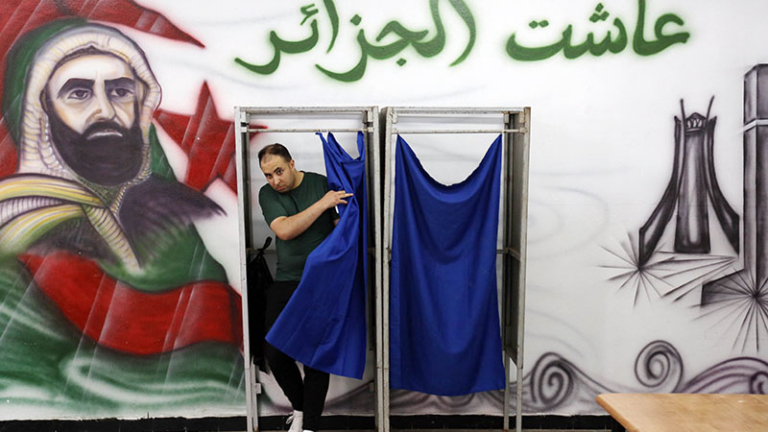
The results of Algeria’s July 2, 2026, parliamentary elections were entirely predictable. The National Liberation Front (FLN), the party that has dominated political life since independence in 1962, emerged in first position with 91 of the 407 seats in the People’s National Assembly. The pro-establishment National Democratic Rally (RND) followed with 74 seats, and the centrist Future Front came in third with 56 seats. Together, the leading parties once again produced a legislature supportive of President Abdelmadjid Tebboune’s political project and of le pouvoir, the political-military establishment that underpins it. The election’s most consequential result, however, was the scale of public withdrawal: final results placed domestic turnout at just 21.24 percent and only 10.75 percent among Algerians abroad—the lowest-ever level of participation ever recorded in an Algerian legislative election. The vote highlights that Tebboune’s regime retains political control and can deliver stability but struggles to produce much genuine enthusiasm among the people.
The question before Algerian voters was never seriously whether parliament would change the balance of power in the country, but whether elections could restore even a measure of legitimacy to a governing system built on centralized authority, managed pluralism, hydrocarbon revenues, and the memory of past instability. The election, instead, reaffirmed the political system’s resilience and continuity while exposing its growing disconnect from society.
Since the Hirak protest movement forced the resignation of the country’s longest-serving president, Abdelaziz Bouteflika, in 2019 after two decades in power, Algeria’s leadership has worked to restore order without fundamentally renegotiating the relationship between state and society. Tebboune’s election to the presidency, his controversial constitutional revisions, and his successive elections restored the appearance of formal institutional life but did not answer the central demand that animated the Hirak: a state that was accountable to its citizens, not a political system managed from above.
The result was a tightly managed election, in which party participation was broadened without meaningfully expanding political choice.
The July elections seemed to follow procedure. Multiple political parties competed and several liberal and left-wing opposition forces participated again after having boycotted previous elections. Their return, however, reflected a tightening of the rules: recent amendments to Algeria’s electoral law threatened to dissolve parties after two successive election boycotts. This effectively turned participation into political survival instead of demonstrating renewed confidence in the system. As in the past, the extent of political competition was tightly controlled. Hundreds of prospective candidates and several party lists were banned from running, while prominent Hirak-linked activists are still excluded from political life or subject to prosecution. Algeria’s parliament itself has limited power over the presidency and executive, and some of the country’s most consequential challenges, from economic diversification and instability in the Sahel to the rivalry with Morocco, barely featured in electoral campaigns. The result was a tightly managed election, in which party participation was broadened without meaningfully expanding political choice. To a certain extent, the outcome was predictable because the political arena itself remained strictly controlled.
The FLN’s victory, therefore, should not be read as a renewed popular mandate. Winning 91 seats made it the largest party, but left it far short of a majority and dependent on a wider pro-presidential bloc. More importantly, nearly four in five eligible voters declined to participate. Abstention became the clearest expression of political judgment available within a system in which the possibility of changing the governing order through the ballot continues to be remote.
For the regime, the situation remains manageable. The memory of Algeria’s civil war in the 1990s still gives the language of stability real political force, particularly because the country emerged from that conflict without the collapse of state institutions. The Algerian state has a formidable coercive capacity, substantial hydrocarbon revenues to finance subsidies and public spending (and pacify the public), and an opposition that is fragmented and weak. The election confirmed that the system can still contain pressure effectively without addressing the underlying causes of discontent.
Continuity, however, is a poor indicator of political viability. A system that narrows meaningful participation limits its ability to hear grievances, correct policy failures, renew elites, and absorb new political forces. The danger is then slow political stagnation whereby institutions continue to function as public trust recedes, elections are held with fewer citizens considering them relevant, and stability is preserved more through disengagement than consent.
Young Algerians still face scarce economic opportunities, persistent centralization and bureaucracy, and frustration with corruption and political exclusion.
The grievances that produced the 2019 Hirak have not disappeared. Young Algerians still face scarce economic opportunities, persistent centralization and bureaucracy, and frustration with corruption and political exclusion. The economy remains heavily dependent on hydrocarbons, leaving the state’s distributive capacity tied to volatile energy markets—and though public spending can ease pressure when revenues are strong, it cannot substitute indefinitely for diversification, accountable governance, or institutional trust.
These domestic weaknesses matter beyond Algeria because the country’s strategic importance has grown. Algeria sits at the intersection of the Mediterranean and the Sahel, Europe’s energy concerns, and Africa’s security crises. Instability across Burkina Faso, Mali, and Niger has made Algeria’s southern frontier more consequential. Instability in Libya, and tensions with Morocco, especially over Western Sahara, continue to obstruct regional cooperation. Migration, counterterrorism, energy security, and competition among China, Europe, the Gulf states, Russia, and the United States all run through Algeria’s strategic geography.
The irony is that Algeria has become more valuable to external partners just as its domestic politics have become more closed. Europe needs reliable gas suppliers, and Washington views Algeria as a difficult but important security and diplomatic actor. China and Russia remain influential, while Gulf states are expanding their economic role. External actors may therefore be tempted to treat political stagnation as an acceptable price for predictability.
Since Tebboune’s rise to power, US policy has gradually shifted from encouraging political reform toward a more pragmatic emphasis on security cooperation, energy, expanded commercial ties, and regional diplomacy. That evolution is understandable given the deterioration of the Sahel, Europe’s energy needs, and growing competition with China and Russia. But the election results this month are a sign that political stagnation should not be mistaken for political stability, itself a function of political openness, credible institutions, and economic opportunity.
The July elections did not reshape Algeria’s political life. The system continues to be capable of managing competition without yielding control. But the vote did reveal the diminishing returns of Tebboune’s model of power. The establishment reproduced its parliamentary majority without reestablishing public belief in the process. What is at stake after the vote is less who occupies parliament and more whether Algeria’s governing system can evolve before political disengagement becomes a deeper source of instability. Le pouvoir has demonstrated that it is firmly in control and can preserve itself. But the record-low turnout raises the harder question of how long a system can claim stability when most citizens have stopped participating in the institutions designed to legitimize it.
The views expressed in this publication are the author’s own and do not necessarily reflect the position of Arab Center Washington DC, its staff, or its Board of Directors.
Featured image credit: Photo by APP / NURPHOTO / NURPHOTO VIA AFP