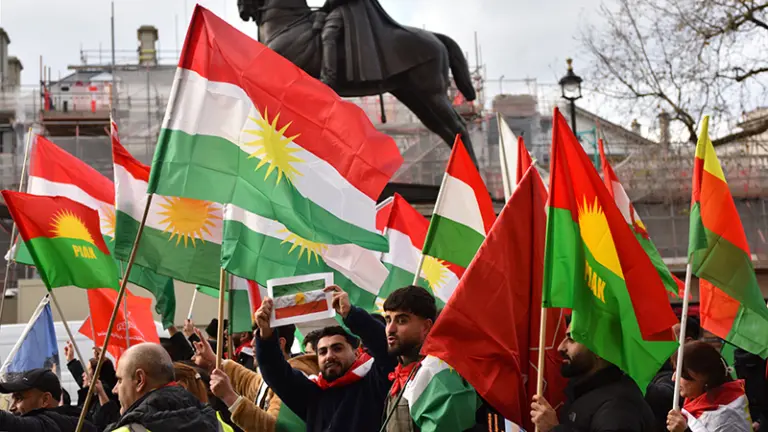
Several of Iran’s Kurdish political factions are hopeful that they may be part of any effort to dismantle the Islamic Republic and achieve autonomy for their community in Iran. An estimated 5,000 to 8,000 Iranian Kurdish militia forces have been training in neighboring Iraqi Kurdistan, and reportedly have links to US and Israeli intelligence. The United States may be tempted to use these forces to advance its war aims if the fighting drags on, even though US President Donald Trump has backtracked on his earlier enthusiasm about the idea. Yet most Iranians, including those strongly opposed to the regime, are not in favor of any Kurdish autonomy, and the involvement of armed Iranian Kurdish groups in toppling the Islamic Republic could be deeply destabilizing for Iran.
A History of Troubled Relations
Kurds constitute about 10 percent of Iran’s 93 million people. Most live in the western mountainous region of Iran near the Turkish and Iraqi borders. Although they are part of Iran’s diverse social and ethnic fabric, Iranian Kurds have long been aggrieved by the centralizing authority of Tehran, whether under the Pahlavi dynasty or the Islamic Republic. Under both regimes Kurds have faced repression and persecution. Primarily Sunni Muslims, many Kurds have resented the state’s imposition of Shia religious authority. Although some Kurds have risen to political prominence in Iran over the decades, they are few and far between.
Notably, the first attempt at Kurdish autonomy took place in Iran. The Kurdish Republic of Mahabad was created in December 1945 with the assistance of the Soviet Union, which occupied northern Iran during World War II. Mahabad was led by Qazi Mohammad, a Kurdish nationalist intellectual. This autonomous republic became vulnerable after Soviet troops finally left Iran in May 1946. The Iranian central government sent troops to crush it as well as the autonomous Iranian Azerbaijani entity in December 1946, assisted by deliveries of British and US arms. Qazi Mohammad was hanged on the Shah’s orders in 1947, becoming a martyr to the Kurdish cause.
Most Iranians would see any attempt at establishing an autonomous Kurdish state as contrary to Iran’s territorial integrity.
After the Shah’s regime collapsed in 1979, some Iranian Kurdish militants opposed the establishment of the Islamic Republic, only to face severe repression and executions. Some leaders of this Kurdish movement escaped to Europe where several were later killed by regime agents. In September 2022, a young Iranian Kurdish woman named Mahsa Amini was beaten to death by the so-called morality police in Tehran who had arrested her for improperly wearing the hijab, or headcover. Amini’s death touched off widespread demonstrations throughout Iran, especially among young people, resulting in a repressive government crackdown. The regime was particularly brutal in her hometown of Sanandaj in western Iran. Its brutality was also on display in late January 2026 when large-scale anti-regime demonstrations broke out again throughout Iran. Security forces killed many thousands (perhaps tens of thousands) of protestors, and the regime was vicious in the Kurdish regions.
Although the anti-regime demonstrators in 2022 showed solidarity with Amini and even highlighted her Kurdish first name, Jina, this does not necessarily mean that they favored Kurdish autonomy. Most Iranians, regardless of political affiliation or sympathies, are nationalists and would see any attempt at establishing an autonomous Kurdish state, such as a body akin to Iraq’s Kurdistan Regional Government (KRG), as contrary to Iran’s territorial integrity. A 2025 poll of 77,000 Iranians found that only 15 percent favored a federal state; much of this support was in non-Persian ethnic areas. Such pro-unity sentiment seems to have been lost on President Trump when he launched the current US-Israeli war on Iran.
Trump’s Calls to Iranian Kurdish Leaders
In early March 2026, days after launching the war, Trump called the leaders of Iranian Kurdish factions based in northern Iraq, including the leader of the Kurdish Democratic Party of Iran, and offered encouraging words. After these conversations Trump was quoted as saying that it would be a “wonderful” idea for such militant groups to cross into Iran, adding, “I’d be all for it.” Trump also spoke to Iraqi Kurdish leaders. These calls suggest that Trump wanted to use Iranian Kurdish militants as a possible spearhead of a ground invasion of the Islamic Republic. Just a few days later, however, Trump reserved himself, saying, “We’re not looking to the Kurds going in,” and adding, “We don’t want to make the war any more complex than it already is.”
Why Trump reversed himself is unknown. Certainly, experts had warned that a Kurdish offensive in Iran could touch off insurgencies in the Baluchi areas of Iran’s southeast, Arab areas of the southwest, and Azerbaijani areas of the northwest, which could lead to severe instability in Iran and even to the dissolution of the state. It is unlikely that Trump was interested in such expert advice, but he may have been influenced to reverse course by Iran experts and Turkish President Recep Tayyip Erdoğan who has strongly opposed Kurdish autonomy in Iran.
Nonetheless, reports from camps where Iranian Kurds are living suggest that they continue to train and hope to take part in overthrowing the Iranian regime. These militants have told journalists that they would only enter Iran with sufficient air cover. Without such cover, one said, “We know we will die because of [Iranian] airstrikes and missiles.” Indeed, the Iranian regime has targeted Iranian Kurdish bases in Iraq with rockets and drones since early in the war, not only to weaken them but to warn them not to enter Iran.
Divisions Could Hamper Kurdish Effectiveness
On February 22, 2026, just days before the war began, Iranian Kurdish factions in northern Iraq formed the “Coalition of the Political Forces of Iranian Kurdistan.” There are still sharp ideological differences between them, with some having a Marxist orientation similar to the Kurdistan Workers’ Party in Turkey, while others espouse a more purely nationalistic position. Whether such a coalition can hold together remains unknown. What they share, at a minimum, is the idea that a post-Islamic Republic Iran should be a federal state in which the Kurds would have autonomy.
The eagerness of the militant Iranian Kurdish factions to participate in the fall of the Iranian regime has put Iraqi Kurdish leaders in a difficult situation. On the one hand, they do not want to get involved in the current war. The deputy prime minister of the KRG, Qubad Talabani, has emphasized that the KRG “is not a part in the regional conflict, and adopts a neutral stance.” Leaders of the KRG have also promised Iranian leaders that they will keep the Iranian Kurdish factions in check. On the other hand, there is popular support among Iraqi Kurds to aid their ethnic brethren facing repression in Iran. Hence, Iraqi Kurdish leaders must play a delicate balancing act. Already the Iranian regime has hit targets in the KRG as a signal that Iranian tolerance of KRG assistance to Iranian Kurdish groups is wearing thin.
Divergent US and Israeli Goals
US and Israeli intelligence agencies reportedly have provided Iranian Kurdish factions in the KRG with small arms. Considering that both countries have previously used the Kurds to further their foreign policy objectives, such reports are plausibly true. In the early 1970s, Iraqi Kurds were encouraged and assisted in their rebellion against the Iraqi central government by Iran, the United States, and Israel, only to be left defenseless when the Shah reached a border deal with Iraq in 1975, prompting all three countries to abandon these Kurds. Although this and similar episodes have made the Kurds wary of receiving outside support—and some Iranian Kurds bring up the recent example of Trump ending US military backing for the Kurdish-led Syrian Democratic Forces—the Kurds are often in such a vulnerable position that they are tempted to rely on outside aid.
US and Israeli goals in Iran are diverging, with implications for how each country deals with Iranian Kurdish factions.
What is apparent is that US and Israeli goals in Iran are diverging, with implications for how each country deals with Iranian Kurdish factions. The articulated US war goals have shifted frequently, with Trump first encouraging regime change and later backing away to emphasize less grandiose objectives. By contrast, Israel’s continual objective has been to bring down the Iranian regime. It has sought to do so not only by degrading Iran’s military arsenal in conjunction with the United States but also by attacking Iranian police stations and Revolutionary Guard outposts to weaken repressive capacity and allow the Iranian public to overthrow the regime. Attacks on such targets have been prevalent in Kurdish areas, which hints that Israel still considers the Iranian Kurdish militants to be a force with which it can partner to help overthrow the regime. Israel does not expect Iran’s Kurds to overthrow the regime alone, but likely believes that could erode Iran’s control over its border regions and distract the Revolutionary Guards, the regime’s power center.
But the war’s end games seem to put Israel and the United States on different paths. If it cannot achieve regime change, Israel may be content with such a weakened Iran that the country breaks up into several autonomous or even independent regions along ethnic lines. Such an outcome would be in line with its policies toward other Middle East countries such as Syria, where it has attacked the government led by Ahmed al-Sharaa, ostensibly on behalf of Syria’s Druze population, indicating that it wants a weak and decentralized Syrian state. Conversely, the United States seems to want a viable Iranian state—either a pliant one led by the remnants of the existing regime or a new regime capable of controlling its territory and hydrocarbon production. Still, given Trump’s erratic behavior, if Israel advocates supporting Iranian Kurds while regime change is within sight, he might gain new enthusiasm for an uprising.
Opposition to the Kurdish Opposition
Exiled opposition figure Reza Pahlavi, the late shah’s son, has stated that all of Iran’s opposition groups are united in the goal of preserving Iran’s “territorial integrity,” an objective that many Iranians likely share. Notably absent is Pahlavi’s support for a federal Iranian state, which is what many Kurds (and possibly other ethnic groups) wish to achieve.
Wide segments of the Iranian population would consider a policy of supporting ethnic or regional autonomy as a diminution of Iranian sovereignty. Iranians may consider US support for Kurdish autonomy as a betrayal of their national identity. Trump should underscore to Israel that supporting an Iranian Kurdish incursion would be destabilizing and dangerous.
The views expressed in this publication are the author’s own and do not necessarily reflect the position of Arab Center Washington DC, its staff, or its Board of Directors.
Featured image credit: Donovan Elmes/Shutterstock