Lebanon today is facing what is arguably its most dangerous moment, as its leaders and politicians grapple with the choice of continuing hostility with Israel or succumbing to American pressure to strike a peace deal with the Zionist state. Neither decision will quickly bring Lebanon the civic peace, political stability, and economic prosperity that it has sought since the early 1970s, when internal challenges and regional interventions began to chip away at the fragile state power and effectiveness that it had achieved since independence in 1943. The dilemma today is how to find a formula that guarantees both an end to Israel’s daily violations of Lebanese sovereignty and killing of its citizens and continued US support for the country’s political institutions.
Serious obstacles stand in the way of this quest. First, Israel does not seem interested in ending its attacks on Hezbollah’s positions and personnel, or in withdrawing from territory that it occupied in South Lebanon during its military operations against the party in 2023 and 2024. Israel does not respect the terms of the November 27, 2024, US- and French-brokered ceasefire agreement with Hezbollah. According to the United Nations Interim Force in Lebanon, or UNIFIL, Israel has violated that ceasefire some 10,000 times. Today, Lebanon is bracing for an extensive Israeli operation against the South if the Lebanese Army (LAF) fails to disarm Hezbollah before the end of 2025, as it pledged to the Beirut government.
Nor does Israel seem to allow for a consideration of goodwill on the part of Lebanese leaders. They say that it is too soon to talk of economic or political normalization. But President Joseph Aoun and Prime Minister Nawaf Salam recently announced that Lebanon is ready to negotiate an end to Israel’s attacks and its occupation of five strategic points in the South. Their willingness to enter negotiations might be a code word for possible normalization.
On December 3, 2025, Aoun appointed Simon Karam, a former ambassador to the United States, to lead Lebanon’s delegation to the monitoring committee charged with supervising the ceasefire. The very next day, Karam participated in a meeting of the military “mechanism” as a civilian adjunct across from Israel’s representative Uri Reznik, thereby adding a distinctly political angle to the work of the committee. While the subject and results of their discussions remain unknown, the mere fact that Karam had been authorized to negotiate on behalf of the country is sufficient indication that Lebanon’s leaders may be ready to swallow the pill of normalization that much of the Lebanese population considers quite bitter.
Despite Lebanon’s apparent willingness to negotiate, Israeli military forces continue with near-daily operations against Hezbollah personnel in the South, sending a clear message that no amount of concessions can replace Israel’s key demands of fully disarming Hezbollah or maintaining a controlling presence on the Lebanese border.
A second obstacle is that Lebanese leaders have to contend with a Trump administration that sees Lebanon through the prism of Israel and puts the disarmament of Hezbollah front and center instead of playing the role of honest broker. In fact, in its current intervention, the United States has sent unhelpful signals and appears not to care too much about what happens to Lebanon. US Ambassador to Turkey and Special Envoy for Syria Thomas Barrack—who is often dispatched to Beirut for discussions with Lebanon’s leaders—has over the last few months made disparaging remarks about the country that betray both diplomatic incompetence and outright condescension. He twice referred to Lebanon as part of “Bilad al-Sham” (Greater Syria)—a dangerous reference questioning Lebanon’s very existence as an independent entity—and disparaged the Lebanese state as non-existent, stating that Hezbollah is actually in charge of the country.
Morgan Ortagus, Deputy Special Presidential Envoy to the Middle East—and another diplomatically challenged political operative—has also on several occasions disparaged Hezbollah and dangerously interfered in Lebanese affairs. In one of her early forays as a representative of the Trump administration, from the podium at the Lebanese presidential palace she called for excluding Hezbollah from the Lebanese government and thanked Israel for “defeating” the party. In April 2025, Ortagus called Hezbollah a “cancer” within Lebanon that must be excised if the country is to have any hope of recovery. While her comments and outright interference in domestic affairs may have met some success among anti-Hezbollah political forces in the country, she appears to disregard Lebanon’s delicate political and sectarian balance, a shortcoming that could lead to the failure of Lebanon’s leaders to find a good pathway forward.
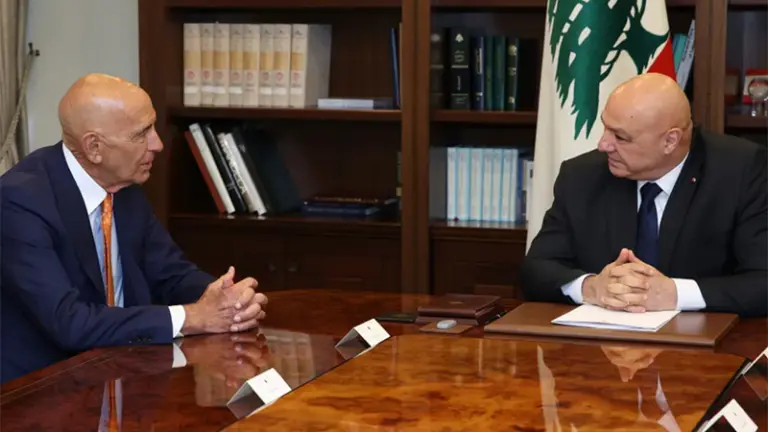
President Donald Trump’s appointment of Michel Issa—a US businessman of Lebanese origin—as his ambassador to Beirut may bring some respite for Lebanon’s leaders. Issa may at least understand the intricacies of Lebanon’s political and social structure enough to appreciate the challenges that the country is facing. His appointment is too recent to allow a reasoned evaluation of how the Trump administration sees its relationship with Lebanon over the foreseeable future, but Issa comes to the country as the United States pushes an economic plan for developing the Lebanese-Israeli border region that witnessed utter devastation during Israel’s two-year assault. Whether that scheme works—if and when it starts—to Lebanon’s benefit is anyone’s guess, considering Israel’s dominant military position vis-à-vis Lebanon and its continued refusal to allow the return of tens of thousands of Lebanese to their towns and homes in the border region.
A third obstacle is the domestic challenge of ensuring Hezbollah’s agreement to dismantle its military structure and to allow the state a monopoly over weapons in the country. The party still rejects the principle of disarmament, citing obvious Israeli violations, and doubts that the LAF is capable of standing up to Israel’s military dominance, although it itself has not mounted any challenge to Israeli aggression. To Israel and the United States, Hezbollah is nothing but an appendage to Iran’s alleged nefarious designs. But to Lebanese leaders it is an important party that represents a sizeable Shia constituency. Challenging Hezbollah may lead to civil war.
These three overlapping challenges—Israel’s refusal to contemplate a change in its behavior, the Trump administration’s less than committed stance to help Lebanon, and Hezbollah’s rejection of giving up its weapons—are what makes Lebanon’s current moment dangerous and unpredictable. The country’s political leadership is scrambling to find the right strategy that, at a minimum, ensures a cessation of Israel’s aggressive behavior, ends its threats to Lebanon’s sovereignty, and convinces Hezbollah to allow the Lebanese state to lead the country’s foreign and defense policy. The leadership will need more time and more diplomacy—two commodities under threat from Israel’s aggressive behavior and the Trump administration’s unserious, inexperienced, and biased involvement in bringing peace to Lebanon.
The views expressed in this publication are the author’s own and do not necessarily reflect the position of Arab Center Washington DC, its staff, or its Board of Directors.
Featured image credit: FB/Lebanese Presidency