
For more than a year, the al-Saudi Maternity Hospital was the only functioning hospital in al-Fasher, the capital of North Darfur in western Sudan. The largest medical facility in the city, it had already faced heavy attacks, including an October 2024 bombing that killed 10 hospital employees and destroyed large sections of the building, including its water and power systems. A subsequent attack in January 2025 killed some 70 people and destroyed the part of the hospital dedicated to emergency care.
In October 2025, the hospital became the site of one of the largest massacres ever recorded at a medical facility. Rapid Support Forces (RSF) fighters stormed the building and indiscriminately killed medical workers, patients, and caregivers. The World Health Organization estimated that 460 people were murdered and six medics kidnapped, with the RSF reportedly demanding ransoms of $150,000 for their release.
The massacre was part of a broader attack on al-Fasher in which RSF soldiers went from house to house, beating and shooting civilians. As many as 1,500 people were killed. Until its capture, al-Fasher was the last city in Darfur outside RSF control. Many residents fled the city, but some 260,000 people remained trapped there with little access to food, water, or medical care.
Since it began in April 2023, the civil war in Sudan between the Sudanese Armed Forces (SAF) and the paramilitary RSF has killed at least tens of thousands of people. Some mortality estimates are as high as 150,000. The former US envoy to Sudan believes the true death toll, including those who died from famine or disease, may be more than 400,000.
Sudan—and Darfur in particular—has endured decades of horrific, destructive warfare, including violence in the early 2000s that is widely recognized as a genocide. The origins of the RSF go back to the Janjaweed, an Arab militia that carried out the Darfur genocide while fighting with the Sudanese government against non-Arab ethnic groups. As many as 300,000 people are believed to have died as a result of that war. The current conflict, however, may prove to be even more deadly and destructive, with no clear end in sight.
Widespread Human Rights Violations and Mass Displacement
The signs of mass atrocities came early in the war, including widespread indiscriminate murders. In July 2023, a shallow mass grave of nearly 90 people was discovered, including women and children. As the war expanded, so too did the atrocities, including mass killings of civilians, destruction and theft of land and livestock, the systematic burning of entire villages, and, in some areas, aerial bombardment. From April 2024, the RSF besieged al-Fasher and prevented the entry of all goods into the city, including food and medicine. In May 2025, the RSF began constructing an earthen wall around the city to tighten control over the movement of goods and people.
Today, no population is safe in Sudan, especially in highly fragile areas like al-Fasher.
Today, no population is safe in Sudan, especially in highly fragile areas like al-Fasher. UNICEF has warned that the 130,000 children still in the region are at high risk of abduction, injury, sexual violence, and killing. As occurred during the Darfur genocide, sexual violence has been widespread, including against girls as young as 15. Reports of post-assault physical and mental trauma are common, but women report having difficulty finding care, especially in the face of global funding cuts that affect the provision of sexual and reproductive health services.
At least 130 aid workers have been killed, including those working for the International Committee of the Red Cross. In June 2025, an aid convoy of fifteen trucks that had traveled over 1,800 km from Port Sudan was attacked just 80 km from al-Fasher, killing five aid workers and injuring others. It would have been the first convoy to reach al-Fasher in more than a year.
Millions of people have been forced to flee their homes to escape massacres, leading to mass movement of internally displaced people. As of April 2025, at least 13 million people (including 5 million children) have been forced to leave their homes due to fighting. Some 9 million have been displaced within Sudan, while millions of others fled to neighboring Chad, Egypt, Ethiopia, and South Sudan.
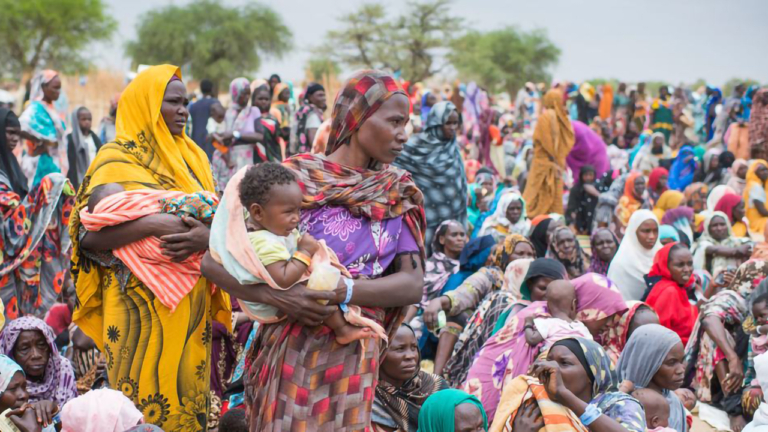
The small town of Tawila in North Darfur has become a destination for civilians, primarily women and children, who arrive on foot after traveling many miles. For now, the group that holds the town has remained neutral in the war, making it relatively safe. But so too was al-Fasher, not so long ago.
A woman who fled al-Fasher for Tawila described the perilous journey. Her phone and money were stolen, and she was beaten and insulted as “dirty.” Her sister was strip-searched in front of her. “We left with nothing. Even water and food were thrown to the ground,” she said. Since April 2025, nearly 400,000 people have arrived in Tawila, leading to the urgent establishment of four new refugee camps.
Even though they may have arrived safely, many were already starving, ill, and dehydrated. But the conditions awaiting them were also inadequate. As the Norwegian Refugee Council reported, “Families are surviving on scraps, sleeping in the dirt under roofs made from straw, with barely any access to clean water and toilets. Cases of cholera are rising, and the rainy season is approaching fast, making living conditions more miserable.”
Recent years have shown that refugee camps offer no protection from violence. Camps in al-Fasher, including Zamzam and Abu Shouk, have faced repeated attacks; in April 2025, at least six children and nine aid workers were killed in Zamzam camp, while one child was killed in Abu Shouk camp. Situated close to the front line of battle, Abu Shouk was already home to many Sudanese who were displaced during the conflict in Darfur in the early 2000s. Today’s violence adds yet another layer of trauma.
Hunger, Disease, and Attacks on Health Facilities
Following the RSF massacres as it captured the city, the United Nations warned that al-Fasher had turned into a “crime scene.” Satellite imagery showed growing piles of bodies and soil soaked red with blood. The violence, siege conditions, and displacement across Sudan have led experts to consider the situation one of the worst humanitarian crises of the 21st century.
The horrific conditions have led to predictable health outcomes, although the ability to track and document conditions and illnesses has become more difficult. Across Darfur, nearly 20,000 cases of cholera, a bacterial infection that spreads through contaminated food and water, have been reported, with hundreds of deaths. Other dangerous and potentially deadly diseases, including measles, malaria, and dengue, have also been reported.
Health workers and facilities have been targets throughout Sudan’s history of armed conflict, but the number of attacks on them had soared even before the current war. In April 2025, an assault on Zamzam camp resulted in the killing of the entire medical staff of the camp’s last remaining clinic. Nine medical workers were murdered in a rampage that left more than 100 people dead across the camp. The purposeful nature of the targeting cannot be overlooked. Dozens of hospitals across the country have been raided, destroyed, or occupied by combatants on both sides. Evidence including threatening social media messages and telephone calls suggests that healthcare workers have been deliberately targeted.
The violence, siege conditions, and displacement across Sudan have led experts to consider the situation one of the worst humanitarian crises of the 21st century.
In some areas where facilities remain intact, local staff have stopped coming to work due to the chance of being killed, assaulted, or kidnapped. Only 32 doctors remain in al-Fasher, for example, where they have to care for hundreds of thousands of patients. Overworked, with few resources, healthcare workers are often hungry and traumatized. Most of Sudan’s remaining medical supplies are located in Khartoum, a site of fighting and restricted movement, which makes these resources inaccessible. Destruction, lack of equipment, and lack of staff mean that an estimated 80 percent of healthcare facilities no longer function.
Hunger has been a defining feature of this period. The World Food Programme estimates that 25 million people—half of Sudan’s population—suffer from extreme hunger. At least 10 locations, including the Zamzam refugee camp, are currently experiencing famine conditions; 17 other locations risk famine if conditions do not improve. Early in the war, Save the Children was forced to close 57 of its nutritional facilities around Sudan, leaving tens of thousands of children left with no treatment for malnutrition. Food stocks were already running low in the remaining facilities more than two years ago.
Decades of Impunity and Delayed Justice
As with so many victims of human rights violations and other atrocities, accountability and justice for the people of Sudan seems unattainable. Although the UN Human Rights Council has supported an investigation into the massacres in al-Fasher, lack of follow-through in previous inquiries raises doubts that even a robust investigation will lead to meaningful action.
Some humanitarian and conflict experts have argued that by ignoring accountability and justice for the crimes in Darfur in the early 2000s, the international community is today “allowing the very same perpetrators to complete the crime.” The International Criminal Court has only convicted one person of committing atrocities in Darfur during this earlier genocide—Ali Muhammad Ali Abd al-Rahman, a Janjaweed militia leader, was sentenced to life in prison for crimes including gang rapes and mass killing. But it took two decades to bring just one person to justice. Multiple other actors, including former Sudanese President Omar al-Bashir, are missing and thus cannot be taken into custody.
During the Biden administration, Washington’s role in trying to end the atrocities was limited to declaring a genocide and imposing sanctions on the SAF and RSF leaders, as well as on UAE-based companies linked to the RSF. It avoided any serious pressure on the UAE for arming the RSF. The Trump administration has basically continued this approach, though in 2025 it imposed further sanctions in response to the Government of Sudan’s use of chemical weapons and began ineffectual ceasefire talks with the governments that are enabling the fighting: Egypt and Saudi Arabia (who support the SAF), as well as the UAE. Secretary of State Marco Rubio recently criticized the role of the RSF and its external support, but chose not to name the UAE. In early November 2025, the RSF accepted a ceasefire proposal, although it did not stop its violence; the SAF leader has rejected the proposal.
In the meantime, humanitarian conditions across Sudan, especially in al-Fasher, continue to deteriorate. While justice may be delayed, the international community should at least attempt to meet the humanitarian needs of those who survived the massacres. But although the UN is calling for $2.7 billion for the country’s humanitarian response, by mid-June 2025 only 16 percent of that amount had been committed. Without an urgent, massive expansion of aid, as well as a coordinated initiative to stop the fighting and to protect civilian life and infrastructure, the outcomes of the current conflict likely will exceed even the horrors witnessed in Darfur just two decades ago.
The views expressed in this publication are the author’s own and do not necessarily reflect the position of Arab Center Washington DC, its staff, or its Board of Directors.
Featured image credit: UNHCR/Colin Delfosse