The Iraqi government and the leaders of the country’s ruling political factions have every reason for alarm. The US–Israeli war on Iran—and its profound consequences for Iraq’s security, political stability, and economy—has produced a national crisis. Yet in Baghdad, political debate is still fixated on who will occupy which positions, what authority and resources they will control, and how to manage factional and personal rivalries through shifting, short-term bargains. Iraq’s political factions seem to be living in a parallel universe. Their discussions do not seriously engage with how Iraq can navigate the current crisis with minimal losses. Most important, Iraq’s ruling political elite—long accustomed to calibrating its choices to maintain a degree of balance between Iranian and US interests—did not adequately prepare itself for a wartime scenario in which even minimal common ground between Washington and Tehran became difficult to sustain.
The April 27, 2026, nomination of businessman Ali al-Zaidi for the position of prime minister will do little to improve the situation. Al-Zaidi’s candidacy emerged only after a long delay in determining who would form Iraq’s government following the November 2025 parliamentary elections. This delay clearly violated the timetable specified in the constitution. Owing to internal rivalries among its constituent factions, the Shia coalition that won the elections, the Coordination Framework, had struggled to agree on a candidate who was acceptable to its competing factions.
The US–Israeli war on Iran has produced a national crisis.
One potential early candidate for the premiership, former prime minister Nouri al-Maliki, had already been vetoed by President Donald Trump in a January 2026 Truth Social post. The outgoing prime minister, Mohammed Shia’ al-Sudani, had wagered on securing US support for his re-appointment without provoking Iranian opposition. Yet al-Sudani lost Washington’s confidence because of his inability to restrain Iran-aligned armed factions from taking sides in the current war. Iraqi militias such as Kata’ib Hezbollah, Harakat al-Nujaba, Kata’ib Sayyid al-Shuhada, and a wing of Asa’ib Ahl al-Haq have responded to the war on Iran by attacking US forces as well as Iranian Kurdish opposition groups in Iraq’s Kurdistan Region. The United States and Israel then retaliated with strikes against the leaders of these factions, killing several of their operatives as well as Iranian military officials overseeing their operations in Baghdad. Some Iraqi factions have also attacked military and civilian facilities in Bahrain, Kuwait, and Saudi Arabia, continuing drone operations even after the April 8, 2026, ceasefire. Approximately half of the drone attacks targeting Gulf countries reportedly have originated in Iraqi territory.
Despite Gulf states’ condemnations and their summoning of Iraqi ambassadors to urge Baghdad to restrain such attacks, al-Sudani’s caretaker government appears unable to do more than issue statements and verbal assurances. The most recent of these followed an April 27 meeting of Iraq’s National Security Council, which recommended adopting “security and legal measures against perpetrators of attacks on the territories of neighboring countries.” However, it is unlikely that an outgoing government would risk direct confrontation with the militias. The decision is consequently expected to be implemented in a narrow and largely formalistic manner. Faced with the inability of both al-Maliki and al-Sudani to win the support of Washington and Tehran, factions in the Coordination Framework sought to identify a secondary figure, without a defined political project or an independent power base, who could be proposed as a consensus candidate. The name of Basim al-Badri, head of the Accountability and Justice Commission, emerged in this context. Al-Badri is closely associated with the president of the Supreme Judicial Council, Faiq Zaidan—arguably the most powerful figure in Iraq today, whom some US officials accuse of maintaining close ties to Iran.
Zaidan has himself signaled some willingness to take Washington’s concerns into account. He has insisted that the Iraqi state alone holds the authority to decide on matters of war—a position that implicitly criticizes the decision of Iraqi armed factions aligned with Iran to join the conflict. His stance appears to have strained his previously cordial relationship with those same factions. Some political actors may have feared that the appointment of a prime minister backed by Zaidan would result in his near-total domination of Iraqi politics by controlling the Council of Ministers, the Supreme Judicial Council, and the Federal Supreme Court. The prospect of concentrating power in Zaidan’s hands contributed to some political leaders’ hesitation in supporting his preferred candidate, al-Badri. Yet, it appears that Zaidan still has significant influence over the recent nomination of al-Zaidi, a businessman who has amassed considerable wealth in recent years from his business dealings and relations with powerful politicians.
The central obstacle is that even a consensus candidate is vulnerable to being perceived as aligned with a particular faction. This risk was evident in the case of Ihsan al-Awadi, the current prime minister’s chief of staff, who had also emerged as an alternative candidate but was rejected by some parties precisely out of concern that he would remain subordinate to al-Sudani’s influence. Ultimately, the nomination of Ali al-Zaidi—an individual with no political background—for the position reflects a compromise among factions of the Coordination Framework, one that is expected to further hollow out the state and undermine its institutional autonomy. His designation came as a surprise to many, as his name had not featured among the principal contenders and he previously managed a bank that is under US sanctions over allegations of money laundering. Some observers interpret this choice as a maneuver by al-Sudani and the Coordination Framework to buy time, in the expectation that al-Zaidi may fail to form a government and in doing so allow the coalition a longer period to negotiate and manage its internal rivalries.
Factions within the Coordination Framework appear to prefer transforming the office of the prime minister into a technocratic post.
However, the possibility that al-Zaidi may succeed in forming a government cannot be ruled out, for a simple reason: the factions within the Coordination Framework appear to prefer transforming the office of the prime minister into an administrative, technocratic post, preferably occupied by a compromised figure and stripped of substantive political weight, thereby making it easier to control—an outcome that al-Zaidi’s nomination seems to convey. With a weakened office of prime minister, the Iraqi government will find it difficult to make decisions autonomously in response to the crisis generated by the war and to chart a course not subordinated to competing outside interests.
The most serious threat facing Iraq today, however, is economic. As a rentier state in which oil revenues account for roughly 90 percent of the public budget, Iraq is one of the countries most severely affected by the closure of the Strait of Hormuz, through which the vast majority of its oil exports traveled before the war. Iraqi oil production has fallen by nearly 70 percent: instead of exporting 4.3 million barrels per day (b/d), the country now exports only an estimated 1.4 million b/d via the Iraq–Turkey pipeline. Losses incurred as a result of the sudden contraction in oil exports have to date been estimated at between $6 billion and $7 billion per month. These losses may worsen should Iraq be compelled to shut down active oil fields.
Unlike the Gulf monarchies, Iraq does not possess a sovereign wealth fund capable of absorbing such a shock. Its primary mechanism for financing budget deficits has been drawing on the Central Bank’s reserves; yet even this option is constrained, including by Washington’s threats to reduce or halt dollar flows to Iraq amid suspicions that Iran-aligned factions are exploiting these channels to finance their activities and mitigate the effects of sanctions. At a time when further economic sanctions are under discussion—measures that would directly impair the Iraqi government’s fiscal capacity—the government faces mounting challenges in funding the salaries of an oversized public sector, pensions for retirees, and social assistance for vulnerable populations. This trajectory points toward a deepening economic crisis in the coming months, particularly if the closure of the Strait of Hormuz persists for an extended period.
Iraq’s ruling political factions have not offered a coherent vision for an exit from the crisis.
Iraq’s ruling political factions have not offered a coherent vision for an exit from the crisis. They deliberately avoid even discussing the armed groups or their participation in the war. These groups have become structurally embedded in the architecture of the Iraqi state: they have representatives in the Coordination Framework and at least 60 members of parliament. Meanwhile, the Iraqi public is not presented with the full scale of the economic crisis; political leaders are absent from meaningful public engagement; and the government abdicates its responsibilities under the pretext of operating in a caretaker capacity.
Iraq is confronting one of its gravest crises since the war against the so-called Islamic State—one that threatens not only its fragile security and political stability, but also carries the potential for long-term economic repercussions, including rising poverty and unemployment (which are already pronounced) and a deepening of domestic discontent. Although this crisis is in full view, Iraq’s political elite has instead chosen to inhabit a parallel reality, sheltered by a system designed to serve partisan interests without holding any of its participants accountable.
The views expressed in this publication are the author’s own and do not necessarily reflect the position of Arab Center Washington DC, its staff, or its Board of Directors.
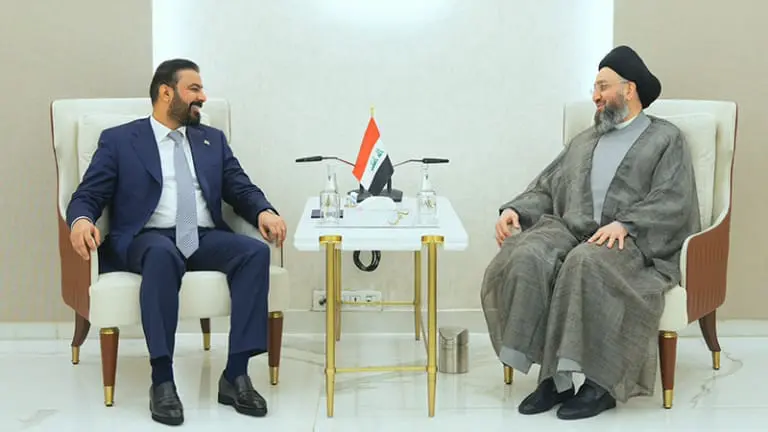
Featured image credit: Ali Falih Alzaidy via X