
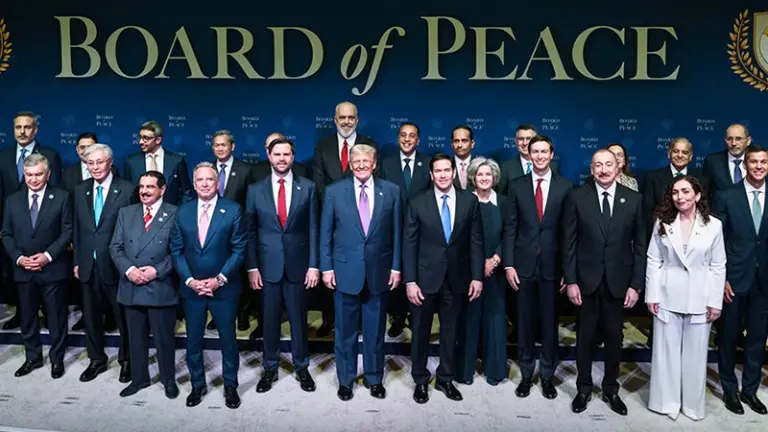
On October 13, 2025, more than 20 world leaders gathered at a ceremony in Sharm el-Sheikh, Egypt, to witness US President Donald Trump sign an agreement ending Israel’s two-year genocidal war on Gaza. “We have peace in the Middle East,” Trump declared. The gathering was a response to global outrage at the horrific violence, starvation, and ethnic cleansing of Palestinians in the besieged Strip. But in the four months since the pomp and circumstance of that signing, the Israeli military has continued to kill Palestinians in Gaza on a regular basis. The start of the second phase of the ceasefire agreement was announced in January 2026, despite the failure to fully implement the first phase, and the prospects for progress on the ground are slim. The reasons for this impasse are largely the same as the reasons why a ceasefire deal was so difficult to reach in the first place. Today, however, the global momentum that was crucial for securing the Sharm el-Sheikh agreement has dissipated—which makes the chances of the situation unraveling more likely than ever.
The “Ceasefire” Agreement and Phase One Implementation
As with the January 2025 ceasefire agreement, which Israel broke just two months later, the first step of the October deal was the easiest to complete, precisely because it centered on the exchange of captives. Both Hamas and Israel were required to release hostages, living and dead, within 72 hours of Israel’s public acceptance of the ceasefire, to be followed by Israel’s release of Palestinian prisoners. Other key obligations included a halt to hostilities, a withdrawal to agreed-upon lines, and the unimpeded flow of humanitarian aid. In each of these areas, Israel has failed to fulfill its obligations.
Hamas released all the living captives whom it still held and facilitated the return of the deceased, including through helping Israel locate buried bodies of captives—cooperation for which President Trump gave credit. For its part, Israel did release nearly 2,000 detainees, although it continues to arrest Palestinians.
Since the ceasefire agreement, the Israeli military has routinely redrawn the line to which it was supposed to redeploy, in the process occupying additional territory in Gaza. Israeli military fire has killed nearly 600 Palestinians and wounded some 1,600. This number does not include Palestinians who have died because of the destruction of civilian infrastructure and the harsh conditions imposed on human life by Israel’s ongoing siege.
Even the most generous assessments put the number of humanitarian aid deliveries at well below the 600 trucks per day that the agreement specified should be permitted into Gaza. The United Nations (UN) records aid trucks into Gaza through a network of humanitarian partners that includes Catholic Relief Services, UNICEF, World Central Kitchen, and the World Food Program, among others. UN figures for mid-October 2025 through the first week of February 2026 show that just under 13,000 trucks were unloaded in Gaza—an average of a little more than 100 trucks per day.
Phase Two Hurdles Higher Than Phase One
Implementation of Phase Two is even more challenging than Phase One, as the overtly political nature of the required decisions is now far more significant. Phase Two stipulates further Israeli withdrawal from nearly all of Gaza, a more durable ceasefire, an international stabilization force, the disarmament and transfer of power from Hamas, the establishment of a transitional governing authority, and the start of reconstruction. In principle, Phase Two should be overseen via a complex set of institutions to include a high-level Board of Peace, an administrative body of Palestinian technocrats, an International Stabilization Force, and a Civil-Military Coordination Center. In reality, these institutions are still in the early stages of establishment six months into the ceasefire.
First, the so-called Board of Peace, to be chaired personally by Trump for life, is still being assembled. More than 50 countries have been invited to join, but so far only some 25 have signed up. Permanent membership of the Board comes with the hefty entry fee of $1 billion; it is unclear where this money will go or for what it will be used. A Board of Peace charter has been issued, which makes no mention of Gaza. It is unclear how membership would be legally binding on states whose leaders decide to join the Board without obtaining proper domestic ratification.
Second, although the technocratic National Committee for the Administration of Gaza has now been assembled, its officials have yet to enter the Strip. The Hamas government in Gaza has called on them to urgently do so and has expressed its willingness to fully cooperate with its mission. But Israel continues to control all entry points into Gaza and has neither permitted the Committee to enter the Strip nor told its members how or where they might safely begin their work in Gaza.
The third component of this institutional architecture, the International Stabilization Force (ISF), also has not yet been formed. Despite rumors that various countries may be willing to contribute troops, the only official public commitment to contribute forces has been from Indonesia. The main obstacle is that countries are unclear what they are signing up for when they offer their soldiers. What is their precise role—peacekeeping, policing, or disarmament? How will they engage with Hamas or the Israeli Defense Forces (IDF)? Will they protect civilians or themselves from attack? How long will ISF deployment last? The lack of clarity partly explains why the ISF has not yet been created. But without a stabilization force on the ground in Gaza, it is unclear how real progress can be made on security and stability.
Finally, the Civil-Military Coordination Center (CMCC), established in southern Israel on October 17, 2025, was supposed to help enforce the ceasefire and to monitor the entry of humanitarian aid. But its 200-strong team has failed to prevent persistent Israeli ceasefire violations, which have escalated in recent weeks, and humanitarian aid flows have fallen far short of the commitment made in the October ceasefire deal. European partners working alongside the United States at the CMCC have reportedly reconsidered their involvement, with diplomats calling the Center “directionless” and a “disaster.” In late January 2026, Reuters reported that the senior military and civilian leaders of the CMCC had stepped down and not yet been replaced amidst uncertainty about the Center’s future.
Problems Bigger than the Sum of Its Broken Parts
The biggest challenges to Phase Two of this agreement stem not just from the dysfunctions of its individual components, but from the factors that are producing this dysfunction and impeding progress toward a more stable Gaza. The most damaging factors are the Trump presidency itself, US deference to Israeli interests, and Israel’s inability to articulate a vision for the future that includes a safe, free, and Palestinian Gaza Strip.
The unique nature of the Trump presidency is casting a troubling shadow on the entirety of this process. The midterm elections to be held in November 2026 could lead to a loss of Republican control of Congress, which would constrain the President’s agenda at home and in the Middle East for the rest of his term. This vulnerability is aggravated by the fact that Trump himself has imposed a highly personal dimension on the entire process, by both creating new international organizations such as the Board of Peace and insisting on playing a leading role in them. But it seems unlikely that the Board of Peace will outlive Trump’s presidency, which raises the question of why the parties should invest time, energy, or political capital in Phase Two of the ceasefire deal. A key problem is that the only alternative to Trump’s harebrained scheme seems to be the continuation of the status quo in Gaza. That scenario might be acceptable—or perhaps even preferable—to Israeli Prime Minister Benjamin Netanyahu, but is both morally unconscionable and strategically foolish, given the ongoing repercussions of conflict in Gaza for regional stability.
Washington’s deference to Israeli interests has also set up the Phase Two process for failure—as was the case in previous US-led conflict resolution processes. The United States continues to try to accommodate Israel’s demands in the process, thereby offering Israel the driver’s wheel so it can choose whether to move forward, veer off the road map, or even hit the brakes entirely. While drafting the ceasefire agreement, for example, Netanyahu was able to push Trump to include language on disarmament and demilitarization that was not present in the version to which Hamas had agreed. Netanyahu noted at the time that Trump “did not force this deal on me, because I worked together with him on its wording,” adding that he had made significant changes right up until the last minute. Unsurprisingly, the process of disarmament remains a key sticking point. Although the United States has struggled to find participants for the International Stabilization Force, furthermore, it has reportedly hesitated so far to accept a Turkish role due to Israel’s outright rejection of the idea—despite Ankara’s willingness to send troops and Trump’s repeated commendations of Turkey’s role in securing the ceasefire agreement.
Third—and perhaps most important—Israel is unwilling to publicly endorse a vision for Gaza that responds to the increasingly widespread international support for Palestinian self-determination. This refusal is tied to both ideology and politics. Partners in Netanyahu’s coalition government do not believe that the terms of the ceasefire deal—even as it has been massaged and twisted by the prime minister—represents the “total victory” that Netanyahu promised. Some of his coalition partners are hellbent on nothing less than total ethnic cleansing, to be followed by re-colonizing Gaza with Israeli settlers. Others, likely representing a broad current in Israeli public opinion, cannot envision meeting Israel’s security needs as long as Gaza remains a home to Palestinians. Absent a political agreement with Palestinians—a goal that the Israeli public long ago abandoned—they see that the reality is that Israel will continue to face security challenges from a population that it systematically abuses and denies rights to. Israel’s insistence that the Palestinian Authority (PA) play no role in Gaza—which to some extent seems to be a point of contention with the Trump administration—is important evidence of this position. Israel has also objected to the National Committee for the Administration of Gaza using Palestinian national symbols. Netanyahu will find it impossible to sell his idea of “total victory” without eradicating any role for Palestinians, whether Hamas, the PA, or technocrats—in determining their own fate in Gaza.
If international pressure means that Netanyahu must accept that Gaza cannot be ethnically cleansed and must retain an Arab population, his next best political alternative is to maneuver for that population to be governed as Arabs—without Palestinian nationality and without political claims as Palestinians—by Arab governments that are willing to absorb the costs and do Israel’s dirty work. This outcome is the least preferred yet still potentially acceptable in Israeli politics—yet it is still light years away from any outcome that the overwhelming majority of people in the Middle East, not to mention in the world, might accept.
The limbo in Gaza therefore is likely to linger, at least as long as Netanyahu continues to lead the Israeli government. A change in Israel’s premiership might unlock other possibilities in Gaza. But given that Netanyahu’s main rival in the upcoming elections is the ultra-nationalist Naftali Bennett, whose politics come from the religious Zionist movement, those possibilities may be even more bleak.
The views expressed in this publication are the author’s own and do not necessarily reflect the position of Arab Center Washington DC, its staff, or its Board of Directors.
Featured image credit: FB/White House