 Qatar has undergone a period of deep introspection over the past few months. On July 12, 2026, Sheikh Hamad bin Khalifa Al Thani—the visionary former leader who helped transform modern Qatar into a regional and global powerhouse during his 18-year reign—passed away at the age of 74. Sheikh Hamad’s death came just six weeks after that of his lifelong friend and contemporary, Abdullah bin Hamad al-Attiyah, nicknamed the “godfather of LNG” (liquefied natural gas) for his role in developing Qatar’s gas sector during his term as Minister of Energy and Industry from 1992 to 2011. Their passing came against the backdrop of the US–Israeli war with Iran, which has put Qatar’s economic model at greater risk than any other recent crisis, including the 2017–21 blockade by Bahrain, Egypt, Saudi Arabia, and the United Arab Emirates (UAE). Since the Iran war began on February 28, 2026, the near cessation of natural gas production and exports—the cornerstone of Qatar’s energy development—and damage to two of its LNG trains at Ras Laffan, have lost the country at least $20 billion in revenue, which does not include the additional costs of repairing infrastructure hit by Iranian missiles in March. At a time of such uncertainty, revisiting the country’s past, particularly in terms of its foreign policy, seems more important than ever.
Since the 1990s, scholars across disciplines have been studying Qatar’s rise to international prominence, especially in terms of its domestic development, political economy, and international relations, as well as the country’s expanding role as an international mediator. Such attention has grown over the past two decades as Qatar has taken on a more assertive geopolitical strategy, defying traditional expectations of the role of small states in the international system.
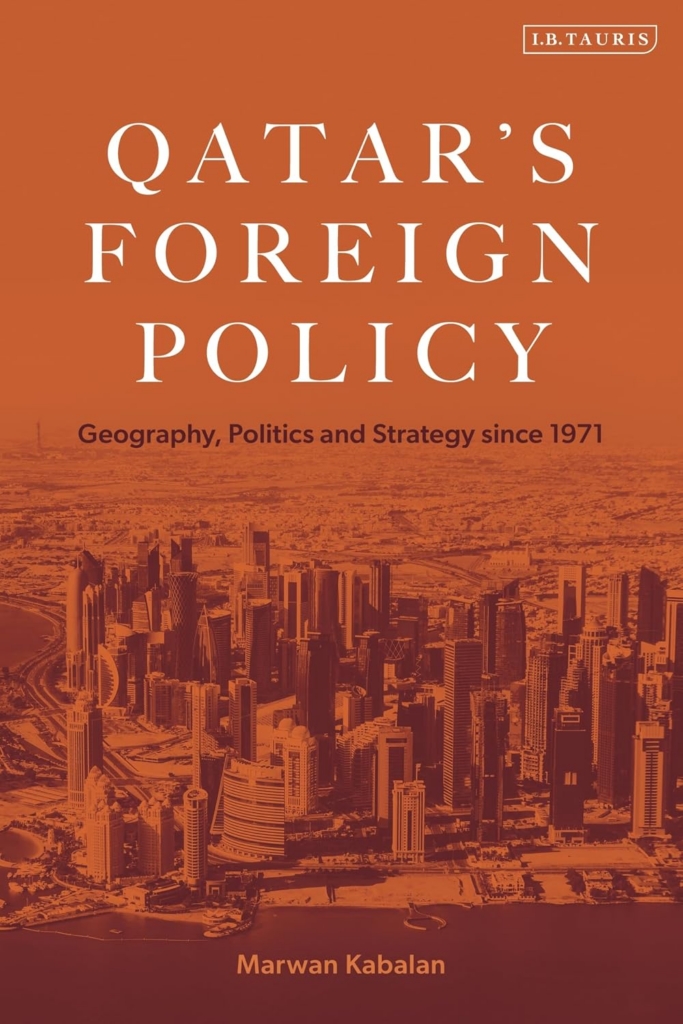
Qatar’s outsized geopolitical power as a small state is one of the core themes in Marwan Kabalan’s Qatar’s Foreign Policy: Geography, Politics and Strategy since 1971. Kabalan sets out to examine how small states “can achieve their aims despite their objective lack of necessary material influence” (p.52) and, specifically, how “Qatar managed to transcend the determinants of geography and conflicting political and economic interests” around it to secure its interests (p.49).
Kabalan rightly draws attention to the interplay between structure and agency in determining the choices made by Qatari leaders.
Through his analysis, Kabalan rightly draws attention to the interplay between structure and agency in determining the choices made by Qatari leaders as they have navigated a challenging regional neighborhood—sandwiched as the country is between Iran and Saudi Arabia, two much larger and more conventionally powerful states—as well as the many geopolitical shocks that have rattled the regional order. Kabalan highlights Qatar’s response to Iraq’s 1990 invasion of Kuwait, which Qatar and the other smaller Gulf states viewed as a warning “that they could not rely on the Saudi-led GCC [Gulf Cooperation Council] for security” (p.21). The subsequent mobilization of the US-led multinational coalition to liberate Kuwait during the First Gulf War—during which Qatari units participated in the Battle of al-Khafji, the first ground offensive of the campaign—further reinforced the need for Doha to diversify its security relationships and develop a more assertive approach to regional affairs.
According to Kabalan, the most significant shift in Qatari foreign policy came after 1995, when Sheikh Hamad bin Khalifa Al Thani assumed power from his father, Emir Khalifa bin Hamad Al Thani, who had ruled since 1972. As heir apparent, Sheikh Hamad had favored a more proactive and dynamic approach to developing Qatar’s gas infrastructure and had already assumed more authority over day-to-day policymaking, particularly through two government reshuffles in 1989 and 1992. It was during the second of these reshuffles that Abdullah bin Hamad al-Attiyah was appointed Minister of Energy and Industry. Sheikh Hamad bin Jassim Al Thani was also appointed Minister of Foreign Affairs before eventually becoming Prime Minister and Chief Executive Officer of the Qatar Investment Authority. It was this triumvirate that transformed modern Qatar. While Kabalan notes that under Emir Khalifa, “Qatari foreign policy was almost entirely dictated by systemic factors (i.e. by the regional system)”, after 1995 this dynamic “changed dramatically” as the new leadership “began to look for ways to overcome or mitigate structural impediments to Qatar’s ability to pursue its own policies” (p.53). Emir Hamad’s approach was “markedly anti-status quo” (p.53) and his “ambitious strategy would not have been possible without Qatar’s resources” (p.54).
Kabalan makes a persuasive case that after 1995, Qatari decision-makers used five strategies to confront and overcome the structural impediments of small stateness to “realize their ambitious vision of becoming a regional power.” These strategies included “securing [Qatar’s] financial independence via a key place in energy markets, obtaining a massive media arm, strengthening ties with Washington, consolidating its role as a mediator, and balancing Iran and Saudi Arabia” (p.66). This “combination of financial resources and an ambitious ruling elite with a clear future vision” enabled Qatar to break free of structural constraints and develop “soft power tools and parallel strategies” (though those strategies are never fully defined) both “defensively, by staving off its enemies’ attempts to achieve hegemony, and offensively, by expanding its regional influence” (p.67). Yet, by doing so, Qatar triggered the “crystal clear” opposition of Saudi leaders, who “saw Sheikh Hamad as a rebel intent on guiding his country out of the Saudi orbit” (p.55), just as some of the other smaller Gulf states, including the UAE, would similarly do in the mid- to late-2000s.
Kabalan’s analysis effectively weaves together the changing regional dynamics with a comprehensive account of the ever-shifting geopolitical landscape.
The remainder of the book examines pivotal aspects of Qatar’s foreign policy trajectory over the past three decades, including the country’s role in regional mediation in the 2000s, the turbulent aftermath of the 2010–11 Arab uprisings, the evolution of Qatar–US ties, and the diplomatic rifts with neighboring states beginning in 2013 and culminating in the 2017 blockade. Kabalan’s analysis effectively weaves together the changing regional dynamics with a comprehensive account of the ever-shifting geopolitical landscape. Kabalan observes, for example, that while Qatar had previously sought to balance its relations with Iran and Saudi Arabia, in 2011, Qatar changed its strategy to simultaneously confront both Tehran (by backing the opposition in Syria) and Riyadh (by supporting the uprising in Egypt). At times, the focus on Qatar expands into a discussion of the broader regional dimensions, as is the case in the chapter on the “Geopolitics of the Arab Spring.”
Kabalan notes that “the elite have played a central role in determining Qatar’s foreign policy” and that “it is impossible to properly understand Qatari policy without first understanding how the Qatari elite think […] and how they conceptualize the challenges they face” (p.52). Yet, at key junctures, specific decision-making processes can be difficult to trace. Kabalan notes that in 2011, “Qatar quickly turned its back on the Iran-Syria axis and formed a pro-Arab revolutions alliance with Turkey” (p.82) and that the Arab uprisings “presented Qatar with an opportunity to change the post-Second World War regional order” (p.190). The thinking behind these decisions is difficult to reconstruct, but one relevant factor is the evolving style and substance of Qatari foreign policy in the new policymaking environment following the 2013 change of leadership to the current Emir, Sheikh Tamim bin Hamad Al Thani—especially as Qatar once again has a Minister of Foreign Affairs, Sheikh Mohammed bin Abdulrahman bin Jassim Al Thani, who is also the Prime Minister.
Qatar’s Foreign Policy ends with a look toward future challenges. Although the book was published before the 2026 war with Iran, Kabalan presciently identifies the “possibility that the Strait of Hormuz might be closed” as “a major source of threat facing the region” (p.173), warning that, were it to happen, it “would literally mean the suffocation of Qatar” and other states that lack alternative trade routes to Hormuz (p.174). Further challenges he identifies include the ongoing retreat of the United States from the region and Washington’s declining commitment to the security of its allies and partners (p.180). What was perhaps unforeseen was how these challenges would all converge at once and be precipitated by Qatar’s most important ally, the United States, rather than by an adversarial power. The challenge for Qatar today is that the logistical and policy workarounds it developed so quickly to mitigate the 2017 blockade are not easily replicable to respond to the damage wrought by the US-Israeli war on Iran.
The views expressed in this publication are the author’s own and do not necessarily reflect the position of Arab Center Washington DC, its staff, or its Board of Directors.