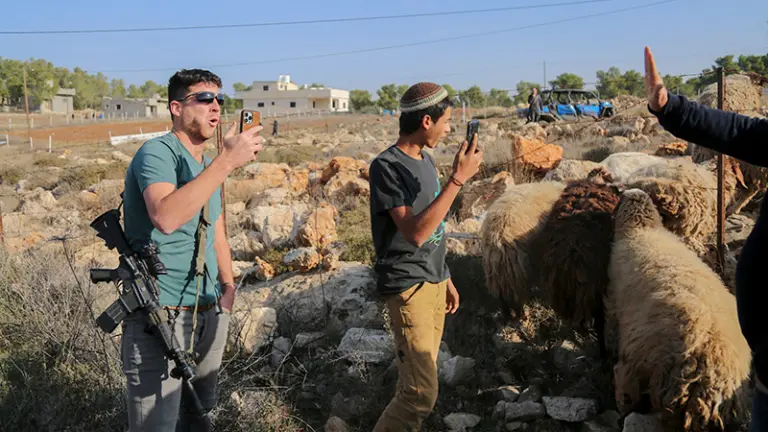
On April 9, 2026, news broke that the Israeli government had recently authorized the construction of 34 new settlements in the West Bank—nearly six times the number approved in the thirty years following the 1993 Oslo Accords. The announcement comes after a month in which Palestinians in the West Bank experienced some of the most dangerous conditions in recent memory. On March 13, settlers broke into a family home in the Bedouin village of Khirbet Humsa, attacked the people inside, including children, stole valuables and sheep, and sexually assaulted a man. Just a week later, during the Eid holiday, mobs of Israeli settlers terrorized Palestinian villages across the West Bank, attacking cars, setting vehicles on fire, smashing windows, and in some cases, hurling Molotov cocktails at families in their homes. During the wave of violence, gangs spraypainted threats and attacked resisting residents in the town of Silat al-Dhahr; the Israeli army closed the entrance to the town, preventing Palestinian firefighters and ambulances from responding. The same weekend, two Palestinians were wounded by settlers who entered the town of Masafer Yatta, protected by the Israeli military. Just days later, settlers injured seven Palestinians near Tulkarem. Then, on March 27, a CNN reporter witnessed Israeli soldiers assaulting his photographer, seemingly to prevent coverage of a settler outpost.
These brazen assaults on a defenseless, occupied population prompted international condemnation. The European Union and the United Kingdom criticized the rise in settler violence, as did Canada and the Arab League. Even Israel’s president, Isaac Herzog, could not defend the attacks in a letter to Jewish Diaspora leaders (although he certainly tried to minimize the scale of the attacks). Israel’s ambassador to the United States, Yechiel Leiter, lamented that allies “are definitely distancing themselves from Israel because of this.” Former Israeli prime minister Ehud Olmert went so far as to call for the International Criminal Court to step in, given that Israel has not prosecuted any settlers for killing Palestinians since 2020.
The impunity afforded to perpetrators by the Israeli government is no accident. The attacks are not merely isolated acts of violence by rogue civilians, but deliberate tactics to terrorize and displace Palestinians as part of a wider strategy of land seizure enabled by the State of Israel itself. Since October 7, 2023, an estimated 59 Palestinian communities in the West Bank have been displaced as a result of settler violence and harassment. Frequently, settler outposts are erected in their place.
The Ongoing Displacement of Palestinians
The number of Israeli settlements on the West Bank increased significantly after the signing of the 1993 Oslo Accords, which divided the territory into three areas (A, B, and C) under decreasing levels of Palestinian governance. In 1993, there were approximately 250,000 settlers in the West Bank and East Jerusalem. By 2025, an NGO estimated that there were at least 737,332 settlers living in 166 settlements and 271 outposts. All of these settlements are illegal under international law.
The settlements, which now house a university, a vineyard, and other significant infrastructure, use most of the West Bank’s water supply.
The settlements, which now house a university, a vineyard, and other significant infrastructure, use most of the West Bank’s water supply (Israeli settlers use about seven times as much water as Palestinians in the West Bank do). Settler-only roads wind through the land and bisect Palestinian areas. As the settlements expand, they come closer to Palestinian villages and towns, especially in Areas B and C. This has led to more harassment of Palestinians by settlers who have engaged in multiple violent and destructive activities against Palestinian communities, including burning and destroying crops like olive trees, killing livestock, dumping trash and sewage, burning cars, vandalizing mosques, schools, and homes, and attacking residents.
Among the most infamous incidents was that of the Dawabsheh family in 2015, when Israeli settlers threw firebombs into homes in a Palestinian village and killed an 18-month-old boy and his parents. Since then, such appalling violence has been all but normalized. Between October 7, 2023, and November 13, 2025, settlers killed at least 1,000 Palestinians in the occupied West Bank, including 221 children.
Land Seizure, Home Demolition, and Policies of Ethnic Cleansing
Israel’s seizure of land in the West Bank is not achieved only through isolated acts of settler violence. The Israeli state itself directly supports settlements financially and politically; some cabinet ministers themselves even reside in settlements. Between 2022 and 2025 alone, the Israeli government says that it approved 69 new settlements, in the process seizing thousands of acres of Palestinian land and displacing the people living there.
In December 2025, the Israeli government pushed forward a plan to expand the Maale Adumim settlement in the E1 area east of Jerusalem, essentially dividing the West Bank in half—a scheme that previous governments had long supported but did not seriously pursue due to international backlash. Israeli Minister of Finance Bezalel Smotrich confirmed that the move “buries the idea of a Palestinian state…This is Zionism at its best—building, settling, and strengthening our sovereignty in the Land of Israel.”
In February 2026, the Israeli government approved a plan to consider lands in the West Bank “state property” unless Palestinians could prove ownership—a strategy that Smotrich called part of “the settlement revolution to control all our lands” and that was widely criticized as de facto annexation. Israel also appropriates Palestinian lands for military purposes, declares land abandoned, or seizes land on the ground of purported public need, including for archaeological sites. Together, these methods represent little more than an ongoing land grab.
The Palestinian village of Sebastia, near Nablus, for example, is home to Roman ruins that are more than 2,000 years old and are the source of significant tourism and local pride. In November 2025, the town mayor received a notice that the Israeli government was planning to seize the entire site. The development plans would cut off residents from the ruins and set the stage for further Israeli settlement in what would be the largest Israeli seizure for archaeological purposes in the West Bank since 1967.
In 2025 alone, Israel issued more than 94 land confiscation orders for purported military purposes across the West Bank.
Seizing land for purported military purposes is common across the West Bank. In 2025 alone, Israel issued more than 94 land confiscation orders for such alleged purposes across the West Bank, in areas that happen to be geographically contiguous with areas to which settlements and their infrastructure may seek to expand while further dividing Palestinian areas.
More recently, in February 2025, the Israeli military launched a campaign near Jenin and Tulkarem in the north, displacing more than 40,000 Palestinians in the largest such displacement in the West Bank since 1967. Most of those displaced today are themselves descendants of refugees. In that operation, Israel used tanks in the territory for the first time since 2002. Fewer than 10 percent of those displaced have been able to return home, while many others’ homes have been destroyed, along with their roads, water pipes, and power lines. Israeli Minister of Defense Israel Katz plainly said, “We will not allow the return of residents.” Videos and photos emerged of soldiers occupying the homes of displaced Palestinians, in one case even holding a Purim party.
Israel has also significantly expanded its practice of home demolitions, especially in Area C, where it has approved almost no Palestinian building permits. In 2024, 1,769 home demolitions were reported, the highest number by far since data was first collected in 2009. In 2026, some 360 homes already have been demolished, displacing at least 560 people. Households that receive demolition orders from Israeli forces are forced to pay a demolition fee, which can cost as much as the equivalent of $32,000, or to demolish their own homes themselves.
Lastly, movement restrictions such as checkpoints, dirt mounds, ditches, gates, and roadblocks prevent Palestinians from traveling freely. In July 2025, the UN reported the occurrence of at least 850 movement restrictions in the West Bank, limiting access to families, lands, and livelihoods, and further fragmenting the West Bank into a series of small Palestinian islands with little connectivity between them, as settlements expand in the restricted spaces.
Israeli Territorial Aspirations in Gaza and Lebanon
The global consensus is that Israel has committed genocide in Gaza. In its military campaign, Israel used forced evacuations to push Palestinians farther and farther south into ever smaller, underserviced areas. Israel has now instituted a “yellow line” that has made more than half of the Strip a “military zone” where Palestinians risk getting shot if they venture close.
Although Israel dismantled its Gaza settlements in 2005, since October 7, 2023, its powerful settler movement has made no secret of its plans to permanently displace Palestinians from the ravaged territory. National Security Minister Itamar Ben-Gvir has even promoted “a solution to encourage the emigration of the residents of Gaza.” The settler movement openly plans to resettle Gaza, discussing their ideas at events attended by Israeli government officials. As a settler leader said in October 2024, “The purpose is to settle the entire Gaza Strip, not just part of it, not just a few settlements, the entire Gaza Strip from north to south…thousands of people are ready to move to Gaza now.”
Israel’s settler movement has made no secret of its plans to permanently displace Palestinians from Gaza.
Bands of settlers have infiltrated and planted Israeli flags in Gaza on several occasions. In February 2026, one such group was accompanied by several ministers from Israel’s current government. One member of the Knesset claimed that Israel’s resurrection could only arrive “when the Israeli flag is raised in Gaza, when Jewish settlements will bloom in Gaza,” adding, “That will be the total victory against absolute evil.”
In recent weeks, Israel has expanded its territorial control into Lebanon. In late March 2026, the Israeli defense minister announced that Israel would occupy South Lebanon for the foreseeable future and destroy homes along the border, thereby preventing the return of 600,000 people. The villages would be destroyed, he pronounced, “in accordance with the Rafah and Beit Hanoun model in Gaza.” This model of wanton destruction appears to accurately describe what Israel is now doing in Lebanon. During the current round of fighting, some 1.2 million people have been displaced as Israel destroys medical facilities, infrastructure, and utilities.
Displacement as an Organizing Principle
It is no coincidence that genocide, mass displacement, settler violence, and land seizures are occurring at the same time. For decades, Israeli leaders across the political spectrum have supported policies to force Palestinians out of historic Palestine, creating a new reality on the ground and erasing not just Palestinian ties to the land but also perhaps even the very idea of Palestinians.
The year 2026 marks the 50th anniversary of Land Day, when six Palestinians were killed and more than 100 were injured while protesting against Israeli land confiscations. For generations, Palestinians have fought for the simple right to keep and live on their and their ancestors’ land; to stay in the houses they built to protect their families; and to travel freely and without fear that their life might end on the whims of a lawless and brutal mob.
The entire infrastructure of Israel’s policies toward Palestinians—the bombings, the raids, the sieges, the displacements, the movement restrictions, and the physical and structural violence that is baked into every one of these acts—must be recognized as much more than disparate incidents in service of Israel’s security, as its leaders frequently claim. Although the current crop of Israeli politicians is more explicit about its goals than some of their predecessors were, expanding the State of Israel’s control of territory at the expense of the Palestinians has been a through line since its establishment.
It is not simply the fading notion of Palestinian sovereignty that is at risk, but the very presence of Palestinians on their historic land. A mass expulsion of Palestinians is underway. Without immediate intervention and accountability, the ongoing Nakba will continue.
The views expressed in this publication are the author’s own and do not necessarily reflect the position of Arab Center Washington DC, its staff, or its Board of Directors.
Photo by MOSAB SHAWER / MIDDLE EAST IMAGES / MIDDLE EAST IMAGES VIA AFP