
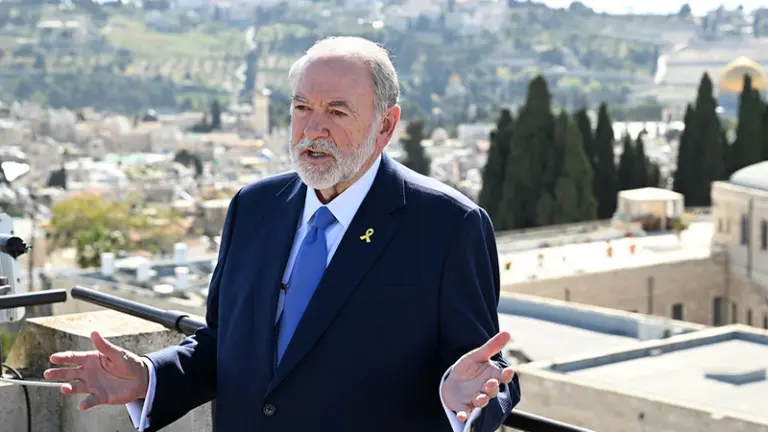
In late February 2026, influential right-wing media figure and former Fox News host Tucker Carlson interviewed the US ambassador to Israel, Mike Huckabee. It turned out to be an intense exchange that elicited an array of conservative criticisms of Carlson. Not least among Carlson’s provocative questions was his suggestion that Huckabee was regularly placing Israel’s interests above those of the United States. But the most interesting tussle between them had to do with religion. In a lengthy discussion, Carlson asked whether Israel’s claim on The Land (the land of Israel/Palestine, the Holy Land) was legitimated by legal or historical precedent, or by religious promise. And if it was religious, could other countries base territorial claims on theology? Huckabee spotted the trap and dodged Carlson like a worried fencer who had just discovered that he was up against a worthy opponent.
Huckabee’s worldview needs some elaboration. Carlson correctly names Huckabee a Christian Zionist; the ambassador does not deny the characterization. This movement underpins his worldview.
Mike Huckabee, 70 years old, grew up in Arkansas, was shaped by his conservative Southern Baptist tradition, and attended the small Ouachita Baptist College, which is affiliated with the Southern Baptist Convention. After graduation, he enrolled at Southwestern Seminary in Fort Worth, Texas, but quit after a year to join the Texas televangelist James Robison. Despite attending a seminary for two semesters, Huckabee may not have acquired the training that would help him navigate a discussion with Carlson, who is more theologically astute.
Huckabee may not have acquired the training that would help him navigate a discussion with Carlson, who is more theologically astute.
At 21, Huckabee pursued a career in Christian broadcasting, although his aspirations were larger. In 1989 he became the president of the Arkansas Baptist Convention. In 1993 he became lieutenant governor of Arkansas and in 1996 stepped in as governor to finish the term of his disgraced predecessor. He was then elected as governor in 1998 and served until 2007. A failed presidential bid in 2008 was followed by a second failed bid in 2015 but his name always circulated among Republicans as a leading influential voice. He supported Donald Trump after his 2020 loss to Biden and wondered aloud (to Trump’s delight) if something was amiss in the election.
After the election in 2024, Trump rewarded Huckabee by announcing that he would be his ambassador to Israel. In 2025 he was confirmed by the Senate. Senator Ted Cruz (R-TX) once described Huckabee as “a pastor and a patriot who loves America, loves Israel, and loves Jesus.” This comment synthesizes something important: For Huckabee, American politics and American Christianity live hand-in-glove. His role at the US Embassy in Jerusalem gives him ample opportunity to demonstrate this conviction.
The Belief System of Christian Zionism
Huckabee has always opposed the idea of a Palestinian state. He has suggested that Palestinian identity is a fiction and regularly refers to the occupied West Bank as “Judea and Samaria.” He remarked in 2017, “There is no such thing as a West Bank. It’s Judea and Samaria.” His words do not just express a political position: they are drawn from the Bible and are regularly used by Israeli settlers who live in illegal settlements throughout the West Bank.
Many of those listening to the Carlson/Huckabee debate may not have recognized the religious scaffolding that stands just outside the stained-glass windows of Huckabee’s political imagination. What is formative for him is the Israel-focused synthesis of politics and religion known as Christian Zionism that is widespread among ordinary American right-wing evangelicals.
Five beliefs contribute to Mike Huckabee’s Christian Zionist interpretation of the landscape in Israel-Palestine, and becoming aware of them suddenly clears the fog for the viewer. Carlson knew this background: in all the dodging and weaving, it seemed as if Huckabee would have preferred to keep some fog in the air to obscure to the wider public what was at stake. The five pillars of Christian Zionism are as follows:
1. God promised The Land to Israel in the Bible (Genesis 15:18–21; 26:3; 28:13–14)
This promise is the hope God provided to Abraham, who had migrated from Mesopotamia to the region known as Canaan. He would no longer be a nomad but would have land and security. He would be a great nation with many descendants (“like the stars in the sky,” Gen 15:5). Above all, God’s promise is eternal and unconditional. No failure of belief or behavior can jeopardize it. God’s promise to Abraham explains why the West Bank cannot be called the West Bank. The geographical regions of The Land should be controlled by the vocabulary of the Bible. This is an uncommon land, living under divine orders, and owned exclusively by the descendants of Abraham. In this worldview, all others are either visitors or interlopers.
Carlson rightly noted that the wider promise in Genesis 15 described a land that included Lebanon, Jordan, Syria, Egypt, and even Iraq. Huckabee knew this, but avoided responding until he said, “It would be fine if they [Israel] took it all.” In other words, Israel may claim land from Egypt to Iraq. In keeping with his theology, Huckabee has rejected the notion of a Palestinian state and even hinted that the US would recognize Israel’s annexation of the West Bank—at least until President Trump announced his opposition to the idea.
2. Blessing Israel is an eternal obligation for all
Genesis 12:3 is the most cited verse among Christian Zionists: “I will bless those who bless you, and the one who curses you I will curse, and in you all the families of the earth shall be blessed.” This verse is an expression of the protection that God promises to Abraham and his family. Today, it has become a timeless promise that leads either to the cursing or the blessing of the world’s nations. If a nation blesses modern Israel, God will bless it. If it curses modern Israel, that nation will be judged.
For most Christian Zionists, this protection determines the fate of America’s prosperity and explains their reluctance to criticize Israel’s domestic or foreign policies. It also explains why Israeli flags adorn certain churches from Arkansas to Brazil to South Africa. Celebrating Israel is not only a Christian duty; it is a spiritual obligation, an expression of God in the world. Moreover, it is a path to blessing so that nations and people may prosper.
3. Modern Israel is a prophetic fulfillment
The 1948 establishment of the State of Israel is not viewed as the product of history or the political maneuverings of Jewish Zionists who had dreamed of their own nation since the late nineteenth century. Rather, modern Israel is God’s creation. Among the nations of the world, it enjoys an exceptionalism unparalleled by any other country. As one pastor told this author, “Israel always deserves the benefit of the doubt.” When asked, “Do other nations deserve this?” The pastor replied, “Of course not. A biblical world view means you look at Israel differently.”
Each of Israel’s successful wars following 1948 is interpreted as miraculous. The conflicts of 1956, 1967, and 1973—and even Israel’s suppression of the Palestinian intifadas of 1987-93 and 2000-05—point to God’s sustaining, protecting presence. Theology even justifies Washington’s role in these wars: God moved so that His will might be fulfilled through US economic and military support. This interpretation can now be seen in Israel’s current confrontation with Iran and Hezbollah: Israel will prevail both on defense and offense because God is at work here in every battle.
4. Israel’s opponents are viewed through a biblical paradigm
The Old Testament contains several stories of “divinely sanctioned violence.” As Moses leads Israel toward The Land of Promise, for example, Joshua assumes leadership and brings the tribes across the Jordan River. From there, Joshua begins a massive conquest of all the indigenous residents (with limited exceptions). The paradigm of divine promise, worldly conquest, and settlement is deeply embedded in Israel’s ancient story and is today used as a paradigm for Israel’s relation with the Palestinians. From Israel’s first prime minister, David Ben-Gurion, to its current incumbent, Benjamin Netanyahu, these models of conquest and replacement have been a constant.
During the war on Gaza that began after October 7, 2023, Netanyahu and his government ministers referred to Palestinians and particularly Gazans as “Amalekites.” This reference should not be missed. In the ancient stories, the Amalekite nation was a regular opponent of Israel. But in Deuteronomy 25, God directs Israel to avenge them: “You shall blot out the remembrance of Amalek from under heaven; do not forget.” This invective prompted a scorched-earth policy towards the Amalekites (see 1 Samuel 15), which modern Israel’s leaders invoked to justify the 2023 bombing of Gaza. The mantra was: Destroy everything.
5. Modern Israel’s story is a prelude to the greatest battle of all.
But all of these elements are merely a prelude. The ultimate aim of this form of Christian Zionism is not the establishment or protection of Israel as an end in itself: this is instead just setting the stage for the culmination of history. Israel must return to the land to ignite the mother of all wars, Armageddon, which will end only with the return of Jesus Christ and the beginning of the world’s judgment. The Second Coming is the crown jewel of Christian Zionism’s eschatology. It views the world pessimistically and sees wars, economic crises, environmental collapse, and moral degradation as signs of hope for the end of the world and the return of Christ. Is it any wonder that until recently, evangelicals rarely invested in movements that might build better kingdoms in the here-and-now? You do not invest in something that has an imminent expiration date.
Conclusion
Scholars have a routine list of objections to the entire system of Christian Zionist thought. Christian Zionists do not realize that God’s promise to Abraham was never eternal and unconditional. Rarely do they read the prophets who abhor the ethnic nationalism on display today, or compare modern Israel to what the scriptures say about how people should live together. In the Bible, Israel’s blessings are tied to its covenant faithfulness. Modern Israel is secular and less religious than the United States, and barely reflects the “faith of Abraham.” Christian Zionists are oddly silent about how the New Testament shifts ancient paradigms and opens a new chapter that is inclusive and hopeful.
It was surprising to see how well Tucker Carlson had done his homework for his interview with Huckabee. He had clearly identified the Achilles’ heel of Christian Zionism—as Huckabee’s evasiveness revealed. This worldview is grounded in a theology that is deeply ill informed and tragic. Worst of all, it betrays what many devout Christians see as the deeper teachings of Jesus and has contributed to dreadful outcomes in the Middle East.
The views expressed in this publication are the author’s own and do not necessarily reflect the position of Arab Center Washington DC, its staff, or its Board of Directors.
Featured image credit: US Embassy in Jerusalem/Flickr