As the popular rebellion in Iran accelerates, the country’s sclerotic autocracy is fighting for survival. The reported deaths of at least 2,000 protesters and the arrest of thousands are shocking, but the numbers could get much worse. When the fires and smoke clear, the regime likely will survive to see another day. Still, the tremors set off by the mass uprising will reach into the very heart of the regime as rival elites struggle over who will succeed the country’s 86-year-old Supreme Leader Ali Khamenei and, in doing so, define what it means to have an “Islamic Republic.” The looming succession struggle will open the door to the reinvention of the system, or its disintegration. The key question now is not what happens tomorrow, next week, or even over the next few months, but rather the direction and nature of political change over the next two to four years.
Watching from the White House, President Donald Trump, who is fired up after the US intervention in Venezuela, has warned Iran’s leaders that if the regime “violently kills peaceful protesters,” the United States “will come to their rescue.” Yet the president’s threats are unlikely to deter Tehran. Moreover, Iran is not Venezuela, and the Middle East is not Latin America. Considering the risks of escalation, the White House may rely on air attacks to unsettle the regime while avoiding steps that could trigger a wider regional war. But even a limited air campaign could prove counterproductive, especially if it spurs Iran’s rulers and their increasingly furious domestic opponents to wage a battle to the finish. If, as is most likely, the victor of that battle is Iran’s hardline leaders, Trump’s promise to rescue the opposition could prove hollow.
The biggest wild card in this volatile situation is Israel. If it tries to assassinate Khamenei and succeeds, the Islamic Revolutionary Guard Corps (IRGC) will move quickly to have a new Supreme Leader appointed. Whoever occupies that post will face the bloody task of imposing order on a fragmenting society. While it is hard to entirely rule out the possibility that the opposition might muster the unity and leadership needed to challenge a reconstituted autocracy, for now the odds are against that happening. Trump should ponder these grim realities before approving of the removal of a leader whose hardline allies will do anything that they deem necessary to survive.
A People’s Revolt That the Regime Could Outlast
Triggered by the cascading devaluation of the Iranian rial, the protests launched on December 28, 2025, by merchants in Tehran’s Grand Bazaar were not unprecedented, yet the ensuing mass demonstrations pose a severe threat to a regime that has been struggling to reassert its authority since the June 2025 Israeli and US attacks on Iran’s nuclear facilities. The September 27, 2025, reimposition of UN “snapback” sanctions on Iran sent the national currency tumbling. Shopkeepers whose livelihoods depend on selling imported electronic goods, including cell phones, shuttered their shops, and many took to the streets. Within 72 hours the protests had spread to more than 21 of Iran’s 31 provinces. Demonstrations by university students in Tehran, Isfahan, Yazd, Zanjan, and other cities were punctuated by calls for “freedom! freedom! freedom!” Echoing the 2022-23 women-led protest movement, these slogans and others—such as “Death to the Supreme Leader”—showed that the protests had quickly shifted from economic issues to the very question of regime legitimacy.
The impact of Pezeshkian’s conciliatory remark was undercut by the security forces’ escalating attacks on protesters.
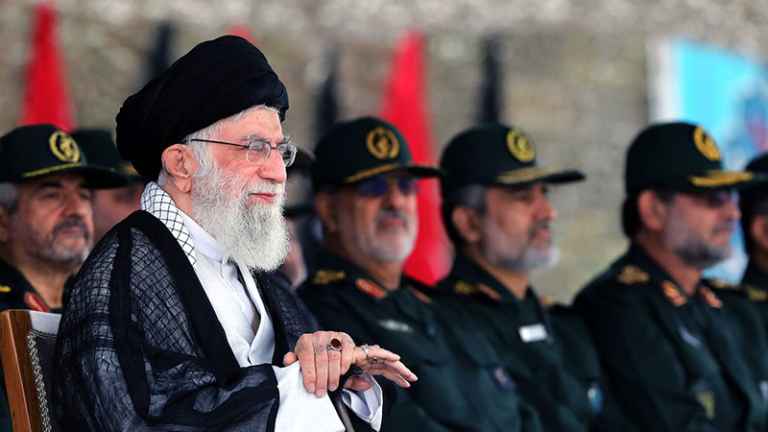
President Masoud Pezeshkian’s initial call for a dialogue with leaders from the merchant, student, and labor sectors signaled his awareness of the demonstrations’ political significance. But the impact of his seemingly conciliatory remark was soon undercut by the security forces’ escalating attacks on protesters. Pezeshkian’s subsequent demand that Iranians come into the streets in opposition to the protesters underscored that he is one with the regime. Khamenei’s warning that “rioters” must be “put in their place,” together with his call for “unity” to confront “terrorists,” signaled that hardliners have drawn the same conclusion that Chinese leaders reached during the 1989 Tiananmen Square uprising: that the regime faces two alternatives, survival or death.
Yet the Islamic Republic of Iran is not China. The Iranian regime needs to avoid allowing its security forces to unleash an unlimited crackdown on protesters. In a country in which the 1979 Islamic Revolution was inspired by the religiously potent theme of martyrdom caused by government violence, mass bloodletting could unite a protest movement that is currently fragmented across ethnic, geographic, ideological, and social divides and lacks a unifying opposition figure. Iran’s self-proclaimed crown prince, Reza Pahlavi, clearly wants to play this role. But while his efforts to assume the mantle of leadership have galvanized many Iranians, many others will not follow him. Pahlavi is not the figure to unify the opposition, much less to lead Iran.
Collapse, Reinvention, or Some Combination
In the short term, the most likely outcome of this protest movement is the total militarization of the Iranian regime. What political props it once used—including controlled elections, a subordinate parliament, and a directly elected, if compliant, president—are now irrelevant. Isolated and turned completely inward, the shrinking alliance of groups that constitutes the ruling apparatus must face the inevitable. What looms is a succession struggle that, even without the threat of popular uprising, was bound to reopen fundamental questions about the nature of the Islamic Republic (as was the case during the first succession struggle following Ayatollah Ruhollah Khomeini’s death in 1989). Thus, the aftershocks of today’s rebellion will reverberate with force even if the regime imposes a precarious victory.
The shrinking alliance of groups that constitutes the ruling apparatus must face the inevitable.
The question is how it will proceed in that victory. One possibility is that the rebellion will open opportunities for a coalition of conservative stalwarts, veteran reformists, and disgruntled actors from the security sector—including the IRGC—to support a candidate for Supreme Leader who will push back against the hardliners and open the political arena. But a far more likely scenario is that hardliners will anoint a Supreme Leader who is little more than an appendage of the IRGC. Unable to play the traditional role of the ultimate arbiter who manages contending forces and elites, a newly appointed Supreme Leader entirely dependent on the IRGC would reinvent the Islamic Republic by turning it into an Islamic dictatorship shorn of all instruments of even state-controlled competition.
It is also possible that rather than reinventing the regime, the succession struggle could invite a genuine democratic transition. This scenario would require a unified opposition, a national leader capable of inspiring broad support, negotiations with elements of the ancien regime’s security apparatus to deter potential spoilers, and Washington’s readiness to relieve Iran’s dire economic crisis by suspending sanctions. These conditions will not easily come about, especially if Kurdish, Arab Sunni, and Baluchi leaders in Iran’s border regions insist on autonomy or even pursue secession. Seeking support from state and/or non-state actors in Turkey, Pakistan, and perhaps the United States, these centrifugal forces might resist the idea of reestablishing Tehran’s political and economic power and Iran’s Persian-Shia center.
Trump to Iran’s Rescue?
Speaking on December 5, 2025, US Ambassador to Turkey and Special Envoy to Syria Thomas Barrack asserted that “President Trump and Secretary Rubio are not into regime change.” Instead, he argued, “they are into a regional solution left to the region itself.” Barrack added that regime change was Israel’s issue, intimating that Trump might support or allow Israel to target Khamenei, an escalation that could drag the United States and the Middle East into a wider war.
Trump and his advisers likely remain wary of such a wider conflict. Indeed, despite the apparent unity of purpose that Trump and Prime Minister Benjamin Netanyahu showed during their December 29, 2025, meeting at Mar-a-Lago, the challenge facing Trump is to make good on his public pronouncements of support for Iran’s protesters without drawing the United States into a full-scale war. Here, there are several scenarios.
Trump Imposes a Variation of the Venezuela Model
The least likely scenario is that the United States would deploy air power to damage Iran’s security apparatus to impel key players in the IRGC to reach an understanding or accommodation with the White House. This situation would be a version of the “Venezuela model,” i.e., allowing partial regime survival, on two conditions: halting the assault on Iran’s protesters and resuming negotiations on the nuclear issue. Yet there do not appear to be any leaders in Iran’s ruling apparatus with the political space, resources, or ideological temperament to take the tremendous risk of trying to cut a deal with a US president who withdrew from the 2015 nuclear deal, reimposed sanctions, and then joined Israel in a war that reportedly significantly damaged (but did not destroy) Iran’s nuclear program.
Moreover, since the regime’s survival depends on its continued control over income generated by the state-owned oil and gas sector, there is zero chance in Iran for the kind of wheeling and dealing that Trump used to pressure some regime actors in Venezuela before, during, and following US military actions there.
US Airpower Emboldens Protesters and the Regime to Fight to the Death
A second scenario is that the carefully targeted use of drones, guided missiles, and air strikes against key military and security targets in Tehran and other locations in Iran could embolden the opposition without necessarily preventing the regime from quelling the protesters. On the contrary, it could strengthen the resolve of the military and IRGC to use even more lethal force—despite the many risks. Having declared his own red line, Trump might be ready to defend it in ways that would seemingly contrast with President Barack Obama’s failure to enforce his own declared red line in Syria back in 2013. But US military action that drives both protesters and the regime into a fight to the death would leave the regime standing. A US military strategy designed to display military power that hardens the regime’s resolve while avoiding a regional war could be a political win for a president whose foreign policy is ultimately driven by his abiding need to constantly express his power and control.
US-Iran Policy Incoherence and the Israeli Wild Card
Neither of the two scenarios described above would prevent the White House from trying to restart indirect nuclear talks with Iran. But Trump’s insistence that negotiations produce a deal that fully dismantles Iran’s nuclear enrichment and ballistic missile programs is surely a non-starter for Tehran. Indeed, any Iranian official who dared explore such a deal would not live to tell the tale. In short, Trump’s Iran policy, such as it is, provides no workable basis for a diplomatic solution. As long as a full collapse of the regime remains unlikely, a US-Iran policy hinging on “zero enrichment” is not grounded in reality.
Perhaps what the administration is counting on, then, to square this circle is the assassination of Khamenei by Israel. It is possible that Trump gave Netanyahu a green light for such a move when they met at Mar-a-Lago on December 29, 2025. Iran’s leaders must assume that Trump gave the Israeli prime minister the go-ahead, and with that prospect in mind, are doing everything possible to protect the Supreme Leader. Unless someone in his inner circle betrays him, Khamenei’s chances of outliving the popular rebellion are not bad. If he survives, Trump will be happy with an outcome that shows he is a “man of action” who means what he says and thus is ready to move on to the next crisis. As for Iran’s leaders, they will only postpone a political reckoning that may be coming sooner than they expect.
The views expressed in this publication are the author’s own and do not necessarily reflect the position of Arab Center Washington DC, its staff, or its Board of Directors.
Featured image credit: Iranian Presidency Online