
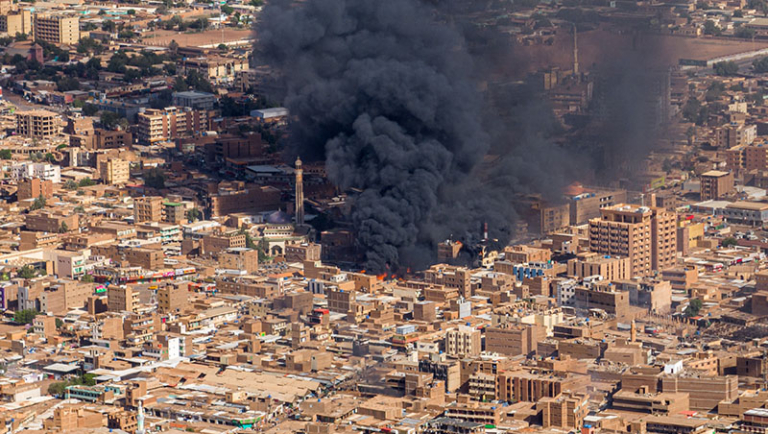
Since June 2026, the United Nations, the United States, several European governments, and human rights organizations such as Amnesty International and Human Rights Watch have warned of an imminent risk of mass atrocities in el-Obeid. The city is a strategic turf for the belligerents in Sudan’s war, the Sudanese Armed Forces (SAF) and the paramilitary Rapid Support Forces (RSF). Besieged for long periods by the RSF since the start of this war in 2023, el-Obeid represents a return pathway toward the capital Khartoum for the RSF and a path westward into Darfur for the SAF.
The statements on impending violence in el-Obeid came as these states strove to avoid repeating their October 2025 failure to prevent atrocities in the Darfuri town of al-Fasher. Warnings of large-scale atrocities were frequently dismissed, despite clear signaling by the RSF and allied militias and the clear echoes of history pointing to the inevitable horrifying outcome. Over 48 hours, up to 10,000 people are thought to have been killed in al-Fasher, with 40,000 civilians still unaccounted for as of March. The UN’s Independent International Fact-Finding Mission for the Sudan, an investigative mechanism, found that the attacks bore the “hallmarks of genocide.” Under its 2005 mandate from the United Nations (UN) Security Council, the International Criminal Court (ICC) is now investigating recent and historic crimes committed in Darfur.
The Coalition for Atrocity Prevention and Justice for Sudan, formed in February 2026 in response to the violence in al-Fasher, is meant to galvanize global action to save lives. But it will struggle to be seen as anything other than a consolation prize for real action if it merely coordinates statements and is therefore unable to actually prevent atrocities. Led by the United Kingdom—which has faced sharp criticism for appearing to privilege its relationship with the United Arab Emirates (UAE), the RSF’s main backer, over saving lives in Sudan—the coalition has yet to articulate a strategy for preventing atrocities beyond issuing statements and producing siloed, uncoordinated sanctions packages.
Despite the manifold comparisons, el-Obeid is not al-Fasher. At the end of June 2026, Yale’s Humanitarian Research Lab (HRL), which had helped raise the alarm on atrocities in al-Fasher, said that it did not assess that “conditions are present similar to the intentional genocidal, large-scale killings which occurred in El Fasher [sic] in the fall of 2025.” HRL was also unable to verify that the level of troop buildup was consistent with an imminent attack. In addition, el-Obeid’s cosmopolitan society differs markedly from al-Fasher’s more pronounced social fissures, where competition over land between pastoralists and farmers maps onto ethnic divisions between Arabs and Africans. El-Obeid also lacks al-Fasher’s earlier history of genocide 20 years ago. These structural factors have all contributed to the atrocities in Darfur since 2023. The RSF has faced recent military setbacks in their control over the territory around el-Obeid, making it harder for them to take the city, at least for now. That said, the recent knee-jerk issuing of statements by the international community exposes several realities.
No lessons were learned from al-Fasher—especially the lesson that statements alone do not save lives.
First, it is clear that no lessons were learned from al-Fasher—especially the lesson that statements alone do not save lives. Instead, what has worked historically is creating a protective wedge between vulnerable citizens and the violent overtures of the RSF and other groups through something like a civilian protection force, which organizations including Amnesty, Human Rights Watch, and the UN’s Fact-Finding Mission have repeatedly called for. A protection force is even more necessary when recalling how in al-Fasher the SAF’s top brass negotiated to leave the city ahead of its fall to the RSF, leaving civilians and lower-ranking officers (often drawn from marginalized groups) unprotected from the impending atrocities. While the SAF has been keen to style itself as a protective force, in reality, it has almost exclusively fought its own people, even using chemical weapons against them in 2016 and, according to the US government, again in 2024. The SAF itself earlier committed genocide (2003–2005) alongside the Janjaweed, which would later morph into the RSF under the watch of successive SAF leaders. Local rights groups have also accused the SAF of using civilians in el-Obeid as human shields.
Second, atrocities are already happening in el-Obeid. Recent diplomatic statements largely anticipate that atrocities will occur once the city falls, not while it is besieged by the RSF. But the town’s 500,000 residents, plus 100,000 people seeking refuge, are already facing constant drone and artillery attacks on civilian infrastructure such as power stations, water points, fuel depots, and petrol stations. These attacks have choked civilian life in the city—much as they did in al-Fasher—and have sharply driven up the cost of evacuations. Inside el-Obeid, women fetching water face sexual violence from the SAF and allied militias that control the city, and people face starvation as the prices of basic goods multiply.
Third, the RSF may take advantage of the global attention on el-Obeid—though welcome after the lack of diplomatic attention on al-Fasher before it fell—to distract from their ongoing atrocities elsewhere. The RSF currently looks to be trying to finish what they started in al-Fasher by conducting arson attacks in North Darfur’s Dar Zaghawa, homeland of the same Zaghawa ethnic group targeted by the RSF in al-Fasher. Survivors of the al-Fasher attacks have also sought refuge in Tawila, a Darfur town in an enclave under the control of the Sudan Liberation Movement, an armed group led by long-time rebel commander Abdal Wahid al-Nur. Tawila may now also face the risk of atrocities.
Action to prevent atrocity is increasingly seen as a risk, not a legal and ethical duty.
Finally, despite atrocities representing a key dimension of Sudan’s war, there has been little international urgency to act against its perpetrators and their supporters. The worst-kept secret in this war is the United Arab Emirates’ (UAE) support for the RSF, for example, which Abu Dhabi denies to countries such as the United States, whose own intelligence reveals the extent of the UAE’s military and political support. Despite mounting evidence, Western countries have refused to sanction or even censure the UAE so as not to upset shared regional interests, not least of which is the country’s strategic alliance with Israel. In today’s geopolitical context, action to prevent atrocity is increasingly seen as a risk, not a legal and ethical duty.
Increased international attention and rhetorical pressure are unlikely to dissuade Sudan’s belligerents from committing further atrocities. After all, the RSF has learned well from al-Fasher that the world can tolerate violence against civilians while pursuing low-ambition engagement, prioritizing geopolitical interests over safeguarding lives, and diminishing the power of judicial bodies such as the International Criminal Court—the only potential recourse to justice open to Sudanese at the moment.
The world may well move on quickly from its concern for el-Obeid, cynically claiming success at staving off the most recent “imminent” atrocities. But Sudan remains at serious risk of atrocity as long as the SAF and RSF’s deleterious war continues. What will also almost certainly remain is an approach to civilian protection that is underpinned by the international community’s fear of failure, rather than a fear of the loss of innocent lives.
The views expressed in this publication are the author’s own and do not necessarily reflect the position of Arab Center Washington DC, its staff, or its Board of Directors.
Featured image credit: Abd Almohimen Sayed via Shutterstock