
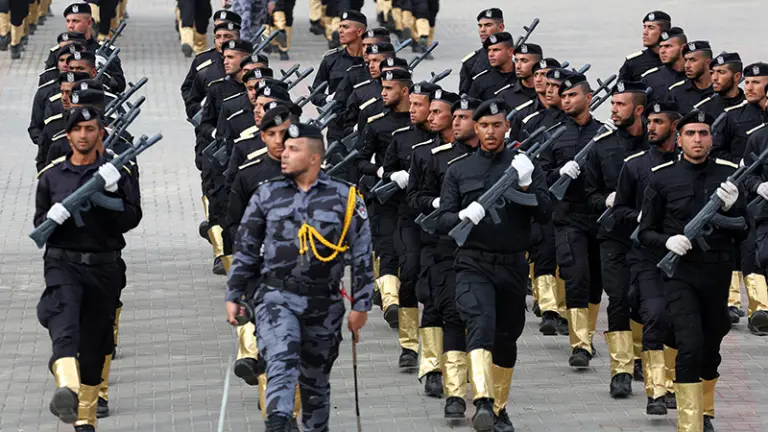
On November 17, 2025, United Nations Security Council Resolution (UNSCR) 2803 authorized the international stabilization force proposed by the United States to be deployed in Gaza as part of Phase 2 of President Donald Trump’s ceasefire initiative. On January 16, 2026, Trump announced his “Board of Peace,” a three-tier governing system that includes an international stabilization force with the mandate of “permanent disarmament.” For their part, Hamas leaders have consistently expressed disinterest in disarmament unless it follows the establishment of a Palestinian state.
Yet Hamas is not the only armed group that the United States has sought to disarm as part of its broader strategy in the region. Since the beginning of Joseph Aoun’s tenure as President of Lebanon in January 2025—and more aggressively since the ceasefire between Israel and Hezbollah was reached on November 27, 2024—US Ambassador to Turkey Tom Barrack has publicly advocated for Hezbollah’s disarmament. Together, these pressures on Hamas and Hezbollah represent a concerted US effort to shape the region into a new reality that grants Israel military dominance over its adversaries and the wider region.
Analysts of Middle East politics have often suggested that Hamas is copying Hezbollah’s playbook in its efforts to resist the pressure to disarm. Some observers argue that Hamas seeks to survive the conflict, embed in the postwar order, and retain an autonomous military capability without burdening itself with the responsibilities of government. This approach is modeled on Hezbollah, which participates in Lebanon’s confessional system but wants to retain its weapons to respond to Israeli aggression. Other observers suggest that Hamas also seeks to maintain its armed capability and spoiler status behind the façade of a future civilian administration in Gaza. US and Israeli officials are reportedly keen to avoid the emergence in Gaza of a Hezbollah-like model, similar to Lebanon. Even Palestinian President Mahmoud Abbas has dismissed the idea of a Palestinian government of national unity that includes Hamas as a “Lebanese-Hezbollah model” that will produce a similar “state-within-a-state” arrangement.
Despite widespread concerns that Hamas is seeking to emulate the trajectory of Hezbollah, the two movements in fact face such fundamentally different political and security conditions that the idea appears far-fetched. Consequently, fears that the Lebanese experience might be replicated in Gaza are not only analytically unsound but also politically misleading.
Political Context
Since he became president of Lebanon in January 2025, Aoun has sought to ensure that the Beirut government has a monopoly over weapons in the country, a formulation that is essentially a euphemism for disarming Hezbollah. Although disarming the Shia militant organization is a key demand of both the United States and Israel, the prospect is also popular in Lebanon: Polls in June-July 2025 show that Christians, Sunnis, and Druze are substantially in favor of disarmament. On August 7, 2025, Aoun convened a cabinet meeting to agree to US disarmament goals, which led to Hezbollah and AMAL, the other Shia party in the cabinet, to storm out in protest. Hezbollah views disarmament as a US-Israeli initiative and argues that it should retain its arms to repel Israeli incursions and defend Lebanese sovereignty. Today, Hezbollah faces a crisis of consensus as the Lebanese government has reinvigorated calls for the state to have a monopoly over arms—and for Hezbollah’s weapons to stop drawing the country into conflict.
70% of Palestinians reject disarmament even as a condition to prevent the war’s continuation.
Hamas is in a very different political context that makes the prospect of disarmament substantially more difficult. Palestinians, even those who are not Hamas partisans, share widespread consensus in support of keeping weapons. In October 2025, Palestinian Polls and Survey Research found that 70 percent of Palestinians (rising to 80 percent in the West Bank but declining to 55 percent in Gaza) reject disarmament even as a condition to prevent the war’s continuation. Palestinians do not consider Hamas’s arms to be the source of their flawed sovereignty: it is rather the occupation that prevents them from making their own decisions on governance, national reconciliation, and economic policy. As Hamas was the governing authority in Gaza, disarmament is not an internal crisis, but a condition imposed by the United States and Israel. The domestic political context means that Hamas does not need to copy Hezbollah’s playbook, as it faces other pressures.
Security
Hezbollah and Hamas do not operate in the same security contexts. Since the 1980s, Hezbollah has created a strong political support base in primarily Shia areas of Lebanon, where it began to develop military infrastructure that allowed it to have territorial control, particularly south of the Litani River, an area that was occupied by Israel from 1982 until 2000. Hezbollah solidified its de facto territorial control of South Lebanon in 2000 after it claimed success in causing the withdrawal of Israeli forces. By offering social services to communities there, Hezbollah has been able to operate as almost a “state-within-a-state” and thereby enhance its political legitimacy.
Hamas operates differently. The Israeli assault on Gaza was unable to paralyze Hamas as a movement due to its bottom-up structure. Since the war began, Israel has carried out many assassinations of Hamas’s leadership, but these killings have not resulted in the destruction or disarmament of the group. The decentralized structure of the organization during conflict allows for fluid decision-making, which reduces the impact of assassinations. Additionally, after the October 10, 2025 ceasefire was implemented, Hamas consolidated control and targeted gangs that had collaborated with Israel during the war. Due to its loose structure, wider political consensus on arms, and a recognition of Israel as a primary obstacle to Palestinian decision-making, Hamas proved itself to be more resilient than Hezbollah. Shifting toward the Hezbollah model would compromise the convenience of decentralization in times of military conflict.
Previous Attempts at Disarmament in Lebanon
The current effort to disarm Hezbollah is not unique. The Taif Accords of 1989 stated that militias should relinquish their weapons and implement a nonsectarian system of power. Yet Hezbollah argued that it was exempt from Taif and that its arms were justified to resist Israel. In 2004, UNSCR 1559 urged the Lebanese government to implement fair elections and to regain territorial control of the state after disarming Hezbollah, which increased international political pressure but had no tangible impact.
In 2006, Hezbollah carried out a cross-border attack on an Israeli convoy, killing three Israeli soldiers and capturing two. This attack marked the beginning of the July 2006 War in which Israel launched an invasion of South Lebanon, killing 1,200 civilians and injuring thousands more. Israel’s campaign failed to fully push Hezbollah away from the border. The conflict ended with UNSCR 1701, which increased the size of the UN Interim Force in Lebanon (UNIFIL) to 15,000 troops. UNIFIL was tasked with supporting the government in restoring its authority, the safe return of displaced residents, Israel’s withdrawal, and the implementation of a buffer zone to ease tensions.
Despite more intensive military action, the demand for complete disarmament has not been realized.
Israel’s recent aggression that began in 2023—most brutal since the invasion of 1982—mirrored the situation in 2006 and resulted in the killing of more than 4,000 civilians in an attempt to neutralize Hezbollah. Despite more intensive military action, more organized international political pressure to disarm, and deepening internal political strife that has placed Hezbollah at a disadvantage, the American demand for complete disarmament has not been realized. If Hamas were to adopt the Hezbollah model and position itself as a military spoiler in a Palestinian state, or to operate as a state within a state, it would be subject to more internal political pressures that would limit consensus on arms. This would limit the organization’s political leverage both in negotiations with Isreal and in dealing with the Palestinian Authority.
Despite a political and security context that seems more favorable in Lebanon, the United States has been unsuccessful in its calls for disarming Hezbollah. In the case of Hamas, which operates with more fluidity and less tangible internal opposition, disarmament will be even more difficult. Hamas will not follow the same course as Hezbollah in South Lebanon and will likely be more resistant to external attempts at disarmament in the future.
Conclusion
Disarmament in Gaza and Lebanon has different security and political contexts and end goals. The analysts who argue that Hamas will follow the Hezbollah model envision a future governance structure in Gaza from which Hamas is removed. They view Hezbollah’s case as a warning of what is to come if Hamas is not disarmed. This view disregards the existing sectarian confessional system in Lebanon—where consensus is required to achieve political ends—and the context of occupation in Palestine. In Gaza, the real task is not to integrate a militia into the state, but to build that state in the aftermath of genocide. A flat comparison between Hezbollah and Hamas is an oversimplification that misrepresents the needs of Palestinian society under occupation. Indeed, this mode of thinking is unrealistic and should prompt policymakers to move away from a one-size-fits-all understanding of disarmament in the region.
The views expressed in this publication are the author’s own and do not necessarily reflect the position of Arab Center Washington DC, its staff, or its Board of Directors.
Featured image credit: Shutterstock/Anas Mohammed