Introduction
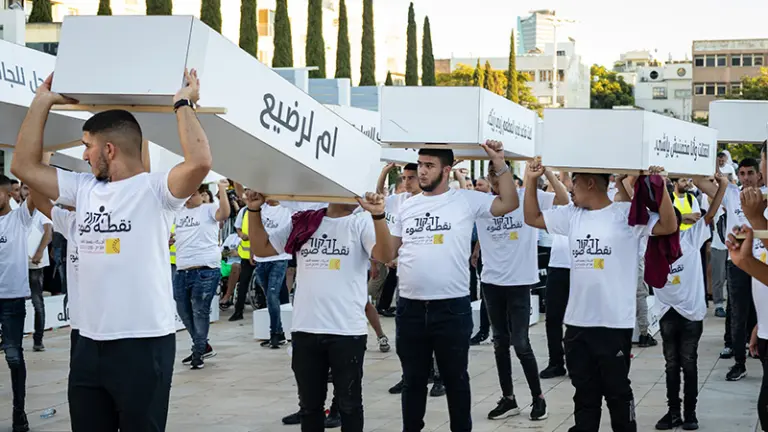
Recently, the phenomenon of violence and organized crime in Palestinian communities inside Israel has become a central issue in political, media, and research discourse in the country.1 Media coverage is not limited to reporting facts or documenting events, but also contributes to reframing the phenomenon by choosing the angle of the story, identifying the causes and perpetrators of crime, and proposing how to understand it. Even the vocabulary used to describe it, and the voices that legitimize the interpretation, contribute to redefining the phenomenon within the public sphere and drawing the boundaries of political and media debate.
This article proposes that the media is not just a medium that conveys events, but an active producer of political and social perceptions. Through mechanisms of selection, framing, and repetition, the media contributes to determining how certain acts are understood and, sometimes, to recategorizing them from crimes or the consequences of a certain social structure to security threats to public order or stability. Academics refer to this process as “securitization”:2 how issues or groups are presented as security threats that justify exceptional measures. Securitization occurs not only through political decision-making; the media plays a central role by establishing the discourse, the prevailing patterns of interpretation, and the actors who legitimize certain interpretations of the evidence. In the case of crime within Palestinian society inside Israel, the debate frequently shifts from the need for accountability for public policies or the performance of law enforcement institutions to interpreting criminality through the putative characteristics of society itself. This reframing redistributes the balance of responsibility from the state onto society, consequently affecting the kind of policies proposed to address crime in particular communities.3
Analysis of Concrete Evidence: Patterns of Israeli Discourse on Crime in Palestinian Society
Hebrew-language media reports, analysis from Israeli think tanks, and official government statements show how violence and organized crime in Palestinian society in Israel is repeatedly explained in a way that redefines the nature of the problem and those responsible for it. This pattern appears not only in the media, but also in security and research discourse and political statements, which reinforce an interpretive framework that goes beyond factual reporting to unduly influence public debate.
There is also, however, a critical discourse that points to the responsibility of the state and law enforcement agencies in exacerbating the phenomenon. This perspective identifies accumulated institutional failures in confronting organized crime in Palestinian towns. Representatives of the Palestinian community, as well as criminology researchers, have said that police behavior and priorities influence the patterns of crime and crime prevention. They also raise questions about the inadequate attention and resources devoted to dealing with crime in Palestinian communities.4
1. Linguistic Securitization of Crime: From Criminal Phenomenon to Security Threat
Analysis from Israeli think tanks, particularly the Institute for National Security Studies, shows a clear shift in how crime has been defined in Palestinian society in Israel. Crime and the proliferation of weapons in the hands of criminal organizations are increasingly presented as threats to Israel’s “national security.” These phenomena could spread to Israeli society in general, threatening “internal security.”5 Crime in Palestinian communities is also characterized as a phenomenon that threatens the “pillars of the state,” namely internal security and the rule of law. This reflects a growing tendency to include crime in national security debates, rather than considering its legal or social contexts.6 The Jerusalem Center for Strategy and Security has argued that the failure to deal with crime in Palestinian society represents “a profound systemic failure” threatening the rule of law, national security, and public trust. This characterization makes crime a structural threat to the state itself. The framing is even more evident when recommendations are made to declare a state of emergency or to deal with criminal organizations with legal tools originally intended to confront hostile organizations. Here, the transition to a security discourse that invokes the logic of exceptionalism and existential threat is complete.
This discourse is echoed in the Hebrew media, which uses similar phrases such as “loss of control” and the risk of “widespread violence.” Ynet described escalating waves of killings as reflecting the state’s “loss of control” on the Palestinian street within the context of political debate about expanding security instruments,7 while op-eds spoke of the state’s loss of control over personal security and the possibility that the repercussions of crime would spill over into Israeli society more broadly.8
2. Redefining Responsibility: From State Accountability to a ‘Community Crisis’
A further pattern in the Hebrew-language media is the redefinition of responsibility. A focus on the shortcomings of the state and law enforcement agencies has gradually been replaced by a portrayal of crime as the reflection of an internal crisis within Palestinian society. The increase in crime is commonly interpreted as the result of a “social collapse” or internal structural imbalance among Palestinians, thus shifting the angle of the debate from public policy to the characteristics of society itself.
Several op-eds and articles in the Hebrew media have diagnosed the high murder rate as the symptom of an “internal crisis” or “social disintegration,” and have even linked the spread of crime to the weakness of local leadership, described as “the failure of society to control itself.” Haaretz linked the rise in crime to what it described as the “collapse of Arab society,” highlighting internal social structure as the central factor and shifting responsibility from public policy to society.9
Israeli think tanks commonly present Palestinian society and its leaders as partly responsible for the continuation of crime, although they also acknowledge government inaction or weakness in law enforcement. The Israel Democracy Institute, for example, noted that weak cooperation between state institutions and local leaders, as well as a decline in mutual trust, are central factors. It emphasized that Palestinian society and its leaders should play a more active role in confronting violence.10 This type of argument leads to assigning responsibility in a way that appears balanced, but in practice shifts the focus of the debate from the failure of government policies to problems within society itself.
Alternative voices are emerging in the Hebrew-language media that reject framing crime as merely transient “waves of violence” or an internal societal crisis, and instead try to bring the debate back to public policy. One article criticized media headlines that reduced the phenomenon to a “bloody weekend,” stressing that crime is not a temporary explosion but the result of accumulated government policies and protracted institutional failures, including the suspension of anti-crime programs.11
This critical approach reveals that the redefinition of responsibility in the Hebrew media is not yet final, although the discourse about the internal societal dimension is dominant, especially in official discourse. Israeli National Security Minister Itamar Ben-Gvir has said that Palestinian society in Israel should assume responsibility for combating increased crime and violence. He directly criticized local Palestinian leaders for not playing their role in confronting criminal organizations.12 This formulation again presents crime as the product of internal societal and leadership failure. In the Israeli Knesset, MK Tali Gottlieb held the Palestinian community almost entirely responsible for the phenomenon, linking the spread of crime to what she described as the absence of “core values” within that society — in essence making crime an internal cultural problem rather than a matter of policy or law enforcement.13
3. Generalization and the Production of a Collective Image of Crime
The media and political discourse on crime in Palestinian society in Israel often presents a general framework that defines society itself through crime, rather than through the activity of specific criminal networks. Media and political expressions that speak of “violence in Arab society” or “loss of control” do not merely describe facts but also produce a perception that identifies crime with the collective Palestinian social space. This conflation blurs the distinctions between criminal actors and the wider society.14
Discussions on reallocating funding from the Palestinian Five-Year Plan toward police and security services show how crime is being redefined within a security framework, rather than being understood as the result of long-term socioeconomic gaps, government policies toward the Palestinian community, and police collusion with criminal organizations. Rather than treating investment in education, employment, and community structures as part of the solution, the center of gravity is shifted to security and enforcement — a shift that clearly reflects the dynamic of security framing.15 This transformation reframes crime from a complex social issue into a security issue with a policing solution.16
4. Official Political Discourse: Crime as a Gateway to Restoring “Order”
In official political discourse, crime — especially in Palestinian towns and in the Negev — is often coupled with the concepts of “restoring order” and “restoring governance and sovereignty.” The fight against crime thus becomes a vehicle for justifying expanded police intervention and projecting force into Palestinian spaces. Extensive field operations take on a political meaning that goes beyond combating crime in its direct sense.
In coverage of large-scale police operations in the Negev, the language of “restoring sovereignty and governance” explicitly appears as the stated goal, in a context where talk of organized crime overlaps with protests linked to demolitions in Palestinian villages. In Ynet’s coverage of the “New Order” operation in the Negev, an official account stated that the goal was to “restore governance to the Negev.” This characterization linked the operation to events described as violent while highlighting the size of the forces involved and the number of security units — placing it within the logic of “imposing order” rather than as a limited criminal response.17
In media reports close to official discourse, confrontation is sometimes presented as a process of “showing who is the owner of the house” or “imposing state sovereignty” through an extraordinary show of force. This perspective is evident in formulations such as “restoring governance” or “show of force,” and in phrases such as “who owns the house” — language that moves the event from the context of combating crime to demonstrating political control over space.18 This discourse is particularly significant in the context of the Negev, where talk of crime intersects with Palestinian protests against house demolitions, afforestation projects, and land confiscation. In the 2022 Negev protests, official statements emphasized the need to “restore governance in the Negev,” linking widespread police deployment to the need to impose order in the face of what was described as a challenge to state authority.19
The irony of this coverage is that the discourse of “imposing sovereignty” is less pronounced than the characterization of organized crime as an ongoing criminal phenomenon within Palestinian society. This discourse escalates especially when it is related to a protest movement or a political challenge to the state in the public sphere. In this sense, the operations are presented not only as a response to crime, but also as a mechanism to redraw the relationship between the state and Palestinian communities in the language of deterrence and control.
This framework is also enshrined in an institutional discourse within the Knesset that directly links crime to the concept of “restoring order and governance,” presenting it as an “internal security” issue that calls for a sovereign approach. An official Knesset press release on discussions of the internal security committees used formulations such as “order and governance must be restored” in the context of crime in Palestinian society, consolidating the phenomenon’s transition from a criminal framework to a “sovereignty” framework.20
Statements made by establishment figures also reveal an interpretive dimension of a cultural-collective nature, linking the phenomenon of crime to characteristics attributed to Palestinian society itself. Omer Bar-Lev referred to what he called a “culture of arms” within Palestinian society,21 and Kobi Shabtai linked the spread of crime to internal social patterns.22 This discourse reflects a shift from accountability for policies and the performance of law enforcement institutions to a general cultural framing that associates crime with social identity.
It is important to highlight that this framework does not go unchallenged within civilian research circles. The Israel Democracy Institute has provided a critical reading of the Negev/Tarabin police operation, arguing that an operational or demonstration-focused approach may reflect a lack of professionalism, produce collective harm, and deviate from the logic of tackling organized crime with focused investigative and enforcement tools. This critique makes clear that “restoring order” is not a neutral characterization but an inherently political framework with implications for human rights and for how the problem is defined and resolved.23 Official political discourse not only supports but also gives a symbolic function to large-scale policing, redefining crime as a challenge to state sovereignty in the Palestinian space. This framing contributes to establishing security-focused approaches as the “natural” solution, and crowds out or postpones more substantive debates about structural policies, patterns of discrimination in law enforcement, and state responsibility for the conditions that allow organized crime to take root.
Conclusion
Media, think tank, and political discourse on crime in Palestinian society in Israel is not limited to reporting on a security or criminal phenomenon, but contributes to redefining it within a broader framework that redistributes responsibility and reshapes the relationship between the state and Palestinian society. When crime is presented as a threat that calls for restoring order and governance, responsibility gradually shifts from public policy to society itself, cementing a security-centered approach as the most applicable solution in public debate. Discourse analysis highlights how this idea is circulated through media coverage, analytical research, and political statements.
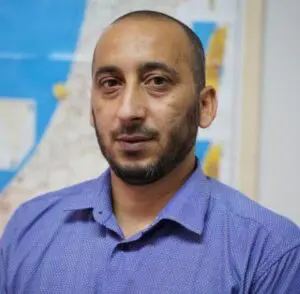
Saher Ghazawi is a Palestinian writer, researcher, and human rights activist with the Meezan Organization for Human Rights in Nazareth, Israel. This Situation Assessment was first published in Arabic earlier in March 2026 by Mada al-Carmel, Arab Center for Applied Social Research in Haifa, Israel. It is one in a series of position papers jointly published by Mada al-Carmel and Arab Center Washington DC.
The views expressed in this publication are the author’s own and do not necessarily reflect the position of Arab Center Washington DC, its staff, or its Board of Directors.
1 See “Violence and crime in Arab society: Reality and policy challenges,” Israel Democracy Institute, 2023, (Hebrew); “Statements and Protocols of the National Security Committee about Increased Crime in Arab Society,” Israeli Knesset, 2023-2024 (Hebrew).
2 Barry Buzan, Ole Wæver, and Jaap Wilde, Security: A New Framework for Analysis (Boulder: Lynne Rienner Publishers, 1998).
3 Atwa Abu Farih, “Violence is crushing Arab society,” Haaretz, May 8, 2025 (Hebrew).
4 Keren Berl Katznelson, “This is not a terrorist organization-Discussion with Dr. Eilat Maoz,” YouTube, February 3, 2026 (Hebrew).
5 Ephraim Lavie, Meir Elran, and Mohammed Watad, “Neglecting fighting crime in Arab society is a threat to national security,” Institute for National Security Studies, June 24, 2024 (Hebrew).
6 Gabi Siboni, “Fighting dangerous Arab crime in Israel,” Jerusalem Institute for Strategy and Security, November 25, 2025 (Hebrew).
7 Ran Rimon, “Loss of Control,” Ynet, August 23, 2023 (Hebrew).
8 Ravia Khandaklo, “A wave of killing in Arab society,” Ynet, February 4, 2025 (Hebrew).
9 Jack Khoury, “Explaining government failure, Arab society is collapsing,” Haaretz, December 21, 2025 (Hebrew).
10 Tomer Lotan, “Crime in Arab society does not explode; it gets deeper,” Israel Democracy Institute, June 4, 2025 (Hebrew).
11 Itay Rom, “Crime in Arab society is literally the responsibility of Itamar Ben-Gvir,” Haaretz, February 5, 2026 (Hebrew).
12 “Ben-Gvir: Leaders of local authorities stand with crime organizations,” Ynet, January 22, 2026 (Hebrew).
13 “If you don’t like someone, do you shoot him? This is how you were raised. Tali Gotliv in plenary session,” Knesset, 2026 (Hebrew).
14 Ran Rimon, op. cit.
15 Thierry Balzacq, Securitization Theory: How Security Problems Emerge and Dissolve (London: Routledge, 2011).
16 Khader Sawaed, “Shrinking the five-year budget will hurt fighting crime in Arab society,” Israel Democracy Institute, December 17, 2025 (Hebrew).
17 Liran Tamari, “General Inspector of police initiated an unprecedented operation,” Ynet, November 26, 2025 (Hebrew).
18 “They will understand who is the owner of the house,” Yisrael Hayom, November 19, 2025 (Hebrew).
19 Nati Yefet, “30 arrested for participating in protests against afforestation,” Haaretz, January 18, 2022 (Hebrew).
20 “Chairman of the Committee for Foreign Affairs and Security Ben Barak: Time for a state of emergency,” Knesset, April 4, 2022 (Hebrew).
21 Josh Breiner, “Barlev: Inequality against Arabs helped crime,” Haaretz, October 19, 2021 (Hebrew).
22 Moshe Nussbaum, “General Inspector of Police in closed discussion,” Channel 12, April 4, 2023 (Hebrew).
23 Yael Litmanovitz and Mirit Lavi, “Police action in Tarabin is part of the problem,” Israel Democracy Institute, January 5, 2026 (Hebrew).